Miami branded residences have become one of the most visible parts of South Florida’s luxury property market. Hotel names, restaurant groups, fashion houses, automotive companies, and lifestyle brands are now attached to towers across Brickell, Downtown Miami, Miami Beach, Sunny Isles, Coconut Grove, and nearby markets.
The appeal is easy to understand. Miami branded residences may offer hotel-style service, recognizable design, highly finished amenities, security, concierge support, and a property that feels easier to use from a distance. For Canadian buyers, international investors, and seasonal owners, that lock-and-leave experience can be especially attractive.
However, a famous name does not automatically make a property a strong investment. Miami branded residences often carry higher purchase prices, substantial monthly fees, detailed operating rules, and resale competition from a growing development pipeline. The brand may add value, but buyers still need to verify what they are receiving and what the property will cost to own.
This guide explains how to evaluate the opportunity before you reserve a unit, sign a contract, or make an offer.
What are Miami branded residences?
Miami branded residences are privately owned homes developed under a formal partnership with a recognized hospitality, fashion, automotive, restaurant, wellness, or lifestyle brand.
The brand may influence the architecture, interior design, amenity package, service standards, staffing, marketing, and ongoing resident experience. Some projects are connected to a hotel. Others are standalone residential towers that use a brand identity and service platform without operating as a traditional hotel.
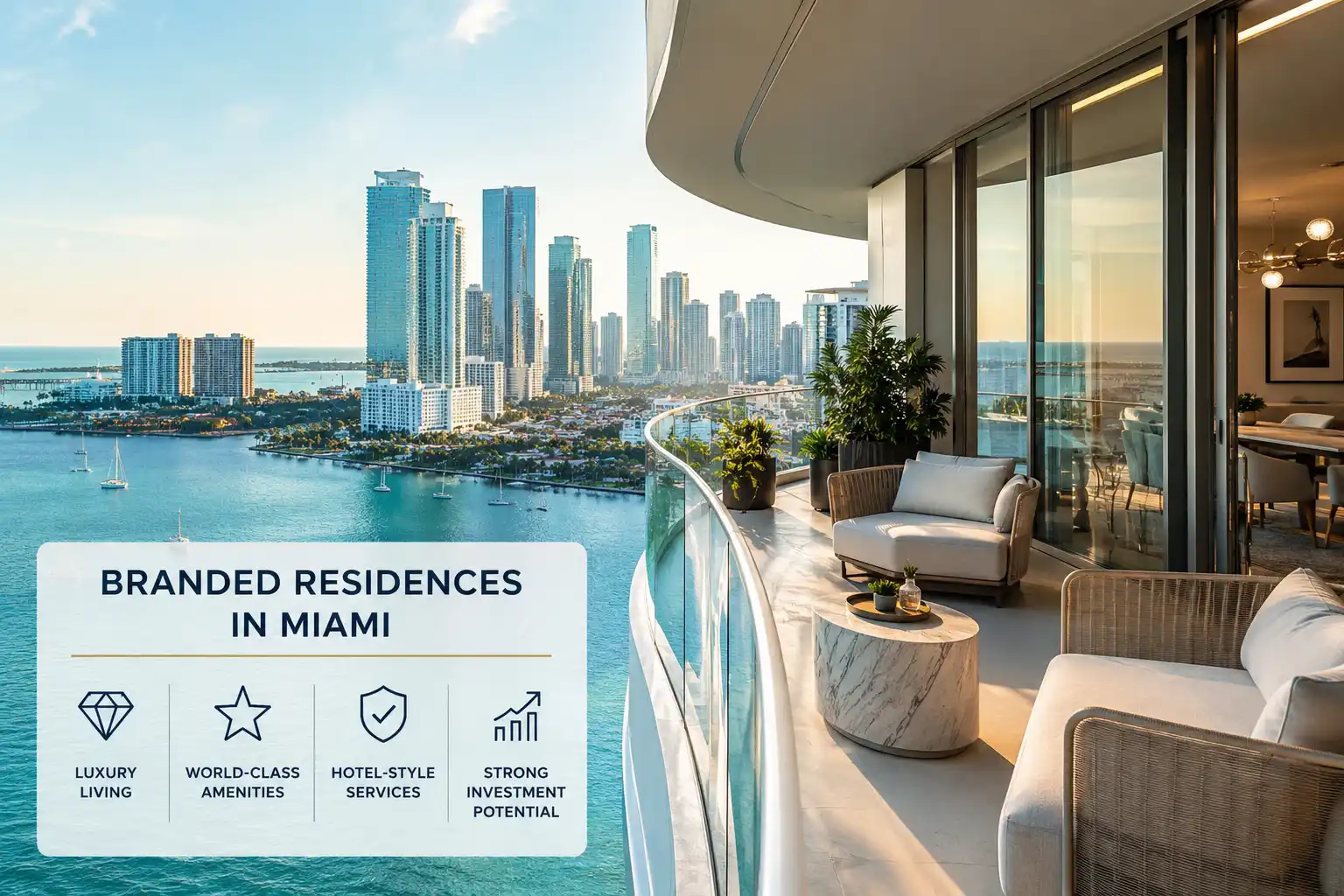
That distinction matters.
Among Miami branded residences, a hotel-connected residence may offer room service, housekeeping, spa access, guest services, or participation in a rental program. A standalone branded tower may focus more heavily on private residential service, design, security, wellness, dining, or exclusive owner experiences.
The ownership structure of Miami branded residences can also differ from a condo-hotel. In a traditional private residence, the owner usually controls the unit subject to the condominium documents and rental restrictions. In a condo-hotel model, the property may have additional hotel operations, occupancy rules, rental-program terms, and financing considerations.
Before comparing prices, confirm exactly which model you are buying.
Why Miami branded residences are expanding so quickly
The growth of Miami branded residences is not happening in isolation. It reflects a global shift in luxury real estate toward managed, service-rich, recognizable residential products.
The Savills Branded Residences 2025/26 report describes a rapidly expanding global sector. Savills reported that branded schemes were expected to grow from 764 at the end of 2024 to 910 by the end of 2025. Its research also found an average global brand premium of roughly 33%, with an average around 36% across the Americas.
Those figures do not mean every branded property deserves a 33% or 36% premium. They show that buyers are often willing to pay more for brand trust, design consistency, service, management, and perceived scarcity.
Miami is a natural market for this model because it combines:
- international wealth and second-home demand
- a large luxury-condo pipeline
- strong interest in turnkey ownership
- buyers who may spend only part of the year in Florida
- a lifestyle market built around hospitality, dining, design, wellness, and waterfront living
- a substantial share of cash and international transactions
The broader Miami real estate market in 2026 is also more selective than the market of several years ago. Buyers generally have more time to compare buildings and negotiate in parts of the resale market. At the same time, highly differentiated new luxury projects can attract a separate buyer pool.
That two-speed environment makes careful comparison essential.
Are Miami branded residences a good investment?
The answer depends on what you mean by “good investment.”
A buyer seeking the lowest price per square foot or the highest immediate rental yield may find that Miami branded residences are not the obvious first choice. Their purchase premiums and service fees can reduce short-term returns.
A buyer seeking prestige, ease of ownership, high-quality amenities, international resale appeal, and a property that is simple to use from abroad may see the value differently.
The investment case for Miami branded residences is usually strongest when the brand is supported by four things:
- a genuinely strong location
- a reputable developer and construction team
- a service platform buyers will continue to value after the building opens
- a price premium that is reasonable when compared with similar non-branded properties
The weakest projects rely too heavily on the name itself. A logo cannot correct a compromised location, an unrealistic fee structure, poor layouts, construction delays, weak property management, or an overcrowded resale market.
Does the brand premium make financial sense?
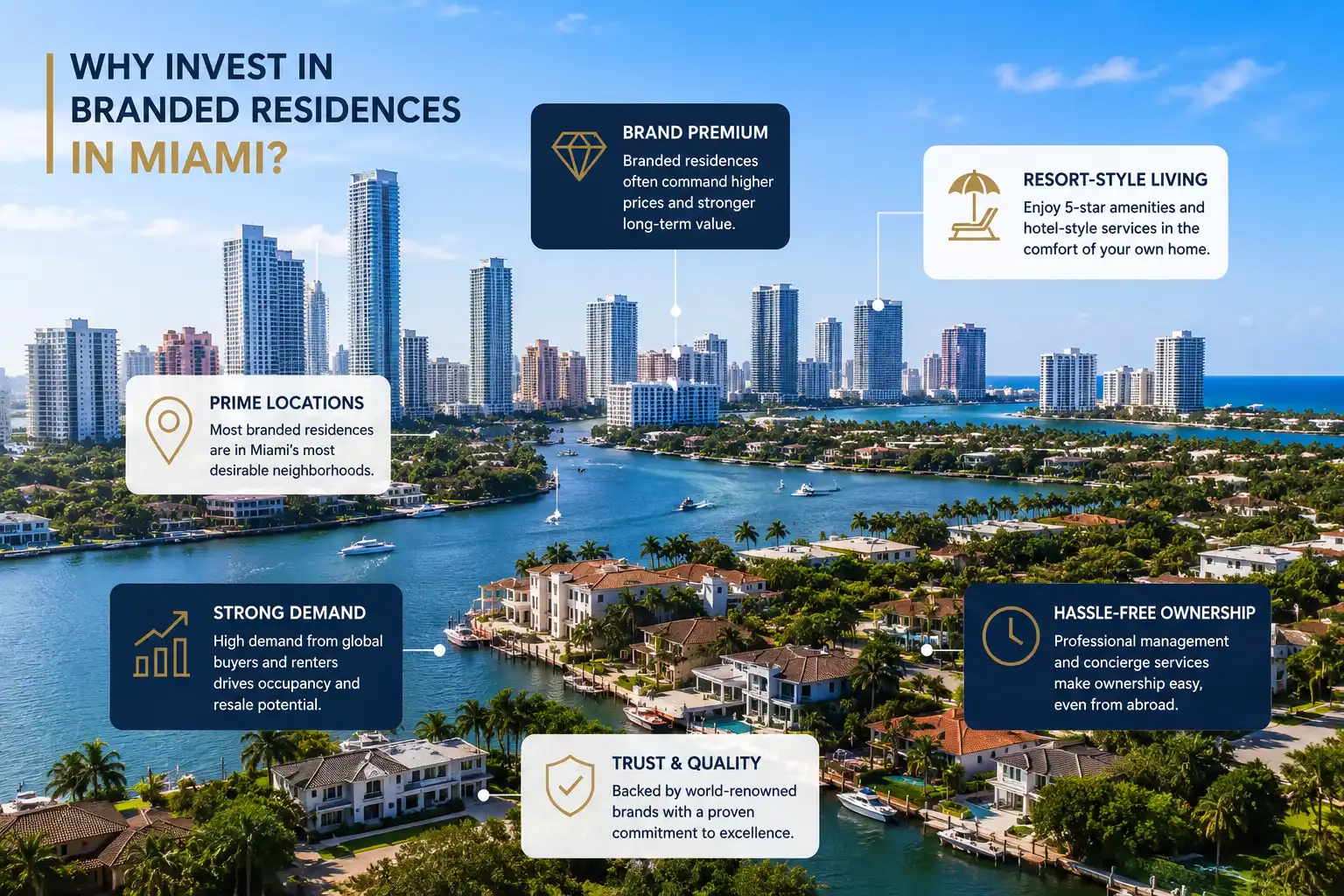
With Miami branded residences, treat the premium as something that must be proven.
Start by comparing the branded unit with at least three alternatives:
- a newer non-branded luxury building in the same neighborhood
- a completed branded residence with an established resale history
- a high-quality resale building with similar views, size, services, and amenities
Do not compare only the headline purchase price. Compare price per square foot, terrace space, parking, storage, monthly fees, reserve funding, insurance exposure, financing, rental flexibility, and expected closing costs.
For current context, the MIAMI Association of REALTORS May 2026 condo report recorded 1,022 Miami-Dade townhouse and condo sales, a median sale price of $415,000, and 12.9 months of supply. That broad dataset includes many property types and price levels, so it should not be used as a direct branded-residence valuation. It does show why buyers should separate the general condo market from the specific building and luxury segment they are considering.
Nine smart checks before buying Miami branded residences
The following checks help buyers move beyond presentation materials and evaluate the actual property.
1. Understand the brand agreement, not just the brand name
The first question is simple: what has the brand actually agreed to provide?
In Miami branded residences, a brand may license its name, establish design standards, manage the building, provide hospitality services, or participate in several of those roles. The relationship may last for a fixed term and may include renewal, termination, performance, and replacement provisions.
Ask for clarity on:
- the length of the branding or management agreement
- which entity controls the resident services
- what happens if the brand leaves
- whether service standards are contractually defined
- whether the condominium can replace the operator
- how brand and management fees are funded
- whether owners have remedies if services fall below expectations
A recognizable brand at launch does not guarantee that the same name will remain attached forever. Buyers should understand the legal structure behind the marketing.
2. Review the developer’s delivery record
A global brand and a local developer are not the same thing.
The developer remains responsible for turning design concepts into a completed building. Review prior projects, delivery timelines, litigation history, construction quality, financing, warranty issues, and how the developer handled owner communication after closing.
This is especially important for pre-construction Miami branded residences. Buyers may commit years before completion and make deposits according to a construction schedule. During that time, costs, interest rates, currency values, personal plans, and market conditions can change.
A strong review should include the developer, general contractor, architect, interior designer, sales disclosures, escrow structure, and any rights to modify finishes, amenities, unit dimensions, or completion dates.
If the unit may need upgrades after delivery, Miami P&B Investments’ construction services can help buyers think beyond the model unit and plan for real-world customization.
3. Compare the premium with real alternatives
The premium on Miami branded residences should not be accepted simply because a brochure says the property is exclusive.
Create a side-by-side comparison with non-branded and completed branded buildings. Include:
| Cost or value factor | Branded residence | Comparable luxury condo |
|---|---|---|
| Purchase price per square foot | Often higher | May offer a lower entry price |
| Monthly association and service fees | May include extensive staffing and amenities | Can be lower or more limited |
| Rental flexibility | Varies by project and operator | Varies by association |
| Brand recognition | Potential international marketing advantage | Depends on building reputation |
| Resale competition | Competes with future branded launches | Competes with local resale inventory |
| Ease of remote ownership | Often a major selling point | Depends on management quality |
Then ask whether the premium is purchasing features you will actually use.
A full-time resident may value privacy, security, wellness, dining, and resident programming. A seasonal owner may value housekeeping, maintenance, arrival preparation, and a reliable concierge. An investor may care more about rental rules, operating costs, tenant demand, and exit liquidity.
The best Miami branded residences are not necessarily the ones with the most recognizable logo. They are the ones where the location, service, ownership model, and price align with the buyer’s real plan.
4. Calculate every recurring fee
For Miami branded residences, monthly ownership cost is one of the most important parts of the decision.
Branded towers may have association dues, service charges, shared hotel expenses, reserve contributions, club fees, parking charges, storage fees, housekeeping costs, food-and-beverage minimums, rental-program fees, and other optional or mandatory expenses.
Request a detailed schedule that separates:
- condominium association assessments
- brand or management charges
- hotel-shared expenses
- reserves
- insurance-related costs
- utilities included in the dues
- valet and parking expenses
- optional housekeeping or residence-care plans
- transfer, application, and resale fees
Do not rely only on the first-year estimate. New buildings can operate on developer-prepared budgets that change after residents take control or actual staffing and insurance expenses become clear.
Buyers should also study Miami property insurance costs because master-policy expenses can affect condominium dues even when the individual unit policy appears manageable.
5. Confirm rental and personal-use rules
Some Miami branded residences are designed mainly for private ownership. Others include structured hotel or rental programs. Some allow flexible leasing, while others impose minimum lease terms, rental caps, owner-use limits, management requirements, or brand-controlled rental standards.
Ask:
- Can owners rent independently?
- Is participation in the building’s rental program optional or mandatory?
- What percentage does the operator retain?
- Are there furnishing standards?
- How often can the unit be rented?
- Is there a minimum lease term?
- Are short stays legally allowed by the city and building?
- Can the owner block personal-use dates?
- Who pays cleaning, repairs, booking fees, and replacement reserves?
A branded property that performs well as a private second home may not work as a short-term-rental investment.
Before depending on rental income, review Miami P&B Investments’ guides to Miami condo rental restrictions and Florida short-term rental laws.
6. Plan for the pre-construction deposit and closing timeline
Many Miami branded residences are sold before completion. Pre-construction can give buyers access to new inventory, staged deposits, and the possibility of value growth before delivery. It also creates timing and financing risk.
Review the deposit schedule carefully. A buyer may need to provide multiple large payments over several years, followed by the closing balance when the building receives the required approvals.
For Canadian buyers, the CAD-to-USD exchange rate can materially change the real cost of each deposit. A project that fits the budget when the reservation is signed may become more expensive in Canadian dollars before closing.
Build a timeline showing:
- reservation deposit
- contract deposit
- construction milestone deposits
- estimated closing date
- financing application window
- final cash requirement
- furnishing and move-in budget
- reserves for the first year of ownership
Miami P&B Investments’ guide to currency exchange risk can help Canadian buyers plan conversions rather than making every transfer at the last minute. Buyers using financing should also review the U.S. mortgage guide for Canadians.
7. Perform normal condominium due diligence
Miami branded residences still require standard condominium review; new design and hospitality branding do not replace it.
Before buying Miami branded residences, examine the declaration, bylaws, rules, budget, insurance, reserve plan, management agreements, rental restrictions, developer rights, construction disclosures, parking rights, storage rights, and pending litigation.
For completed or resale buildings, review meeting minutes, financial statements, engineering reports, special assessments, reserve studies, and building recertification records.
Florida’s DBPR condominium information portal provides information about the state’s condominium laws, milestone inspections, Structural Integrity Reserve Studies, and reporting resources. Miami-Dade also provides a building recertification portal for properties within its jurisdiction.
Miami P&B Investments has separate guides covering Florida condo documents, Florida condo reserve requirements, and title insurance in Florida. Those checks remain relevant even when the building is new, expensive, or internationally recognized.
8. Study the future resale competition
Miami branded residences may feel rare when a buyer signs the contract but face more competition by the time the unit is resold.
The pipeline of Miami branded residences includes different hotel, restaurant, design, fashion, automotive, and lifestyle concepts. That creates buyer choice, but it also means a future seller may compete with newer projects offering fresh amenities, deposit structures, and aggressive marketing.
Review the likely future supply in the same neighborhood and price range. Ask:
- How many similar units will be delivered before your planned sale?
- Does the project have a distinctive waterfront, location, view, or service advantage?
- Are the floor plan and unit size practical for resale?
- Will the brand still feel relevant in five or ten years?
- Does the building appeal to local residents as well as international buyers?
- Are resale restrictions or developer sales rights likely to affect your exit?
A durable property should make sense without relying entirely on launch excitement.
9. Decide who will manage the property after closing
Remote ownership is one of the strongest reasons buyers consider Miami branded residences, but Miami branded residences do not always include every service an owner needs.
The concierge may receive packages and make reservations. The building engineer may maintain common systems. Hotel staff may offer housekeeping. Yet owners can still need help with unit inspections, repairs, furnishing, contractor access, storm preparation, insurance claims, leasing, tenant communication, accounting records, and arrival preparation.
Confirm what is included and what remains the owner’s responsibility.
A realistic operating plan should identify:
- who checks the unit while it is vacant
- who responds to leaks or air-conditioning issues
- who coordinates vendors
- who prepares the residence before the owner arrives
- who manages tenants or guests
- who tracks income and expenses
- who handles storm preparation and post-storm inspections
Miami P&B Investments’ property management and property maintenance services are designed for owners who need reliable local support after the purchase.
Which Miami neighborhood fits a branded-residence buyer?
The best location depends on the lifestyle and investment objective. The right Miami branded residences shortlist should reflect how the buyer plans to use, finance, and manage the home.
Brickell
Brickell offers the strongest concentration of high-rise luxury, finance, dining, and branded development. It may suit buyers who want a recognizable urban address, a newer tower, and direct access to Miami’s business core.
The trade-off is competition. Buyers should compare many new and future projects, study traffic and construction activity, and verify whether the unit offers a view or floor plan that will remain distinctive.
Coconut Grove
Coconut Grove real estate appeals to buyers who prefer a lower-key waterfront environment, established wealth, greenery, marinas, and a more residential pace.
New luxury and branded development is increasing, but the buyer profile can differ from Brickell. Families, long-term residents, and second-home buyers may place more value on privacy, neighborhood character, and usable layouts.
Edgewater and Downtown Miami
Edgewater Miami combines bayfront views with access to Downtown, the Design District, Wynwood, and Miami Beach. It can offer a quieter residential feel than Brickell while remaining close to the city’s cultural and business areas.
Downtown Miami may appeal to buyers focused on new development, entertainment, transit, and access to the waterfront. In both areas, evaluate the future construction pipeline and the permanence of the view.
Aventura, Sunny Isles, and northern Miami-Dade
Aventura and nearby oceanfront markets often attract Canadian snowbirds, seasonal residents, international families, and buyers seeking shopping, beaches, marinas, and established condominium living.
These markets can provide a different version of branded ownership: less focused on the financial-district lifestyle and more focused on resort access, security, oceanfront living, and long-term seasonal use.
What Canadian buyers should check before purchasing
Canadian buyers considering Miami branded residences should review the property in both U.S. and Canadian-dollar terms.
The purchase price is only the beginning. Deposits, closing costs, association dues, insurance, furnishings, property taxes, management, repairs, and future assessments are generally paid in U.S. dollars. Currency movement can change the effective cost even when the developer’s price stays the same.
Canadian buyers should also coordinate:
- U.S. financing or cash-transfer timing
- ownership structure
- cross-border tax reporting
- rental-income reporting
- FIRPTA planning for a later sale
- estate and succession considerations
- U.S. banking and recurring payments
- property management while in Canada
Some buyers consider an LLC for investment or operational reasons. That structure is not automatically right for every Canadian, especially when the unit will be used mainly as a personal vacation home. Review the educational guide to buying Florida property through an LLC and obtain individualized legal and tax advice before deciding how to take title.
Miami P&B Investments’ dedicated Canadian investor resources provide a useful starting point for the broader cross-border process.
A simple decision framework
Before choosing among Miami branded residences, score each property from one to five on the factors below.
| Factor | Question to ask |
| Location | Would I still want this address without the brand? |
| Developer | Has the team delivered comparable quality before? |
| Brand role | Is the brand operating, managing, designing, or mainly licensing its name? |
| Total cost | Can I comfortably carry all fees in a conservative scenario? |
| Rental fit | Do the legal and building rules match my income plan? |
| Unit quality | Is the floor plan, exposure, size, and view competitive? |
| Building documents | Are the budget, insurance, reserves, and contracts understandable? |
| Resale durability | Will this property stand out after more projects are delivered? |
| Ownership support | Who will manage the residence when I am away? |
A property with a famous name but weak scores in location, cost, or resale durability may not be the right choice. A project with a less dramatic brand but a better site, stronger developer, practical fees, and excellent management may provide more lasting value.
Work with a team that evaluates the property behind the brand
Miami branded residences can offer an exceptional ownership experience. They can also create expensive surprises when buyers focus on design and prestige without reviewing the contracts, fees, rental rules, construction details, and long-term operating plan.
Miami P&B Investments helps buyers compare the full picture. The team can support the property search through its real estate services, coordinate legal and ownership questions through legal support, connect the numbers to accounting services, and remain involved after closing through management, maintenance, and construction support.
The goal is not to choose a building because the name is impressive. It is to choose a property that fits your lifestyle, budget, investment strategy, and long-term ownership plan.
To compare Miami branded residences or review a specific project, start with a conversation through the Miami P&B Investments contact page.