
Florida rental income tax can affect the return on a Miami or South Florida property as much as rent, financing, or HOA fees. Canadian owners must understand how the income is reported in the United States, converted into Canadian dollars, and included on a Canadian return.
Before buying, connect the tax plan to the property plan. Miami P&B Investments’ guidance for Canadian investors can help you evaluate expected rent, ownership costs, and the cross-border support needed to operate from Canada.
This guide explains Florida rental income tax in plain language. It is general information, not personal tax advice. Your filing position depends on residency, ownership structure, personal use, rental activity, and the property’s financial results.
How Florida Rental Income Tax Works for Canadians
A Canadian resident who owns a Florida rental usually has responsibilities in both countries. The United States can tax income from U.S. real property because the property is located there. Canada generally taxes residents on worldwide income, so the same rental activity is also reported in Canada.
That does not automatically mean paying the full tax twice. Proper returns and foreign tax credits are designed to reduce double taxation, although currency conversion, depreciation, and different deduction rules can still create surprises.
A clean Florida rental income tax process normally has four parts:
- Report the rental activity in the United States.
- Report income and expenses in Canada in Canadian dollars.
- Claim eligible foreign tax credits for qualifying U.S. taxes paid.
- Keep records that support and reconcile both returns.
The best time to organize Florida rental income tax is before the first tenant arrives. Waiting until tax season can leave you without the forms, exchange-rate records, or expense details needed to file efficiently.
Do Canadians pay tax twice on Florida rental income?
Usually, the goal is no. A Canadian resident may be able to claim a federal foreign tax credit for eligible U.S. income or profit taxes paid on income also reported in Canada.
The credit is not always a dollar-for-dollar refund of every U.S. payment. Limits depend on the income, Canadian tax otherwise payable, and whether the foreign amount qualifies. Sales taxes, lodging taxes, penalties, and some local charges are not the same as foreign income tax.
Two U.S. Treatments That Shape Florida Rental Income Tax
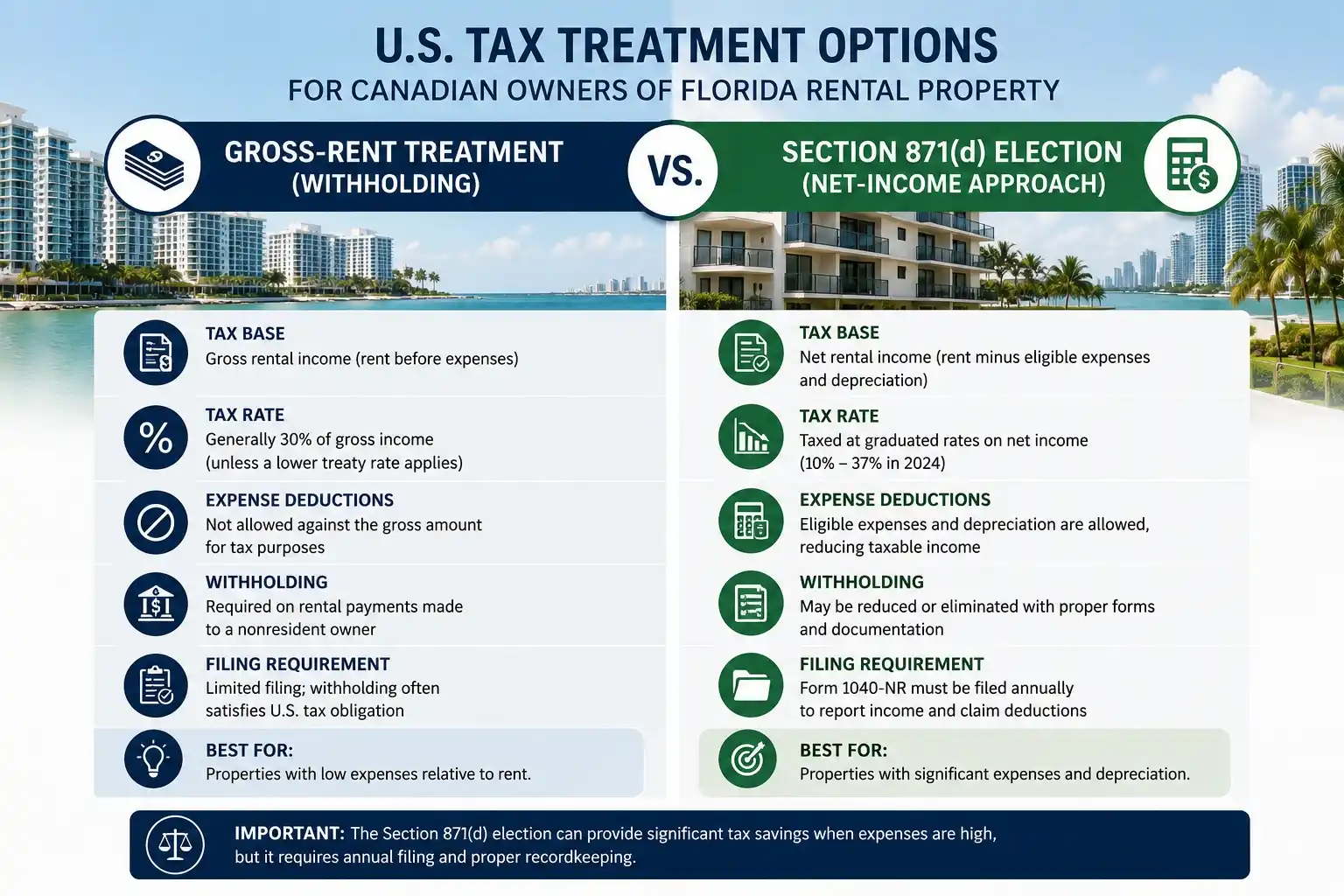
For a nonresident owner, U.S. real-property income can fall under a gross-income withholding framework. The IRS states that U.S. real-property income owned by a nonresident alien is generally taxed at 30% of gross income unless a lower rate applies.
Many Canadian owners instead consider an election under Internal Revenue Code section 871(d). It treats qualifying U.S. real-property income as effectively connected income, allowing eligible expenses to be deducted and net income to be taxed at graduated rates.
The IRS overview for nonresident owners explains the election and related filing requirements.
| U.S. treatment | Tax base | Expense deductions | Typical filing impact |
|---|---|---|---|
| Gross-rent treatment | Gross rental income | Generally unavailable against the gross amount | Withholding may apply to rent collected |
| Section 871(d) election | Net taxable rental income | Eligible expenses and depreciation may be claimed | Form 1040-NR is generally filed annually |
The net-income approach can improve Florida rental income tax results when the property has meaningful expenses, but it also creates annual filing and recordkeeping duties. A cross-border advisor should model both methods rather than assuming one is always best.
What is the Section 871(d) election?
It is an election available to certain nonresident owners of income-producing U.S. real estate. Once properly made, it generally applies to qualifying U.S. real-property income and continues until revoked with IRS consent.
The election is normally made by attaching a statement to Form 1040-NR. The owner may also need to provide appropriate withholding documentation to a property manager or other withholding agent. Late filing can restrict deductions, so the setup should be completed early.
For support with records and filings, review Miami P&B Investments’ accounting services for Canadian investors.
Florida Rental Income Tax Deductions and Expenses
Under a net-income approach, ordinary and necessary rental expenses may reduce taxable income. Treatment depends on whether an item is a current expense, capital improvement, or personal cost.
Common categories include:
- Property management and leasing fees
- Repairs and routine maintenance
- Insurance and property taxes
- Rental-related HOA or condominium fees
- Owner-paid utilities
- Advertising and tenant screening
- Accounting and legal fees
- Eligible mortgage interest
- Depreciation on the building and qualifying assets
Capital improvements are generally not deducted all at once. A new kitchen, major roof project, or substantial renovation may need to be added to the tax basis and depreciated.
Personal use matters too. If a Canadian owner stays in the property part of the year, expenses may need to be divided between rental and personal periods. This allocation can materially change Florida rental income tax.
Can Canadians deduct Florida condo fees and mortgage interest?
Often, the rental portion of eligible condo fees and mortgage interest can be considered in the U.S. net-income calculation, but documentation is essential. Special assessments tied to capital work may receive different treatment from ordinary monthly fees.
The Canadian return may not match the U.S. return line for line. Canada has its own rules for deductibility, capital cost allowance, personal-use allocation, and currency conversion. Use the same source documents, but prepare each return under that country’s rules.
Canadian Reporting, Currency, and Form T1135
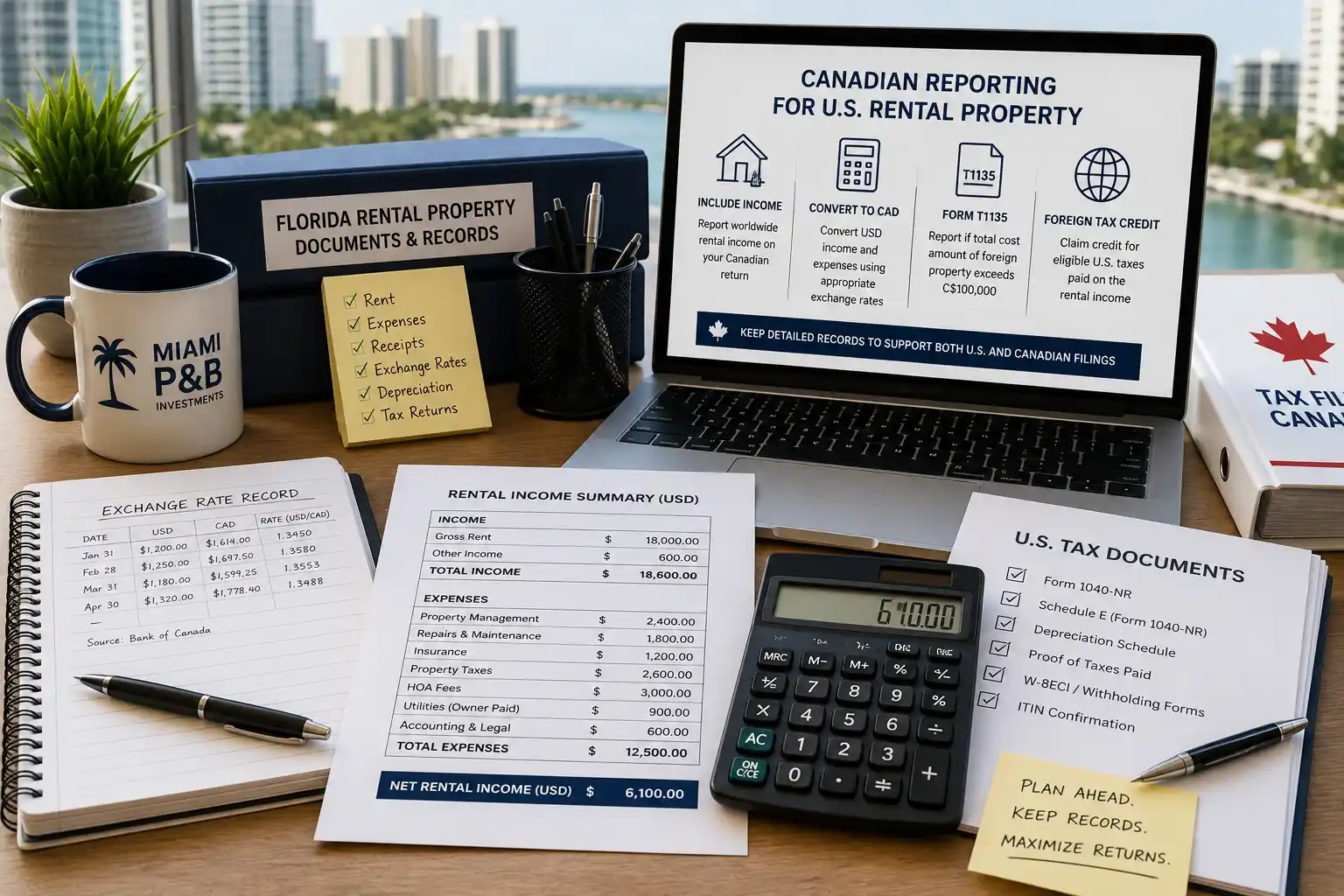
Canadian residents report foreign rental income in Canadian dollars. Rent received in USD and expenses paid in USD must therefore be converted using an acceptable exchange-rate method.
Keep the rate, date, source, and transaction amount for major payments. An accountant may use an accepted annual-average method for recurring items where appropriate, while purchases, capital improvements, and sale proceeds often require transaction-date calculations.
A practical Florida rental income tax record set should include:
- Monthly rent and property-manager statements
- Bank and wire confirmations
- Invoices and receipts
- Mortgage interest, tax, and insurance records
- Closing documents
- Personal-use dates
- Exchange-rate records
- U.S. returns and proof of tax paid
These records support tax filings and reveal the property’s real return in CAD rather than only its headline rent in USD.
Does a Florida rental need to be reported on Form T1135?
It may. The CRA generally requires Form T1135 when the total cost amount of a Canadian resident’s specified foreign property exceeds C$100,000 at any time during the year.
Personal-use property is generally excluded. However, the CRA’s Form T1135 questions and answers explains that a Florida condominium rented for most of the year with a reasonable expectation of profit may be specified foreign property.
The threshold is based on cost amount, not equity or down payment. Form T1135 is an information return rather than a separate tax bill, but missing it can still produce significant penalties.
Short-Term Rentals Add More Florida Rental Income Tax Layers
Short stays can create more than income tax. Depending on the location and activity, the owner may need to address Florida sales tax, county tourist-development tax, local registration, platform collection, and licensing.
Do not assume Airbnb, Vrbo, or another platform handles every obligation. Florida rental income tax planning for short stays must include these indirect taxes and filing duties. Platforms may collect certain taxes in some jurisdictions, but owners can remain responsible for registration, returns, local taxes, or amounts not covered.
Before estimating returns, read the guide to Florida short-term rental laws in Miami and South Florida and confirm the building’s rental restrictions. A condo can be legal to own but unsuitable for the rental frequency your model requires.
Does personal use change Florida rental income tax?
Yes. Personal use can change expense allocation, loss limitations, T1135 analysis, and how the property is characterized in both countries.
Track each day the property is rented at fair market value, used personally, provided to family, or vacant for repairs and marketing. Do not reconstruct the calendar from memory at year-end.
Seven Smart Florida Rental Income Tax Planning Moves
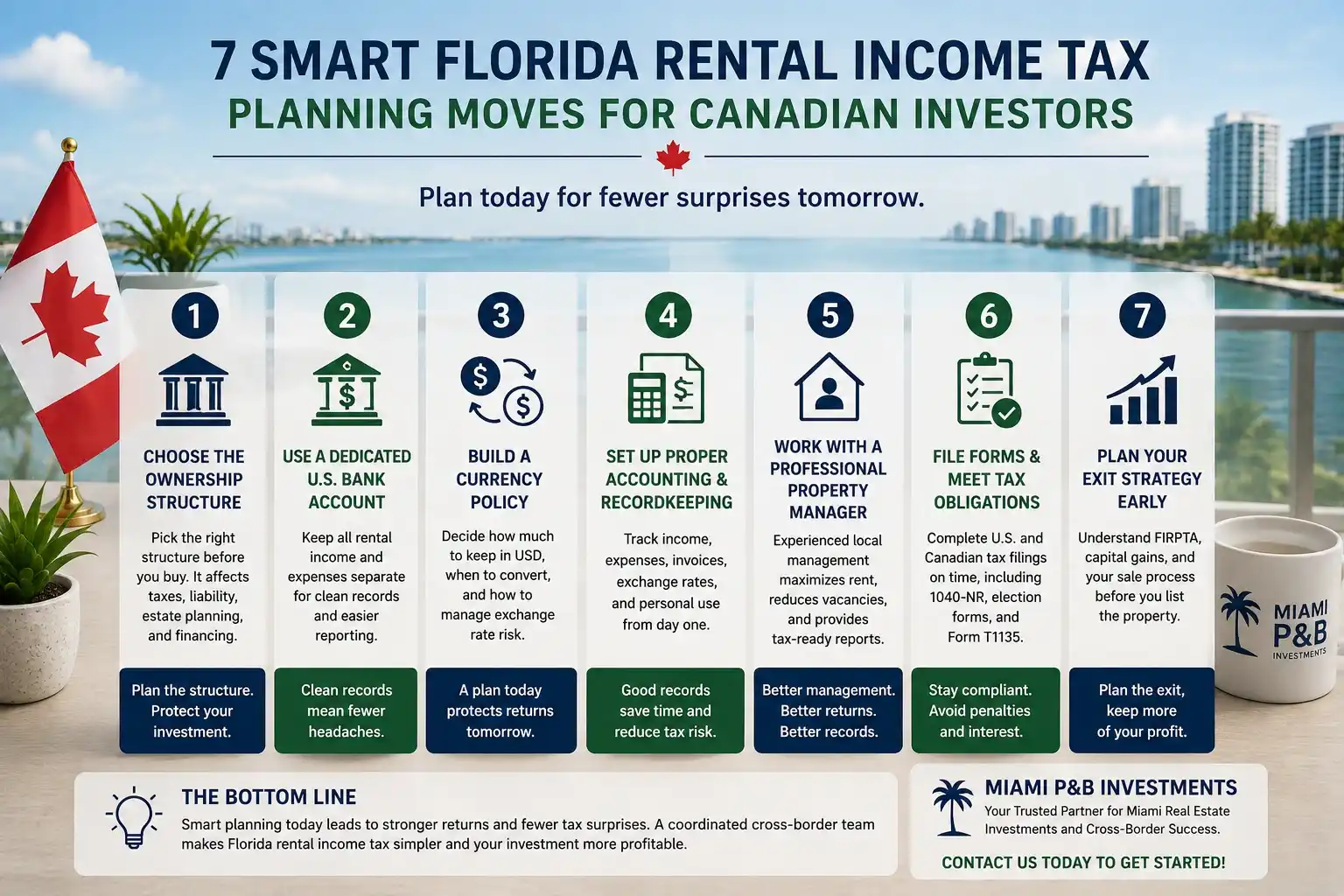
1. Choose the ownership structure before making an offer
Personal ownership, joint ownership, a U.S. entity, a Canadian corporation, or a trust can create different tax, legal, estate, financing, and compliance outcomes. An LLC is not automatically the best structure for a Canadian.
Coordinate the decision with qualified professionals. Miami P&B Investments’ legal services can connect ownership planning to the transaction.
2. Model tax on net cash flow, not gross rent
Gross rent is not profit. Include vacancy, management, repairs, insurance, HOA fees, property taxes, licensing, accounting, reserves, and financing.
Then estimate Florida rental income tax under the likely U.S. treatment and Canadian reporting rules. This gives a more useful comparison than applying a percentage to annual rent.
3. Use a dedicated U.S.-dollar operating account
Separating property transactions creates a cleaner audit trail for rent, repairs, taxes, security deposits, and owner contributions. It also reduces accidental mixing of personal and rental expenses.
4. Build a currency policy
Decide how much rent to retain in USD, when to convert surplus cash, and how large the operating reserve should be. Currency policy affects both cash flow and recordkeeping.
The guide to managing currency exchange risk when buying in Miami explains staged conversions and USD reserves.
5. Set up withholding and tax forms correctly
Confirm whether the manager or payment agent needs Form W-8ECI or another document. Obtain an ITIN when required for filing, and make the Section 871(d) election properly if that is the chosen approach.
6. Require tax-ready property-management reports
Monthly statements should clearly separate income, management fees, repairs, owner-paid bills, deposits, and capital work.
Professional property management for Canadian owners can make Florida rental income tax reporting far more reliable.
7. Plan for the sale from day one
Keep the purchase closing statement, improvement invoices, depreciation schedules, and exchange-rate records.
The IRS generally requires FIRPTA withholding when a foreign person disposes of U.S. real property, often at 15% of the amount realized. Review the site’s FIRPTA tax strategies for Canadian investors before listing.
Common Florida Rental Income Tax Mistakes
The most expensive errors are often procedural:
- Reporting rent in Canada but forgetting the U.S. return
- Assuming the property manager handled every tax
- Claiming all expenses despite personal-use days
- Treating a capital renovation as a current repair
- Losing invoices and exchange-rate records
- Missing Form T1135 because the down payment was below C$100,000
- Using an entity without checking Canadian consequences
- Ignoring depreciation and its effect on sale calculations
A yearly Florida rental income tax review is more effective than repairing several years of inconsistent filings at once.
Build a Cross-Border Rental Plan Before You Buy
A strong Miami rental investment starts with a property that fits your strategy, but it stays strong through disciplined accounting, local management, and coordinated Florida rental income tax planning.
Miami P&B Investments helps Canadian buyers connect acquisition, accounting, legal support, and property operations. Before committing to a condo, vacation home, or long-term rental, contact Miami P&B Investments to review the operating model and assemble the right cross-border team.
Planning Florida rental income tax before closing gives you cleaner numbers, fewer filing surprises, and a more accurate view of the return your South Florida property can produce.