The Florida real estate closing timeline can feel complicated when you are buying a Miami or South Florida property from Canada. The transaction may involve an agent, title company, lender, association, inspector, insurer, attorney, and cross-border bank.
The Florida real estate closing timeline becomes much easier when you know what must happen, who owns each task, and which delays can be prevented. Start with Miami P&B Investments’ step-by-step guide for Canadians buying property in Miami, then use this timeline to organize the period from accepted offer to recorded deed.
This guide explains a typical Florida real estate closing timeline for resale homes and condos. Actual dates depend on the contract, financing, property type, association requirements, title conditions, and holidays.
Florida Real Estate Closing Timeline at a Glance
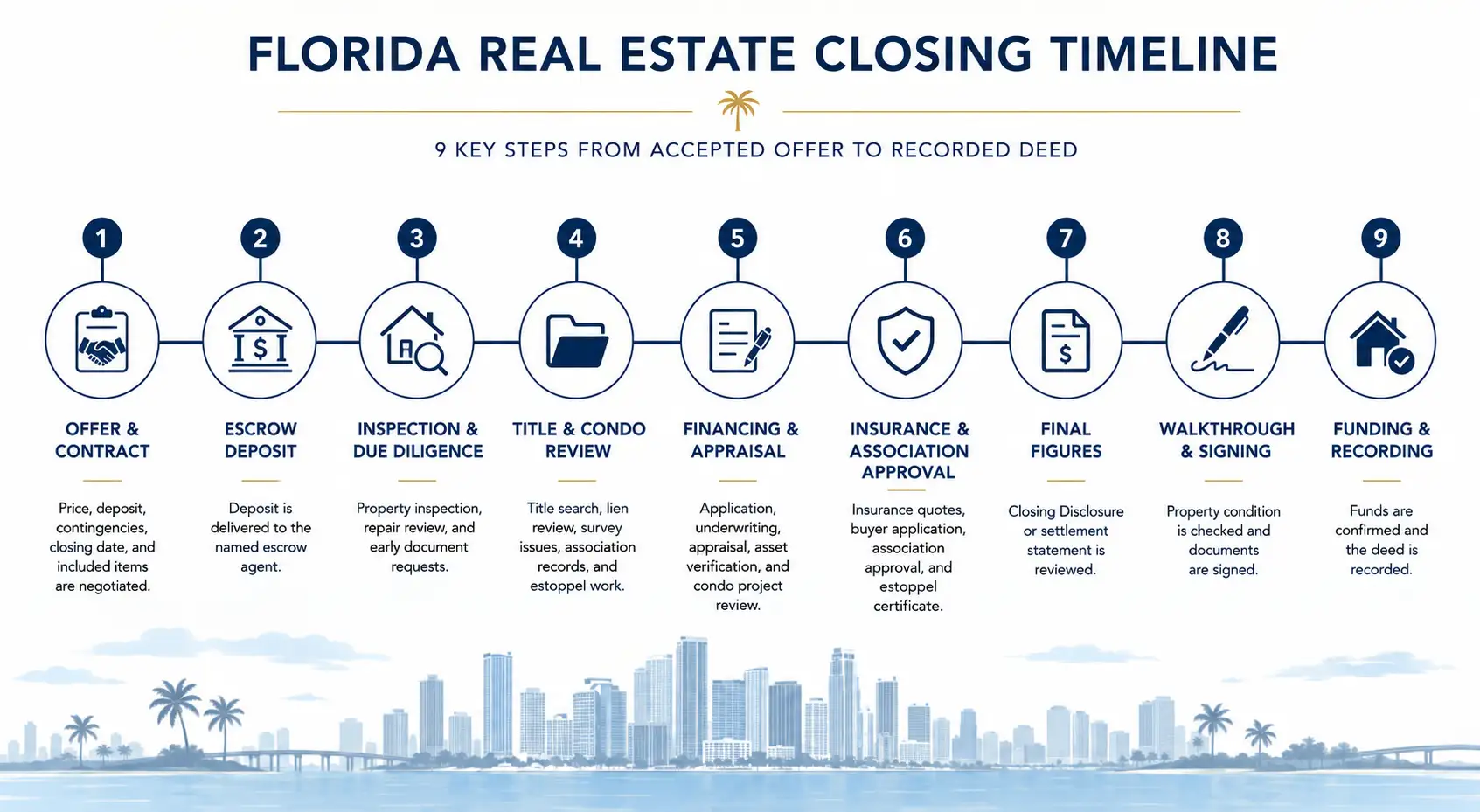
A straightforward cash purchase may close faster than a financed purchase. A condominium can take longer than a single-family home when the association requires an application, interview, approval, estoppel certificate, or extensive document review.
The table shows a practical Florida real estate closing timeline, not a guaranteed schedule.
| Stage | Typical timing | What happens | Buyer priority |
|---|---|---|---|
| Offer and contract | Days 0–3 | Price, deposit, contingencies, closing date, and included items are negotiated | Read every deadline before signing |
| Escrow deposit | Usually within the contract deadline | Deposit is delivered to the named escrow agent | Confirm receipt in writing |
| Inspection and due diligence | Often Days 1–10 | Property inspection, repair review, and early document requests | Book inspections immediately |
| Title and condo review | Often Days 3–20 | Title search, lien review, survey issues, association records, and estoppel work | Track missing documents |
| Financing and appraisal | Often Days 3–30+ | Application, underwriting, appraisal, asset verification, and condo project review | Answer lender requests quickly |
| Insurance and association approval | Often Days 5–30 | Quotes, master-policy review, buyer application, and approval | Start before deadlines tighten |
| Final figures | Usually final week | Closing Disclosure or settlement statement is reviewed | Verify names, credits, fees, and cash to close |
| Walkthrough and signing | Closing day or shortly before | Property condition is checked and documents are signed | Report unresolved issues before funding |
| Funding and recording | Closing day or next business day | Funds are confirmed and the deed is recorded | Wait for confirmation before taking possession |
Step 1: Treat the Effective Date as Day One
The Florida real estate closing timeline usually begins when the contract becomes effective, not when you first make an offer. The effective date triggers deadlines for the escrow deposit, inspections, financing, document review, association applications, and closing.
To protect the Florida real estate closing timeline, do not rely on a verbal summary. Create a deadline sheet from the signed contract and share it with your agent, lender, attorney, and title company. The Florida Bar’s home-buying guidance emphasizes careful review of the purchase contract because it controls the parties’ rights and obligations.
When is the escrow deposit due?
The contract states the amount, recipient, and deadline. Some transactions use an initial deposit followed by an additional deposit. Canadian buyers should confirm how the escrow agent accepts funds, whether an international wire is permitted, and how long their bank may take to release and transmit money.
Send funds early enough to solve a banking problem without missing the contractual deadline. Ask the escrow agent to confirm receipt directly.
Step 2: Start Inspections and Document Review Immediately
The early due-diligence period is one of the busiest parts of the Florida real estate closing timeline. Schedule the general inspection as soon as the contract is effective. Depending on the property, you may also need specialists for the roof, HVAC, plumbing, electrical system, seawall, pool, mold, termites, or other concerns.
For a condo, the Florida real estate closing timeline must include more than the unit inspection. You also need to evaluate the association, building condition, budget, reserves, insurance, rental rules, pending litigation, special assessments, milestone inspection information, and Structural Integrity Reserve Study when applicable.
Use Miami P&B Investments’ Florida condo documents checklist to organize the building-level review. The Florida Department of Business and Professional Regulation also publishes an official guide to purchasing a condominium.
How long is the inspection period?
There is no universal period for every Florida purchase. The negotiated contract controls. Many residential transactions use a window of roughly one to two weeks, but a shorter or longer period may be agreed.
The practical rule is simple: assume every day matters. Delayed inspections leave less time to obtain estimates, negotiate repairs or credits, review specialist findings, and make a contract decision before the deadline.
Step 3: Open Title Work Before Problems Become Urgent
Title work runs alongside the Florida real estate closing timeline, inspections, and financing. The title company or attorney researches ownership, mortgages, liens, judgments, taxes, legal descriptions, and other recorded matters that may affect the transfer.
A title issue does not always stop a sale. Many problems can be resolved through payoff statements, releases, corrective documents, probate work, association estoppels, or seller action. The risk comes when an issue is discovered late and there is not enough time to cure it.
Review Miami P&B Investments’ guide to title insurance in Florida for a deeper explanation of title searches, commitments, exceptions, and owner’s coverage.
The Florida real estate closing timeline should include time for you or your attorney to read the title commitment, not merely receive it. Check the purchaser’s legal name, ownership structure, property description, exceptions, and requirements that must be completed before the policy is issued.
Step 4: Move Financing and Condo Approval in Parallel
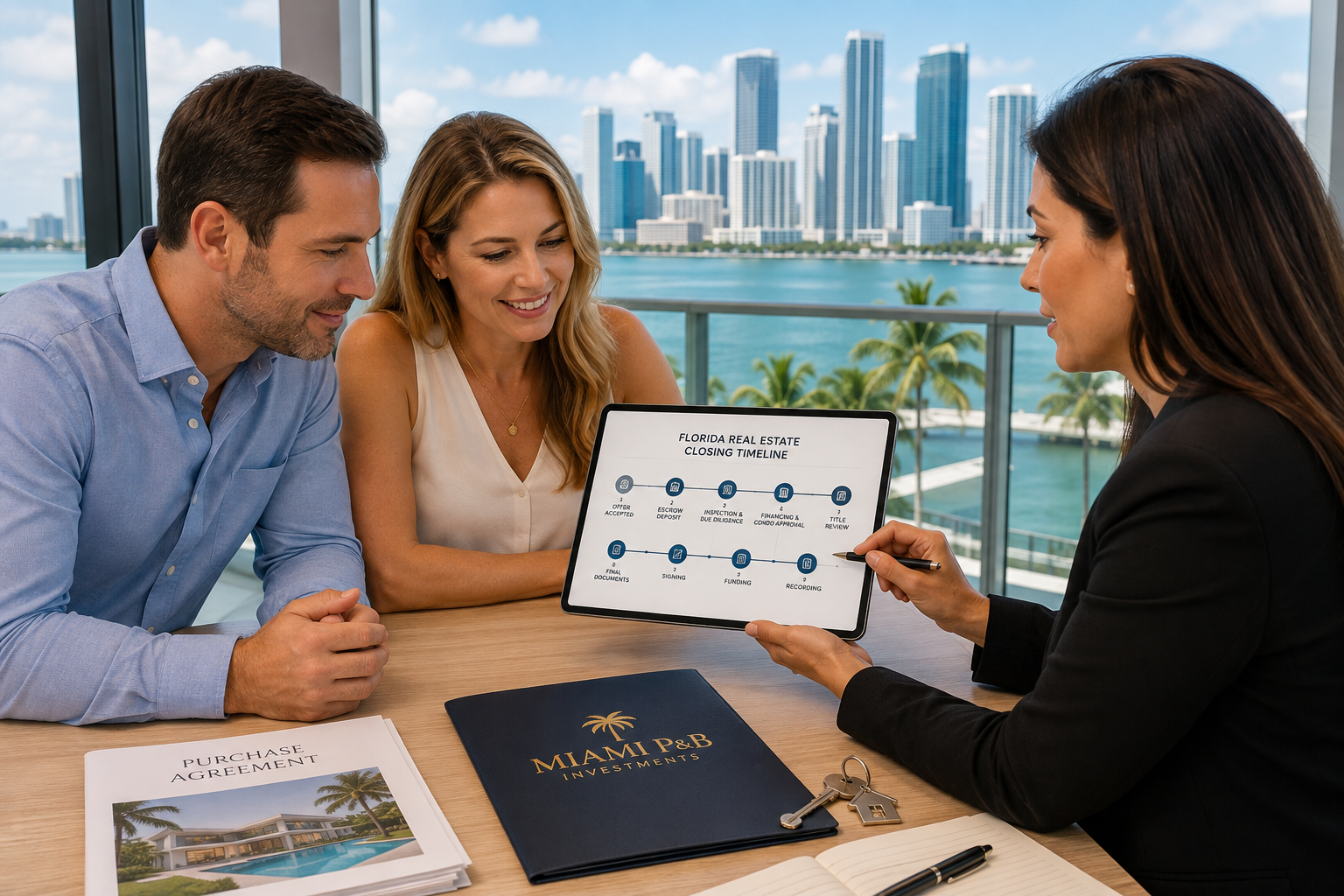
In a financed Florida real estate closing timeline, buyers should complete the full mortgage application immediately after contract acceptance. Pre-approval is only the starting point. The lender may still need updated income records, bank statements, proof of down payment, explanations for large deposits, an appraisal, insurance information, title documents, and final underwriting approval.
Within the Florida real estate closing timeline, Canadian borrowers may also need tax documents, credit information, passport identification, proof of residency, clarified records, and evidence showing the source and movement of funds. Miami P&B Investments’ U.S. mortgage guide for Canadians in Florida explains the cross-border preparation in more detail.
For a condominium, the lender evaluates both the borrower and the project. Building insurance, reserves, litigation, assessments, delinquency levels, structural concerns, and other project issues can affect approval.
How long does a financed Florida closing take?
A well-prepared financed purchase often targets roughly 30 to 45 days, but the contract and lender set the real schedule. Complex income, a jumbo or foreign-national loan, a difficult appraisal, or a slow condo review can extend the Florida real estate closing timeline.
Can a cash purchase close faster?
Yes. Removing mortgage underwriting and appraisal requirements can shorten the Florida real estate closing timeline. Cash does not eliminate inspections, title review, condo approval, association documents, insurance decisions, or the need to verify the condition and legal status of the property.
Step 5: Coordinate Insurance, Association, and Estoppel Work
Insurance should be reviewed early in the Florida real estate closing timeline, especially for coastal property and older buildings. A lender may require proof of acceptable coverage before issuing final approval. Condo buyers should compare the association’s master policy with the coverage needed for the unit, personal property, liability, improvements, loss assessment exposure, and flood risk.
Association applications can create a separate track in the Florida real estate closing timeline. Some communities require fees, identification, financial information, references, orientation, or an interview. Submit a complete package and obtain written confirmation that it was received.
The association or management company may also prepare an estoppel certificate showing amounts due, assessments, transfer charges, and other unit-specific information. Missing signatures, unpaid balances, or an unresolved violation can delay final figures.
Step 6: Plan the CAD-to-USD Transfer Before the Final Week
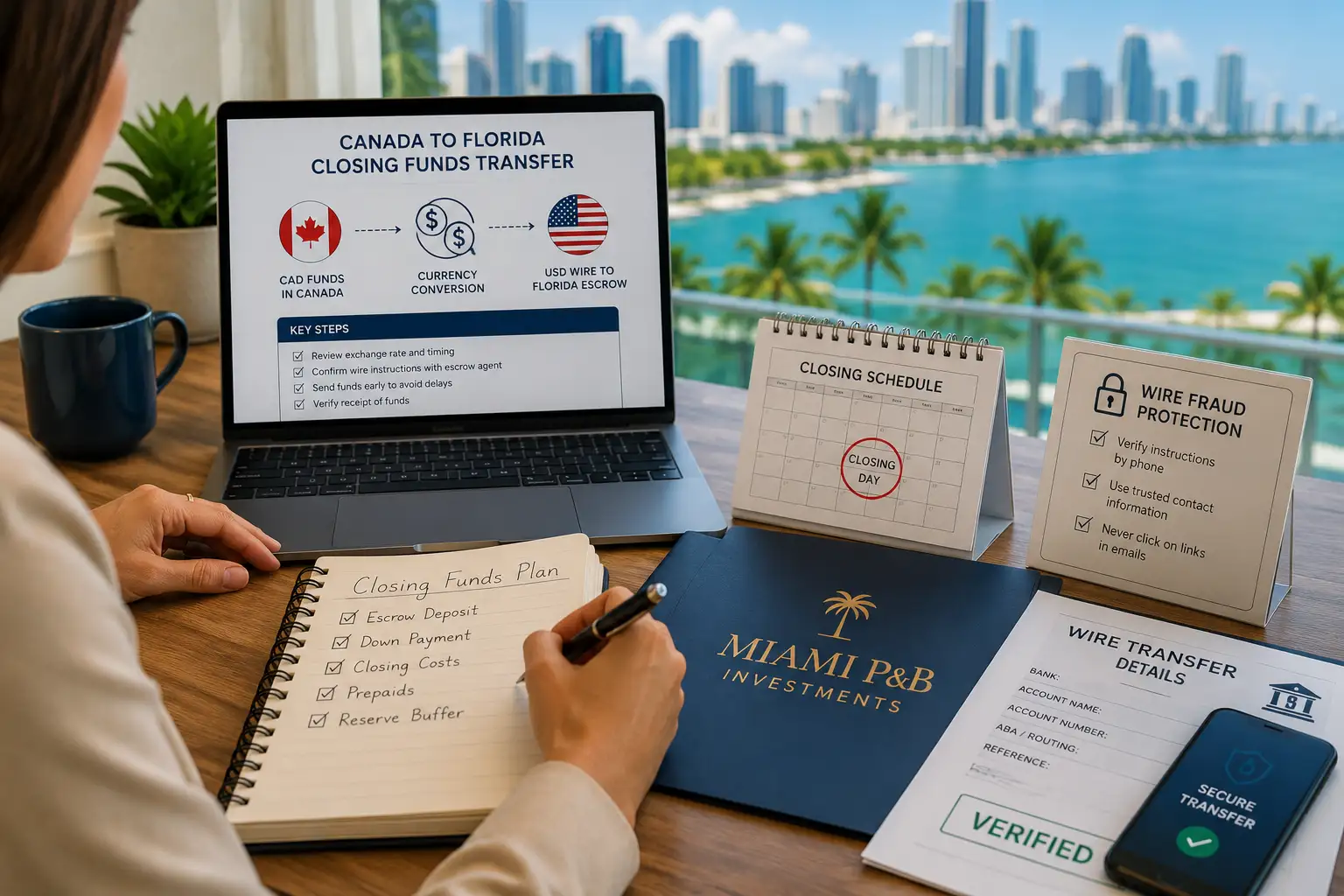
In the Florida real estate closing timeline, Canadian buyers should not wait for the final settlement statement before deciding how to move the purchase funds. Bank limits, compliance reviews, currency conversion, wire cutoffs, weekends, and Canadian or U.S. holidays can all affect timing.
Build a funds schedule that covers:
- The escrow deposit
- Inspection and appraisal charges
- Association application fees
- The remaining down payment
- Closing costs and prepaid expenses
- A contingency buffer for final adjustments
Ask the title company when it needs cleared funds and whether the wire must come from an account held in the buyer’s name. Ask your lender before moving money between accounts because unexplained transfers can create new underwriting questions.
Wire fraud is a serious closing risk. The Consumer Financial Protection Bureau’s closing guidance warns that scammers may impersonate settlement professionals and send changed wiring instructions. Verify instructions through a trusted phone number obtained independently, not from the email requesting the wire.
Step 7: Review Final Documents Before Signing
Near the end of the Florida real estate closing timeline, the title company and lender assemble the final documents. Financed buyers generally receive a Closing Disclosure at least three business days before the scheduled mortgage closing. The CFPB Closing Disclosure explainer helps buyers compare the final loan terms and costs.
Review the purchase price, deposit credit, lender credit, seller credit, prorations, title charges, association fees, taxes, insurance items, loan amount, interest rate, and final cash to close. Confirm that your name and vesting match the ownership plan approved by your legal and tax advisors.
Do not assume every last-minute change creates a new waiting period. Some loan changes do and others do not. Ask the lender and closing agent how a revision affects the scheduled signing.
What should you question on the settlement statement?
Question any fee you do not recognize, any missing contract credit, an incorrect deposit amount, an unexpected association charge, or a tax or rent proration that does not match the agreed date. Small errors are easier to correct before documents are signed and funds are released.
Step 8: Arrange Remote Signing Correctly
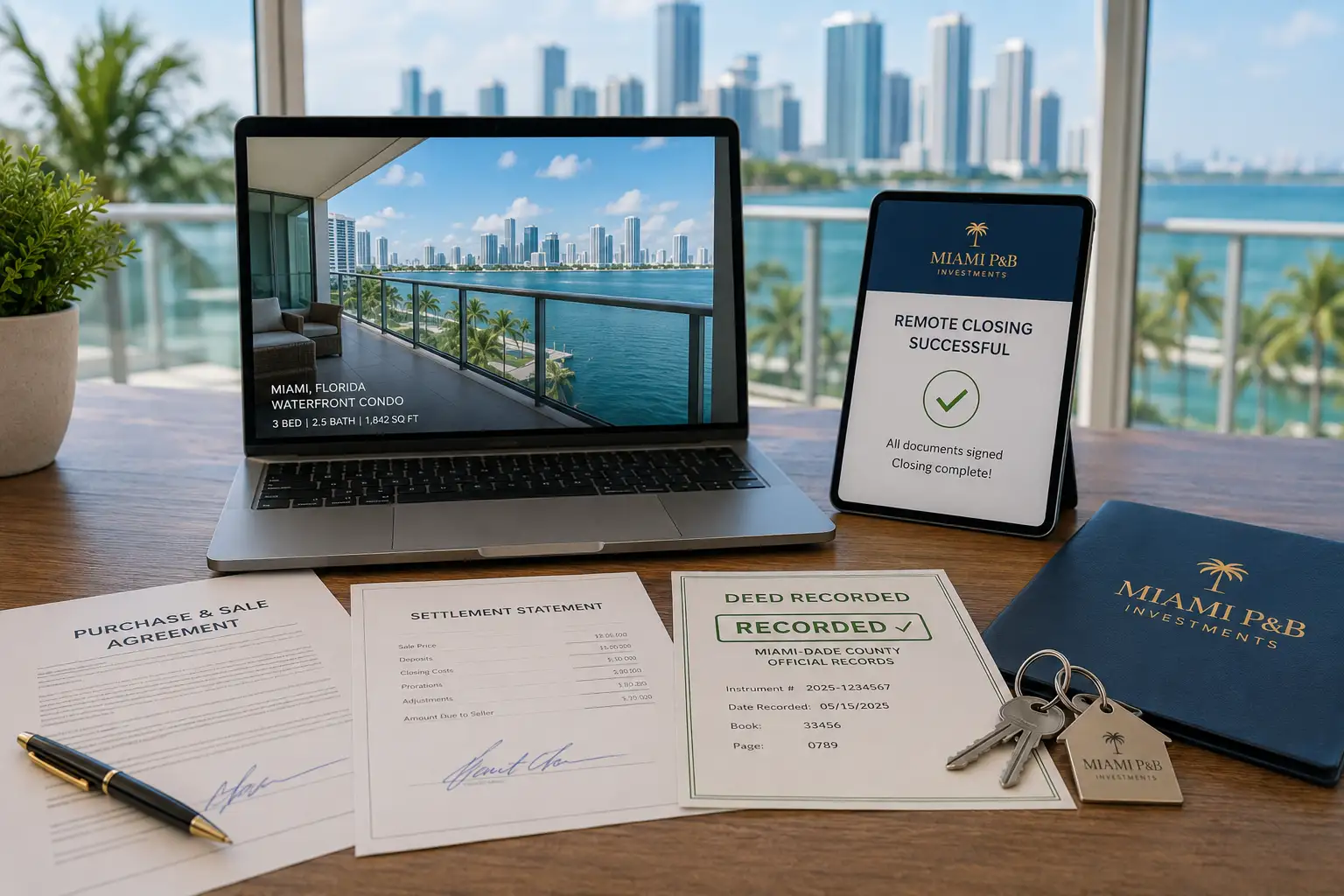
The Florida real estate closing timeline can often be completed without a Canadian buyer traveling for closing. Depending on the lender, title company, document type, and transaction, signing may use electronic signatures, remote online notarization, a mobile notary, or a mailed document package.
Remote closing is not automatic. Confirm the approved method early in the Florida real estate closing timeline. Some original documents may need to arrive before funding, and a lender may have stricter requirements than a cash transaction.
A power of attorney should never be treated as a last-minute backup. The form, authority, signatures, notarization, and lender acceptance may require advance review. Coordinate it with a Florida attorney and the closing team well before signing day.
Step 9: Complete the Walkthrough, Funding, and Recording
The final walkthrough is not a new inspection. It confirms that the property is in the expected condition, agreed repairs are complete, included items remain, and no major damage occurred after the inspection.
Report a problem before closing. Depending on the contract and facts, the parties may resolve it through repair, credit, escrow holdback, delay, or another written agreement.
After documents are signed, the closing agent confirms funds and closing conditions. The deed is then sent for recording in the county’s public records. Keys and possession should be released according to the contract and closing agent’s confirmation—not merely because signatures are complete.
The Florida real estate closing timeline is finished only when the transaction has funded, required documents are accepted, and the closing team confirms that you may take possession.
What Commonly Delays a Florida Closing?
Most delays are not caused by one dramatic problem. They come from small unfinished tasks that accumulate.
Common causes include:
- Late lender documents or unexplained bank transfers
- Appraisal issues
- Condo project review problems
- Missing association approval
- Slow estoppel or payoff requests
- Title defects or open permits
- Insurance that does not meet lender requirements
- Repairs that are incomplete at walkthrough
- International wires sent too late
- Names or ownership structure changed near closing
- Holidays, time-zone differences, and courier delays
A strong Florida real estate closing timeline gives each critical task an owner and a backup plan. Use one shared checklist, hold a weekly status call, and ask a direct question: “What could prevent us from closing on the contract date?”
What is the best way to prevent a closing delay?
Respond quickly, keep documents organized, avoid major financial changes, submit association packages early, verify insurance before the final week, and move funds with a time cushion. Most importantly, make sure the agent, lender, title company, attorney, and association are working from the same closing date and buyer information.
Plan Your Miami Closing With Miami P&B Investments
A successful Florida real estate closing timeline is a coordinated project, not a single appointment. Canadian buyers need local property knowledge, responsive transaction management, cross-border financing awareness, careful document review, and a clear plan for funding and remote signing.
Miami P&B Investments supports buyers before, during, and after the transaction. Explore the Canadian investor resource hub, review the team’s real estate legal services, or book a consultation to build a closing plan around your property, financing, ownership goals, and timeline.
The earlier the team identifies deadlines and dependencies, the easier it is to protect your deposit, avoid preventable delays, and move from accepted offer to Miami ownership with confidence.