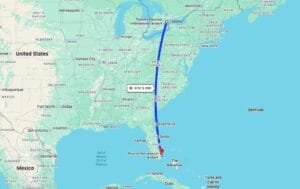
Florida seller closing costs can change the answer to a simple question: “If I sell my Florida property, how much money will I actually receive?” For a Canadian snowbird, the listing price is only the starting point. Brokerage compensation, documentary stamp tax, title and closing charges, mortgage or association payoffs, negotiated credits, FIRPTA withholding, and CAD/USD conversion can all affect the cash that reaches you.
That is why a Canadian owner should build a seller net sheet before listing, not after accepting an offer. Reviewing Florida seller closing costs before you list also gives you a better floor for negotiations. Miami P&B Investments’ Canadian investor resources can help coordinate the real estate side with the tax, legal, and accounting professionals needed for a cross-border sale.
What Florida Seller Closing Costs Actually Include
Florida seller closing costs are the expenses, payoffs, adjustments, and withholdings that reduce the amount distributed at closing. Some are true transaction costs. Others are debts being paid off. FIRPTA is different again: it is generally a federal withholding mechanism, not necessarily your final U.S. tax bill.
A useful net sheet separates transaction costs, transfer taxes, property obligations, and cross-border withholding. That separation matters because two properties with the same sale price can produce very different take-home amounts.
Is FIRPTA a closing cost or a tax?
FIRPTA withholding reduces your cash at closing, so it belongs on a practical net-proceeds estimate. But it should not automatically be treated as your final tax cost.
Under IRS FIRPTA rules, a foreign seller’s disposition of U.S. real property is generally subject to withholding, with the buyer usually acting as the withholding agent. The seller later reports the disposition and can claim credit for eligible amounts withheld.
Miami P&B Investments already has a separate guide to FIRPTA tax strategies for Canadian investors. This article focuses on the seller net sheet rather than repeating that broader tax-planning guide.
7 Florida Seller Closing Costs Canadians Should Put on the Net Sheet
1. Brokerage compensation
Brokerage compensation can be one of the largest Florida seller closing costs. For your net sheet, use the actual percentage or dollar amount contained in your signed listing agreement and the terms ultimately negotiated for the transaction.
A generic online assumption may not match your closing statement. When comparing offers, look at expected net proceeds instead of evaluating the headline purchase price alone.
2. Documentary stamp tax on the deed
Florida imposes documentary stamp tax on deeds and other documents transferring an interest in Florida real property.
According to the Florida Department of Revenue, the rate in counties outside Miami-Dade is $0.70 for each $100, or portion thereof, of consideration. Miami-Dade uses $0.60 per $100 and also imposes a $0.45-per-$100 surtax, although the surtax does not apply when the document transfers only a single-family dwelling.
Because county and property type matter, this part of Florida seller closing costs should be calculated for the specific sale.
How much is Florida documentary stamp tax on a $600,000 sale?
For a qualifying single-family dwelling in Miami-Dade, $600,000 at $0.60 per $100 produces $3,600 of documentary stamp tax.
Outside Miami-Dade at $0.70 per $100, the same $600,000 consideration produces $4,200.
If a Miami-Dade transfer is subject to the additional surtax, the number changes. Confirm the final calculation with the closing agent handling the property.
3. Title, settlement, legal, and closing charges
Florida seller closing costs can include settlement or escrow charges, title-related work, document preparation, courier or wire fees, and legal fees when counsel is involved. Which party pays a particular item can depend on the contract and transaction structure.
If you are selling from Canada, ask the title or closing company for an early estimate rather than waiting for the final settlement statement.
Miami P&B Investments also provides access to legal services for international real estate clients when additional contract or transaction support is needed.
4. Mortgage payoff, liens, and association balances
A mortgage payoff is not technically a selling expense, but it directly reduces cash proceeds. The same is true for recorded liens, unpaid balances, special assessments, or other obligations that must be resolved through closing.
Condo sellers should pay particularly close attention to association charges.
A pending special assessment, unpaid monthly balance, or other association obligation can materially change the seller net sheet. How an assessment is handled depends on the contract, association documents, and circumstances of the transaction.
5. Repairs, credits, concessions, and prorations
Repair credits, seller concessions, property-tax adjustments, association dues, rent, and other prorations can change the final number after the property goes under contract.
These Florida seller closing costs are difficult to know precisely when the property first hits the market.
Use an estimated adjustments line in your initial net sheet. Once you have a signed contract, replace estimates with the actual negotiated credits and closing-company figures.
6. FIRPTA withholding
For many Canadian snowbirds, FIRPTA is the biggest cash-flow item among Florida seller closing costs.
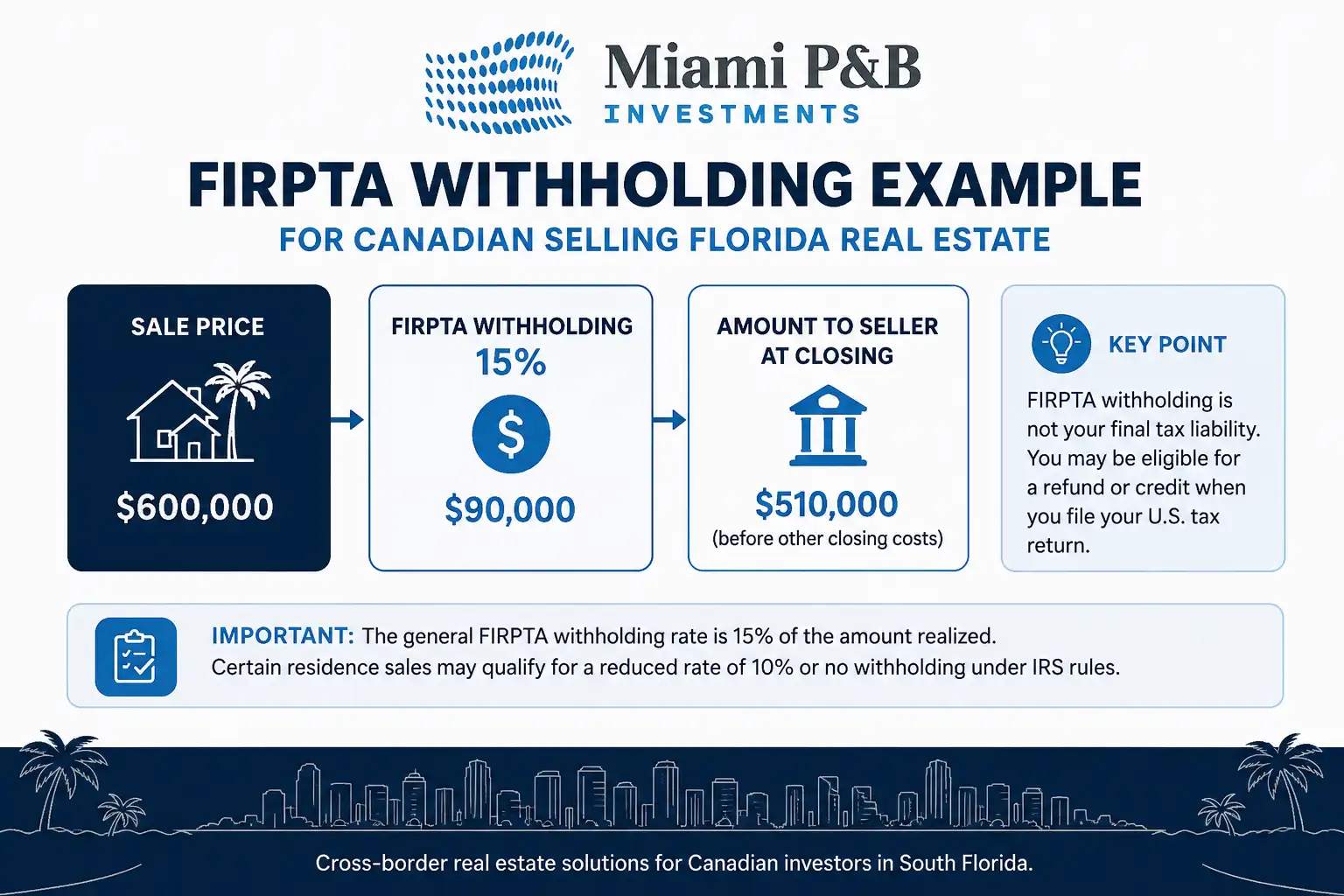
The general FIRPTA withholding rate is 15% of the amount realized, rather than 15% of the seller’s profit.
Important residence rules can change that result. If an individual buyer acquires the property for use as a residence and the amount realized is no more than $300,000, withholding may be eliminated when the applicable residence requirements are met.
For a qualifying residence transaction above $300,000 and no more than $1 million, the withholding rate is generally 10%. Above $1 million, the general 15% rate applies.
Treat FIRPTA first as a closing cash-flow assumption. Then have a qualified cross-border tax professional calculate your expected actual U.S. tax liability.
7. Currency conversion and repatriation costs
Currency conversion is not a Florida closing charge, but for a Canadian seller it affects the result that ultimately matters: how many Canadian dollars you receive.
Your proceeds may be wired to a U.S. account, a Canadian USD account, or converted directly into CAD. The exchange rate, bank spread, wire cost, and timing of conversion can change the final Canadian-dollar result.
Miami P&B Investments has a separate guide to managing CAD/USD currency exchange risk.
The practical lesson is simple: build the currency plan before closing instead of making a rushed conversion decision after a large USD wire arrives.
How FIRPTA Changes Florida Seller Closing Costs at Closing
Florida seller closing costs are easier to understand when FIRPTA is shown separately from true transaction expenses.
Under the general FIRPTA rule, withholding is based on the amount realized, not simply on the seller’s profit. For a straightforward $600,000 sale with no special rule, 15% equals $90,000 of withholding.
That can create a large difference between the economic gain on the property and the cash released at closing.
The buyer is generally the withholding agent. Forms 8288 and 8288-A are used in the reporting process, and Form 8288 is generally due by the 20th day after the disposition.
Can a Canadian seller reduce FIRPTA withholding before closing?
Potentially, yes.
A foreign seller can use Form 8288-B to request an IRS withholding certificate when reduced or eliminated withholding may be appropriate.
The IRS states that it will generally act on a complete withholding-certificate application within 90 days after receiving the required information, including taxpayer identification numbers for the parties. IRS withholding-certificate guidance explains the circumstances in which reduced withholding may be approved.
If your expected actual tax is substantially below standard withholding, ask a cross-border tax advisor early whether a withholding-certificate application fits your circumstances.
Miami P&B Investments’ accounting services can help coordinate transaction records and closing information with the appropriate professionals.
A pending application does not make the statutory withholding amount disappear automatically. The closing agent and tax advisor should coordinate how the transaction is handled under the applicable rules.
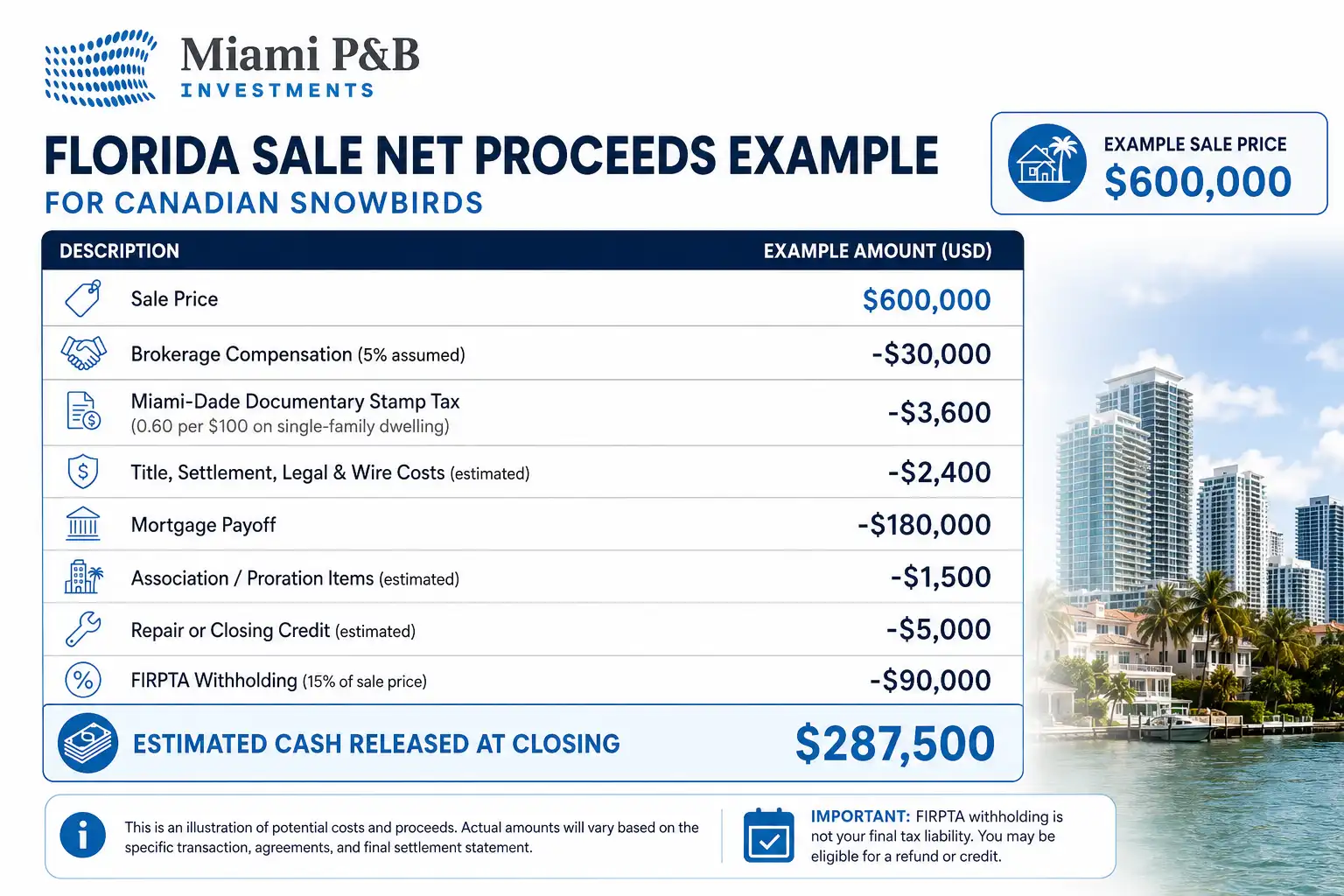
Florida Seller Closing Costs Example: $600,000 Sale
The following seller net sheet shows why Florida seller closing costs should be modeled line by line.
It is an illustration, not a quote or personalized tax calculation.
Assume a Canadian owner sells a Miami-Dade single-family property for $600,000 and has a $180,000 mortgage payoff.
Brokerage compensation is assumed at 5% solely for this example. The buyer does not qualify the transaction for a FIRPTA residence reduction, so the model uses 15% withholding.
| Item | Example amount |
|---|---|
| Sale price | $600,000 |
| Brokerage compensation, assumed 5% | -$30,000 |
| Miami-Dade deed documentary stamp tax | -$3,600 |
| Title, settlement, legal, and wire costs, assumed | -$2,400 |
| Mortgage payoff | -$180,000 |
| Association/proration items, assumed | -$1,500 |
| Repair or closing credit, assumed | -$5,000 |
| FIRPTA withholding at 15% | -$90,000 |
| Estimated cash released at closing | $287,500 |
This table illustrates cash flow, not final after-tax wealth.
The $90,000 FIRPTA amount may be more than, equal to, or less than the seller’s eventual U.S. tax liability.
If the same $600,000 transaction legitimately qualified for the 10% residence withholding rate, only $60,000 would be withheld instead of $90,000 — a $30,000 difference in cash flow at closing.
That is why FIRPTA review can matter before the closing date.
When to Estimate Florida Seller Closing Costs
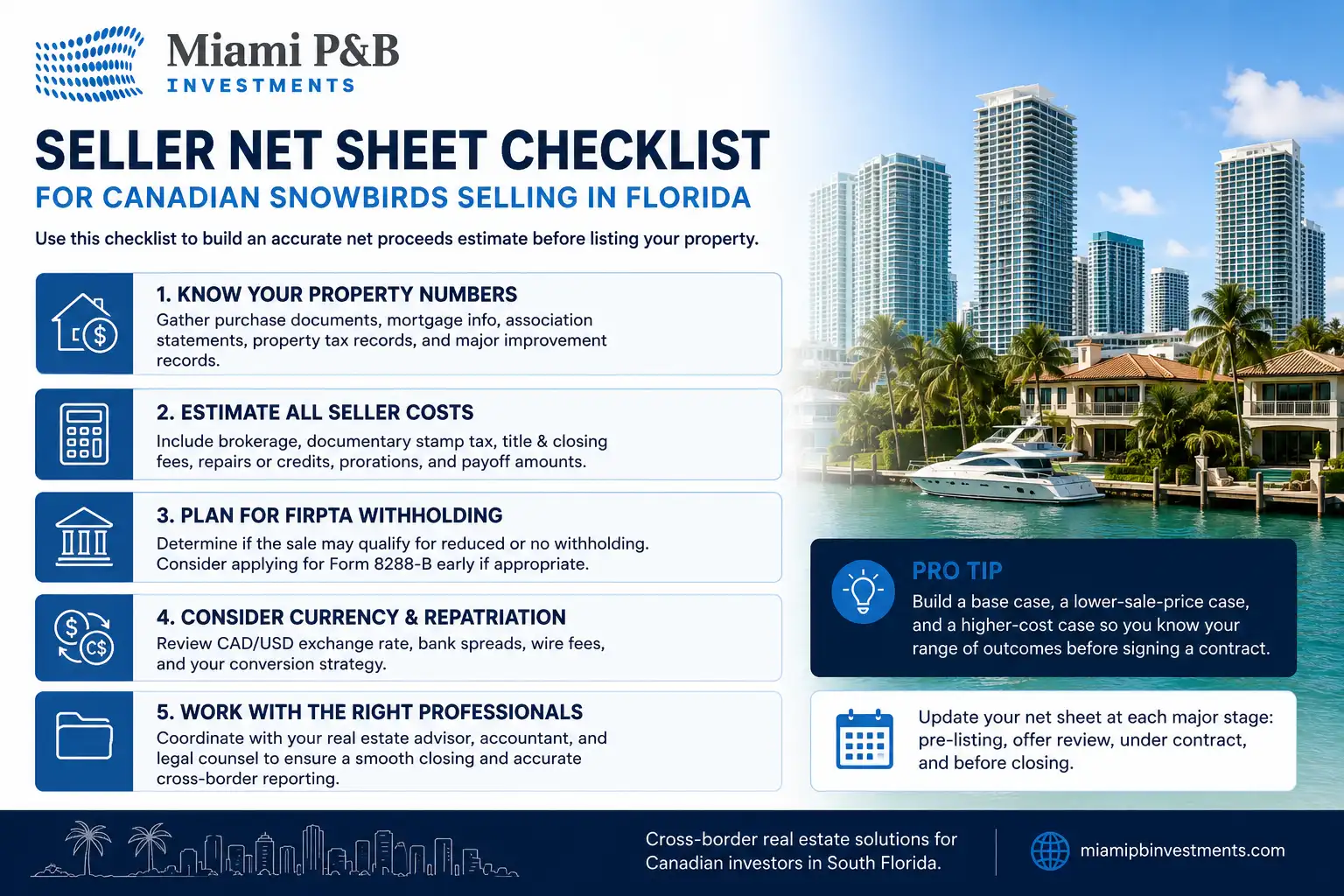
A Canadian owner should estimate Florida seller closing costs before the property is listed, then update the seller net sheet at each major stage.
60–90 days before listing or an expected contract
Gather your:
- Original purchase closing statement
- Major improvement records
- Depreciation records if the property was rented
- Mortgage information
- Condo or association statements
- U.S. taxpayer identification information
- Recent property-tax records
Ask your tax professional whether a FIRPTA withholding certificate should be considered.
You should also get a realistic expected market value rather than building the net sheet around an aspirational asking price.
Miami P&B Investments’ real estate services can help Canadian owners evaluate pricing, property condition, and likely buyer demand.
Before accepting an offer
Update Florida seller closing costs using the actual offer price, brokerage terms, requested concessions, and expected closing date.
Request an updated mortgage payoff and confirm condo or HOA amounts likely to appear on the settlement statement.
If the buyer’s intended residence use may affect FIRPTA withholding, make sure the closing and tax professionals understand the relevant facts.
Under contract and after closing
Replace estimates with written figures from the title company, association, lender, and tax advisor.
Confirm how FIRPTA will be handled and whether a Form 8288-B application has been filed.
After closing, keep your final settlement statement, Form 8288-A when available, tax documents, and evidence of foreign tax paid. Those records can become important when the U.S. and Canadian tax filings are prepared.
Should you wait for a better CAD/USD rate before selling?
Usually, exchange rates should be one factor rather than the only reason to sell or hold.
The property’s achievable sale price, carrying costs, insurance, HOA obligations, assessment risk, and your personal timeline may matter more than a short-term currency movement.
You may also be able to separate the property-sale decision from the currency-conversion decision by discussing USD-account or staged-conversion options with an appropriate financial or currency professional.
That avoids turning a real estate sale into an all-or-nothing bet on one day’s exchange rate.
Canadian Tax Reporting After the Florida Closing
Florida seller closing costs are only one part of a cross-border transaction.
A Canadian resident may also have Canadian reporting obligations, and eligible foreign taxes paid in the United States may be relevant when calculating a Canadian foreign tax credit.
The Canada Revenue Agency’s foreign tax credit guidance states that foreign income and foreign taxes used in the calculation must be converted into Canadian dollars. Form T2209 is used to calculate the federal foreign tax credit.
The exact treatment of your sale depends on factors including residency, property use, ownership structure, adjusted cost information, and other circumstances.
A Florida closing agent can tell you what was withheld and disbursed. That is not the same as preparing your U.S. and Canadian tax returns, which is why coordinated cross-border review matters.
Does FIRPTA mean you paid your final U.S. tax?
No.
FIRPTA is a withholding system. A foreign seller generally reports the disposition on the appropriate U.S. income tax return and claims credit for qualifying FIRPTA withholding.
This is one of the most important distinctions in net-proceeds planning.
The settlement statement tells you how much cash left the closing table. Your tax filings ultimately determine the tax result.
Common Florida Seller Closing Costs Mistakes Canadian Snowbirds Make
The biggest errors with Florida seller closing costs tend to happen before the closing table.
- Treating FIRPTA withholding as a permanent 15% tax instead of an amount that must later be reconciled
- Using a generic commission assumption instead of the signed brokerage agreement
- Forgetting documentary stamp tax or using the wrong county rate
- Ignoring mortgage payoff, liens, condo balances, special assessments, or prorations
- Estimating net proceeds from the list price rather than a realistic expected sale price
- Waiting too long to ask whether Form 8288-B could reduce excessive withholding
- Converting the entire USD balance into CAD without first having a currency plan
A strong seller net sheet should show a base case, a lower-sale-price case, and a higher-cost case.
That way, you know what range of outcomes is acceptable before signing a contract rather than discovering your true proceeds days before closing.
Estimate Your Florida Seller Closing Costs With Miami P&B Investments
Florida seller closing costs should be part of the decision to sell, not a surprise discovered on the final closing statement.
For Canadian snowbirds, the best estimate combines the likely sale price with transaction costs, mortgage and property obligations, FIRPTA cash flow, and the eventual CAD conversion.
Miami P&B Investments works with Canadian owners and investors in South Florida and can help organize the real estate side of the sale while coordinating with qualified accounting and legal professionals when cross-border issues arise.
If you are considering selling, contact Miami P&B Investments for a consultation and a property-specific estimate of the real estate and closing items that may affect your proceeds.
Tax and legal conclusions should always be confirmed with qualified U.S. and Canadian professionals using the facts of your specific transaction.