
Florida short-term rental laws can make or break the numbers on a Miami investment property.
A condo that looks perfect for Airbnb income may have building restrictions. A single-family home that seems flexible may sit in a city zone where short-term lodging is limited. A property with strong nightly-rate potential may still need state licensing, local registration, tax setup, safety standards, and a realistic management plan.
That is why buyers should study the rules before they fall in love with a listing.
This is especially important for Canadian buyers, snowbirds, and long-distance investors who want a Miami or South Florida property that can serve more than one purpose. You may want winter personal use, seasonal rental income, long-term appreciation, and hands-off management. That can be a smart plan, but only if the property actually supports short-term rental use.
If you are still comparing property types, start with the broader homes for sale in Miami Florida page, then use this guide to understand how Florida short-term rental laws fit into the buying decision.

Why Florida Short-Term Rental Laws Matter Before You Buy
Short-term rentals are not just a marketing strategy. They are a legal, financial, and operational decision.
In Florida, a vacation rental can involve state-level licensing, local government rules, zoning approvals, tax collection, safety requirements, condo or HOA restrictions, platform rules, and guest management. In Miami and South Florida, those layers can vary widely from one building, street, city, or county to another.
That is why two similar-looking properties can produce very different outcomes.
One condo may allow daily rentals, have a clear rental desk, and be located in a short-term-rental-friendly area. Another condo across the street may require a 30-day minimum lease, limit the number of rentals per year, or prohibit Airbnb-style use completely.
The same applies to single-family homes. Some areas are more flexible. Others have strict zoning, registration, occupancy, parking, noise, or neighborhood rules.
For investors, the key question is not simply, “Can this property rent well?”
The better question is, “Can this property legally, practically, and profitably operate the way I want?”
That question should be answered before making an offer, not after closing.
Short-Term Rental Rules Are Layered, Not One-Size-Fits-All
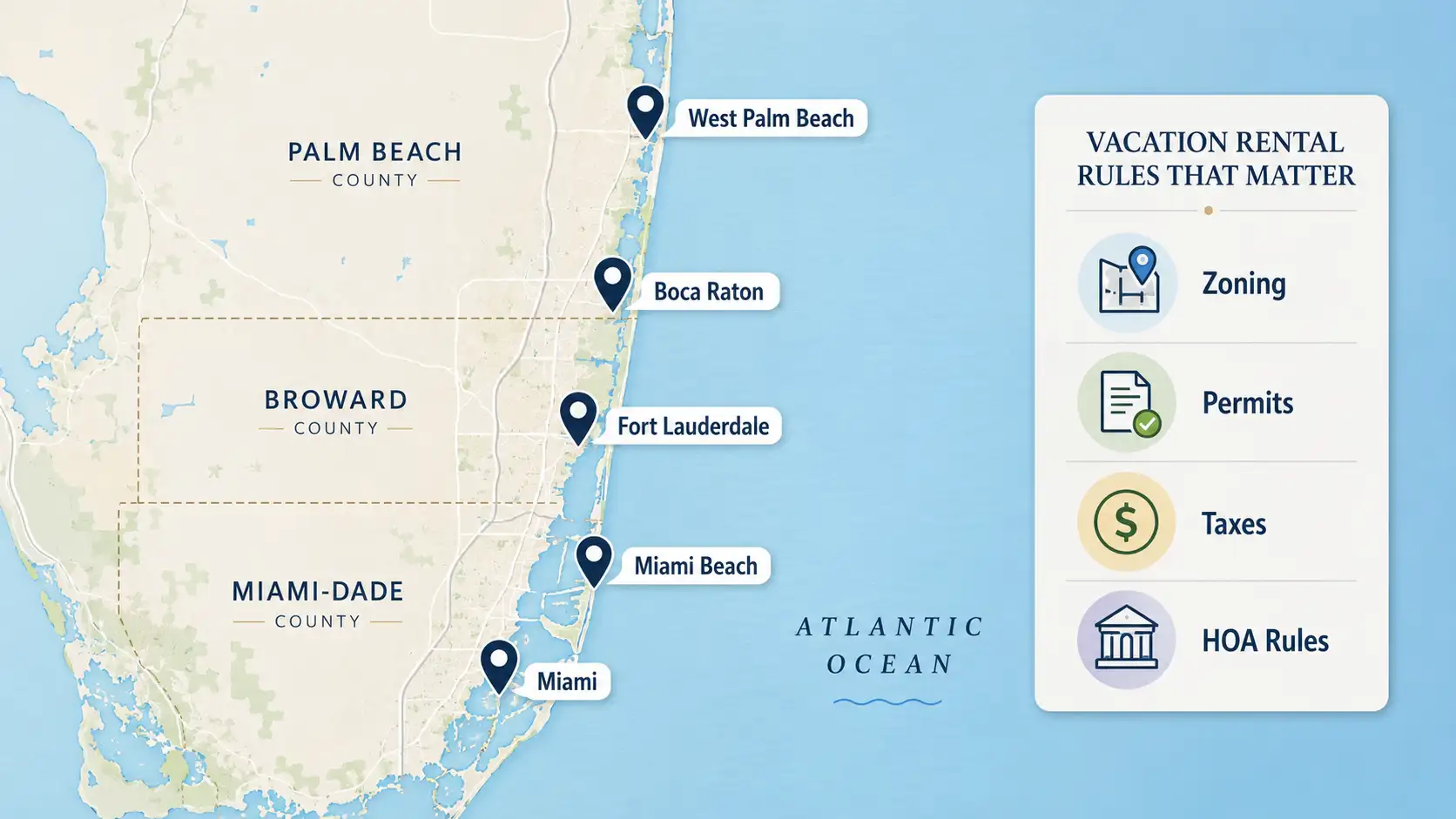
Many buyers search for Florida short-term rental laws expecting one simple answer. In reality, there are several layers.
Here is the practical way to think about it:
| Rule Layer | What It Controls | Why It Matters |
|---|---|---|
| State rules | Vacation rental licensing and lodging standards | Determines whether the rental needs state-level licensing |
| County rules | Local registration, certificates, local taxes, enforcement | Often applies even when the city also has rules |
| City rules | Zoning, permits, occupancy, lodging use, inspections | Can determine whether short-term rental use is allowed |
| Condo or HOA rules | Lease minimums, guest registration, rental caps, approvals | Can block short-term rentals even if the city allows them |
| Tax rules | Sales tax, tourist tax, platform collection, filings | Affects net income and compliance |
| Management rules | Guest screening, cleaning, maintenance, noise, turnover | Determines whether the rental works in real life |
This layered structure is why due diligence matters so much.
A property can pass one layer and fail another. For example, a buyer may confirm that Florida allows vacation rentals generally, but later discover that the condo association requires a six-month minimum lease. Or a buyer may see Airbnb activity nearby and assume a property qualifies, only to learn that the building does not have the right certificate or the zoning does not support lodging use.
If you are considering a condo, read the related guide on Miami condo rental restrictions before relying on short-term income assumptions.
The 9 Checks Buyers Should Make Before Depending on Short-Term Rental Income
Florida short-term rental laws are manageable when you break them into a checklist.
The goal is not to scare buyers away from Miami or South Florida. The goal is to protect the deal, the income plan, and the exit strategy.
1. Confirm Whether the Property Type Qualifies
Start with the property itself.
Short-term rental rules can treat condos, cooperatives, single-family homes, duplexes, triplexes, fourplexes, and apartment-style units differently. A condo in Brickell, a duplex in Fort Lauderdale, and a house in Hollywood may all have different compliance paths.
Before you focus on projected nightly rates, confirm whether the property type can legally operate as a vacation rental under the relevant rules.
A common mistake is assuming that because a listing says “Airbnb-friendly,” everything is settled. That phrase should trigger more review, not less. Ask what specifically makes it Airbnb-friendly. Is it the zoning? The condo documents? The existing license? The building operations? The rental history? The platform setup?
For buyers comparing South Florida submarkets, the main South Florida properties for sale page can help you evaluate location options beyond Miami alone.
2. Review State Licensing Requirements
Florida short-term rental laws often begin with state licensing through the hospitality and lodging framework.
Buyers should review the official Florida vacation rental licensing guidance to understand how the state views vacation rentals and timeshare projects. This matters because a rental that operates like transient lodging may need to meet requirements that are different from a traditional annual lease.
This is where professional guidance becomes valuable. A buyer does not need to become a licensing expert, but they do need to know whether the property will require a license, whether the current owner already has one, whether it transfers, and what must happen after closing.
If the property is being sold with rental income history, ask for proof of compliance, not just screenshots of revenue.
3. Check Miami-Dade or County-Level Rules
County rules are another major part of Florida short-term rental laws.
In Miami-Dade, short-term vacation rentals are generally treated as rentals of less than 30 days or one calendar month. The county has its own short-term vacation rental standards and requirements, which buyers should review through the official Miami-Dade short-term vacation rentals page.
This is important because county requirements can apply alongside city rules.
A buyer may need to understand certificates, responsible party requirements, tax registration, safety expectations, and enforcement standards. If the property is outside Miami-Dade, the same principle applies: check the specific county, not just the state.
For Broward-focused buyers, a property in Fort Lauderdale may have a different compliance path than one in the City of Miami. For Palm Beach County buyers, a property near West Palm Beach may have a different rental and tax profile again.
4. Confirm City Zoning Before Assuming Airbnb Use
City zoning is one of the biggest short-term rental deal-breakers.
In the City of Miami, short-term rental or lodging use is tied to zoning and building use. Buyers should review the city’s official short-term rental/lodging procedures and zoning guidance before assuming a property can be used for stays under 30 days.
This matters because Florida short-term rental laws do not override every local zoning issue.
A property can look ideal on paper, but if the use is not allowed in that zone or the building lacks the right approvals, the investment plan may need to change. That could mean switching from nightly rentals to monthly rentals, seasonal rentals, or annual tenants.
This is also why neighborhood research matters. Some investors focus on Wynwood Miami real estate because certain buildings and nearby areas have historically attracted more flexible rental strategies. Others prefer Brickell condos or Edgewater Miami condos for long-term executive tenants rather than nightly rentals.
The right answer depends on the building, rules, and your goals.
5. Check the Building Rules Before the City Rules
For condo buyers, building rules can be even more restrictive than city rules.
This is where many investors get surprised.
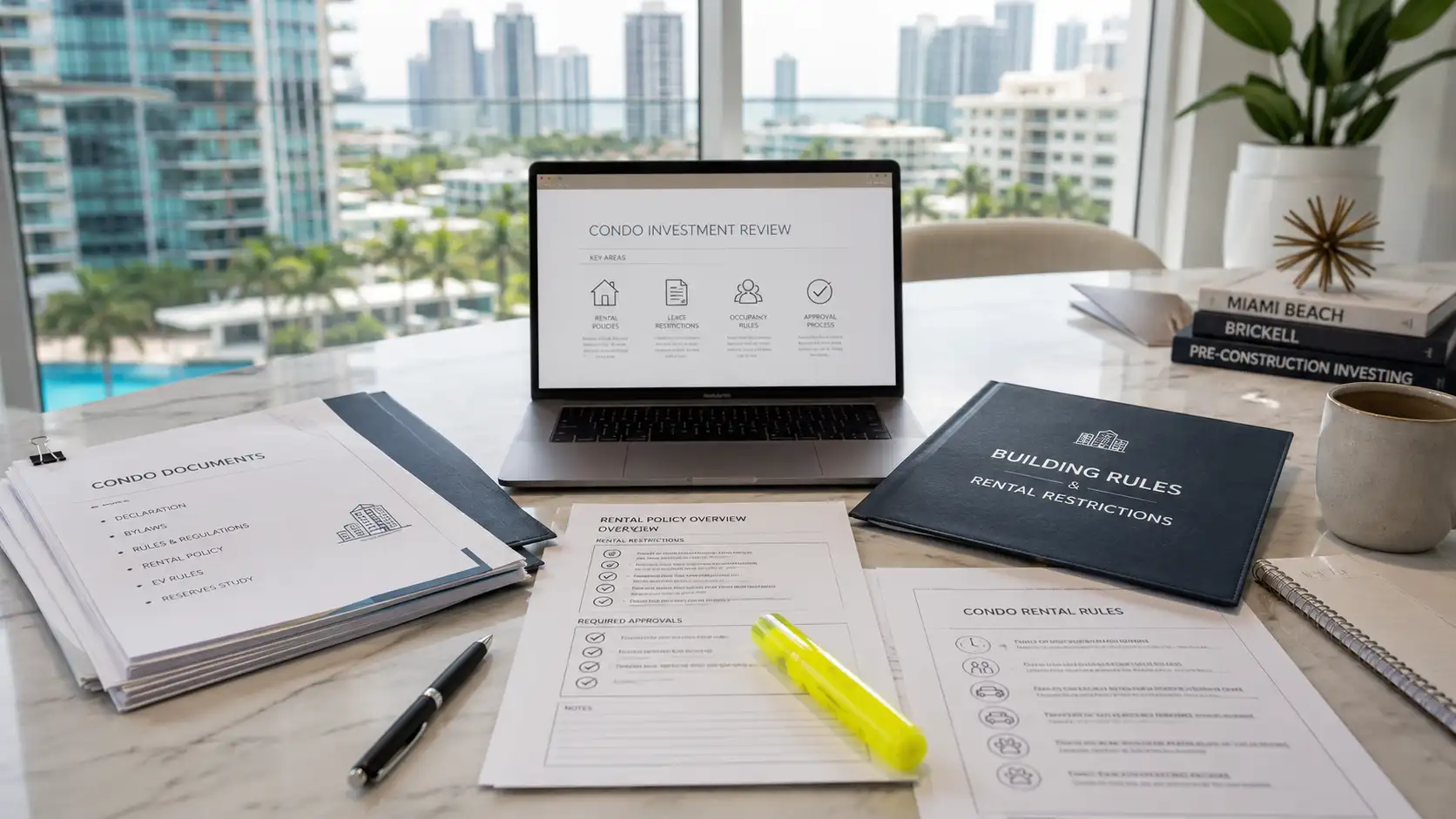
A city may allow short-term rentals in a certain area, but the condo association may require a minimum lease term of 30 days, 90 days, six months, or one year. Some buildings cap the number of leases per year. Others require tenant approval, guest registration, fees, deposits, or background checks. Some prohibit platform-style rentals completely.
That is why Florida short-term rental laws should always be reviewed together with condo documents.
Ask for the declaration, bylaws, house rules, leasing policies, application package, recent meeting minutes, budget, and any rental amendments. If the building has hotel-like operations, commercial units, or a high concentration of investors, review that carefully too.
The guide on Florida condo documents is a helpful companion because rental rules are often hidden inside documents buyers do not read closely enough.
A simple question can save a lot of trouble: “What is the shortest legal rental period in this building, and how many times per year can the unit be rented?”
6. Understand Taxes on Short-Term Rental Income
Taxes can change the real return.
Short-term rentals in Florida may involve sales tax, discretionary surtax, local option transient rental taxes, tourist development taxes, or county-administered taxes depending on the location and rental structure. Buyers should review the official Florida Department of Revenue local option tax information and confirm what applies to the property.
Do not rely only on platform automation.
Some platforms may collect and remit certain taxes in certain areas, but that does not automatically mean every obligation is covered. Owners should confirm registration, collection, remittance, filing obligations, and income tax treatment with qualified advisors.
For Canadian buyers, this becomes even more important because the income is in U.S. dollars, while your broader financial life may be in Canadian dollars. Currency exchange, non-resident tax reporting, deductions, depreciation, and future resale planning should all be discussed before buying.
The existing Miami P&B guide on Florida property taxes for non-residents is a useful next read if you are building a cross-border budget.
7. Compare Gross Revenue to Net Cash Flow
Short-term rentals can show attractive gross income, especially in high-demand South Florida markets.
But gross income is not the same as profit.
A realistic short-term rental budget should include platform fees, cleaning, supplies, utilities, internet, insurance, repairs, furniture replacement, management, licensing, taxes, vacancy, seasonal pricing changes, HOA fees, reserves, special assessments, and currency conversion if you are Canadian.
This is where many buyers overestimate returns.
For example, a condo may produce strong nightly rates during winter, Art Basel, major events, or spring break. But if the building charges high HOA fees, requires expensive insurance, limits rental days, or needs constant guest turnover, the net result may be less impressive.
A long-term tenant with lower monthly rent may sometimes produce a smoother, lower-risk return.
That does not mean short-term rentals are bad. It means they should be modeled carefully. The guide on Miami rental cash flow can help you compare income strategies more clearly.
8. Review Insurance, Flood, and Safety Requirements
Short-term rentals carry a different risk profile than owner-occupied homes or traditional annual rentals.
Guests come and go more often. Wear and tear can be higher. Liability exposure may be different. Some insurers treat short-term rental use differently from personal-use or long-term rental use.
Before buying, confirm that the property can be insured for the intended use. Ask whether the policy covers short-term rental activity, guest-related liability, wind, flood, loss assessment, contents, business interruption, and any required building or association coverage.
This is especially important in Miami and coastal South Florida, where windstorm and flood exposure can materially affect ownership costs.
The related Miami P&B guides on Miami property insurance costs and Miami flood zones are useful for understanding how insurance and location risk affect the budget.
Florida short-term rental laws may get the attention, but insurance is often what determines whether the plan is financially comfortable.
9. Plan for Management Before You Close
A short-term rental is not passive unless the systems are already in place.
Someone must handle guest questions, check-ins, cleaning, supplies, repairs, complaints, reviews, pricing, calendar management, inspections, emergencies, and local notices. If you live in Toronto, Montreal, Vancouver, Calgary, or another Canadian city, you cannot easily fly to Miami every time a guest cannot find parking or the air conditioning stops working.
That is why management should be part of your buying decision.
A property may only make sense if the management structure is strong. Look at cleaning access, parking instructions, smart locks, building front desk rules, guest registration, maintenance response times, and the neighborhood’s tolerance for short-term rental activity.
Miami P&B Investments offers property management services and property maintenance support for owners who need a reliable local team on the ground.
For Canadian investors, this can be the difference between owning a useful income property and owning a constant source of stress.

How Canadian Buyers Should Think About Short-Term Rentals
Canadian buyers often approach Miami real estate with several goals at once.
They may want a winter escape, a U.S. dollar asset, a hedge against Canadian market concentration, a future retirement base, and income when they are not using the property. That combination can work well, but it requires a clear plan.
Florida short-term rental laws should be reviewed alongside exchange rates, financing, taxes, estate planning, insurance, and practical management.
A Canadian buyer may ask, “Can I use the property for two months and rent it the rest of the year?”
The answer depends on the property. Some buildings may allow that structure. Others may not. Some cities may permit it with the right approvals. Others may restrict the use. Some properties may generate better returns as monthly furnished rentals rather than nightly rentals.
This is why buyers should avoid generic advice.
A good strategy for a Canadian snowbird buying in Miami may be very different from a Toronto investor buying a Fort Lauderdale duplex or a Vancouver buyer comparing condos in Aventura, Brickell, and Miami Beach.
If your starting point is cross-border investing, review the dedicated page for Canadian investors buying in Miami and South Florida. Snowbirds can also explore Canadian snowbirds realty for a more lifestyle-focused approach.
Short-Term Rental vs Seasonal Rental vs Annual Rental
Not every property needs to be a nightly rental to be a strong investment.
In South Florida, buyers often compare three rental strategies.
Short-term rentals usually mean stays under 30 days. They may offer higher nightly rates, but they require more compliance, more turnover, more active management, and more sensitivity to local rules.
Seasonal rentals often serve snowbirds and longer-stay visitors. These may run for one to six months, depending on the building and market. They can offer a strong balance of personal-use flexibility and lower operational intensity.
Annual rentals usually provide the most predictable income. They may not produce the highest gross revenue, but they can reduce vacancy, cleaning, guest management, and regulatory complexity.
So, which is best?
The best strategy depends on location, building rules, financing, tax treatment, personal use, risk tolerance, and management capacity. For example, a condo in Aventura may appeal to longer-term tenants or seasonal residents, while certain urban buildings may be better positioned for flexible furnished rentals. A property in Boca Raton may attract a different renter profile than a property in Downtown Miami.
The mistake is buying first and choosing the rental strategy later.
The smarter approach is to define the strategy first, then buy the property that supports it.
Red Flags That Deserve Extra Review
When evaluating Florida short-term rental laws, watch for red flags that could weaken the investment plan.
Be cautious if the seller cannot provide rental permits, tax records, building approval, rental history, or proof that the use is allowed. Be careful with listings that rely heavily on phrases like “great Airbnb potential” without documentation.
Also review any property where the condo rules are unclear, the building has active disputes over rentals, the city has recent enforcement activity, or the income numbers assume full occupancy during peak season.
Other red flags include unusually high HOA fees, pending special assessments, older building systems, insurance uncertainty, flood exposure, weak reserves, limited parking, difficult guest access, strict front desk policies, or neighbors who have already complained about rentals.
For condo buyers, the guides on Florida condo reserve requirements, Florida condo special assessments, and Florida condo estoppel certificates can help you review the broader building risk before closing.
Short-term rental income is only attractive when the foundation is solid.
A Simple Buyer Workflow Before Making an Offer
Before relying on short-term rental income, use this workflow.
First, define the target use. Decide whether you want nightly rentals, monthly furnished rentals, seasonal snowbird rentals, annual tenants, or a hybrid model.
Second, confirm the city and county rules. Do not assume the rules are the same across Miami, Miami Beach, Fort Lauderdale, Boca Raton, and West Palm Beach.
Third, review the condo or HOA documents. If the building blocks the use, the rest of the analysis does not matter.
Fourth, verify licensing and tax obligations. Know what registrations, filings, and remittances may apply.
Fifth, model net income conservatively. Include management, cleaning, insurance, HOA fees, taxes, maintenance, vacancy, furnishing, and currency conversion.
Sixth, confirm financing and insurance. Some short-term-rental-heavy buildings may create financing or insurance complications.
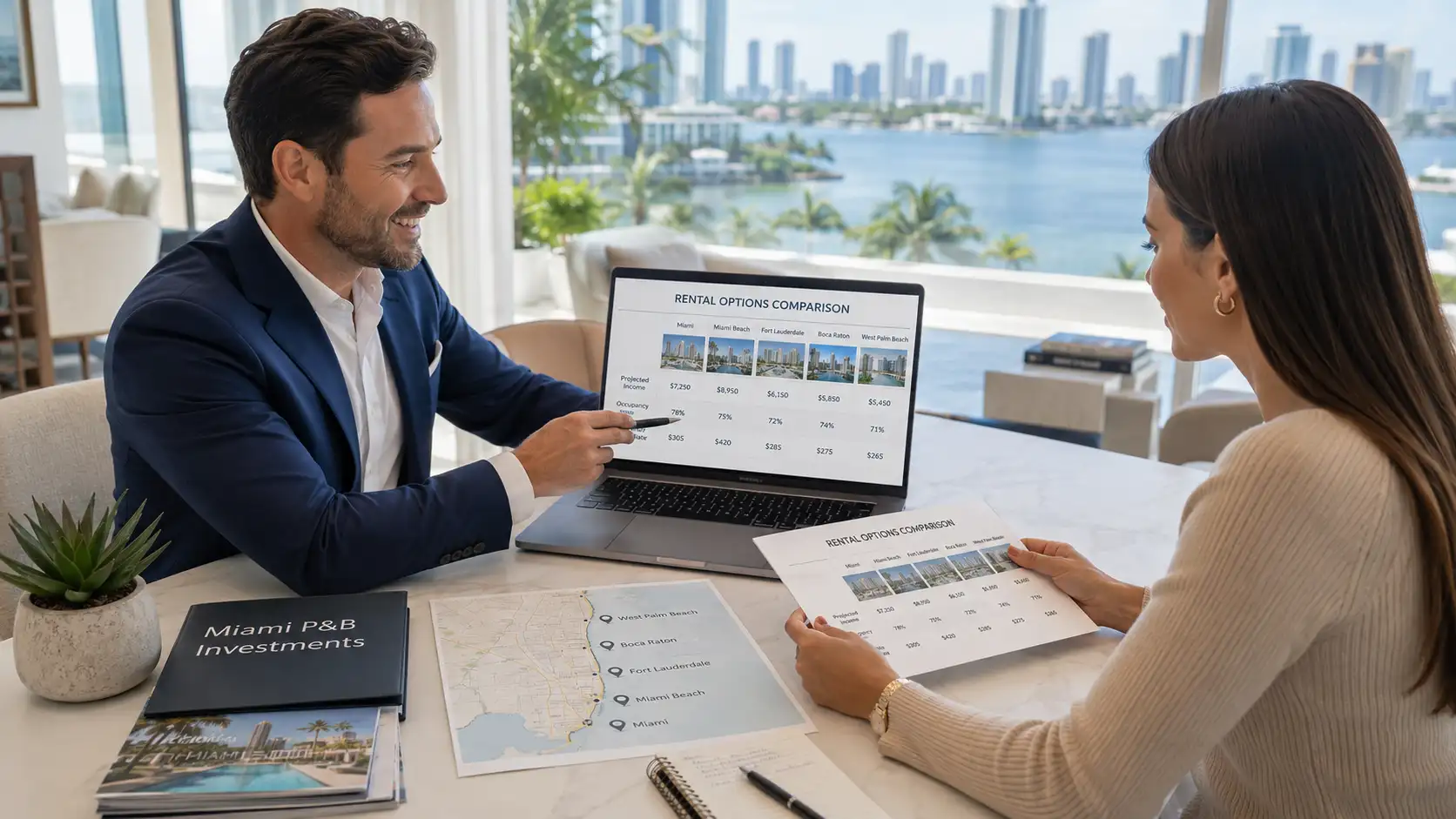
Seventh, plan operations before closing. Know who will manage guests, maintenance, emergencies, and compliance.
This process makes Florida short-term rental laws much less intimidating because each step answers one practical question.
Build the Right Miami Rental Strategy With Miami P&B Investments
Florida short-term rental laws are not a reason to avoid Miami or South Florida real estate. They are a reason to buy with better information.
The right property can still offer lifestyle value, rental income, U.S. dollar exposure, and long-term appreciation potential. But the right property is not always the one with the flashiest revenue projection. It is the one where the legal use, building rules, location, insurance, taxes, management, and exit plan all work together.
That is where local guidance matters.
Miami P&B Investments helps buyers compare properties, review investment potential, understand rental strategy, and coordinate the practical support needed after closing. Whether you are looking at condos, single-family homes, duplexes, pre-construction opportunities, or long-term rental assets, the team can help you evaluate the deal from both a real estate and ownership-management perspective.
Explore real estate investment services, review available Miami and South Florida listings, or learn more about support for accounting, legal coordination, construction, and ongoing property care.
If you want a Miami or South Florida property that can support your rental goals with fewer surprises, start with a clear plan. Then work with a team that understands the local rules, the Canadian buyer perspective, and the details that protect your investment.
To discuss your goals, use the Miami P&B Investments contact page and request guidance before you buy.