A Florida home inspection checklist can protect you from buying a property that looks excellent in listing photos but carries expensive problems behind the finishes. For Canadian buyers purchasing in Miami or elsewhere in South Florida, the inspection also affects insurance, financing, renovation planning, cash flow, and how confidently you can manage the property from another country.
If you are still learning the buying process, start with Miami P&B Investments’ step-by-step guide for Canadians buying property in Miami. Then use this Florida home inspection checklist once you have a specific home, townhome, or condo under serious consideration.
Why a Florida Home Inspection Checklist Matters in South Florida
Florida home inspections are not designed to guarantee that a property is perfect. Under Florida law, a home inspection is a limited visual examination of readily accessible systems and components, including the structure, electrical system, HVAC, roof covering, plumbing, interiors, exteriors, and site conditions that affect the structure. You can review the state definition in the Florida home inspector statute.
That limitation matters. A Florida home inspection checklist helps you organize what a general inspector can evaluate, what may need a specialist, and what must be verified through documents rather than a visual walkthrough.
For Canadians, the stakes can be higher because you may be evaluating the property remotely. Miami P&B Investments’ Canadian investor resource hub is built around that cross-border reality: you need clear numbers, reliable local information, and a process that reduces surprises after closing.
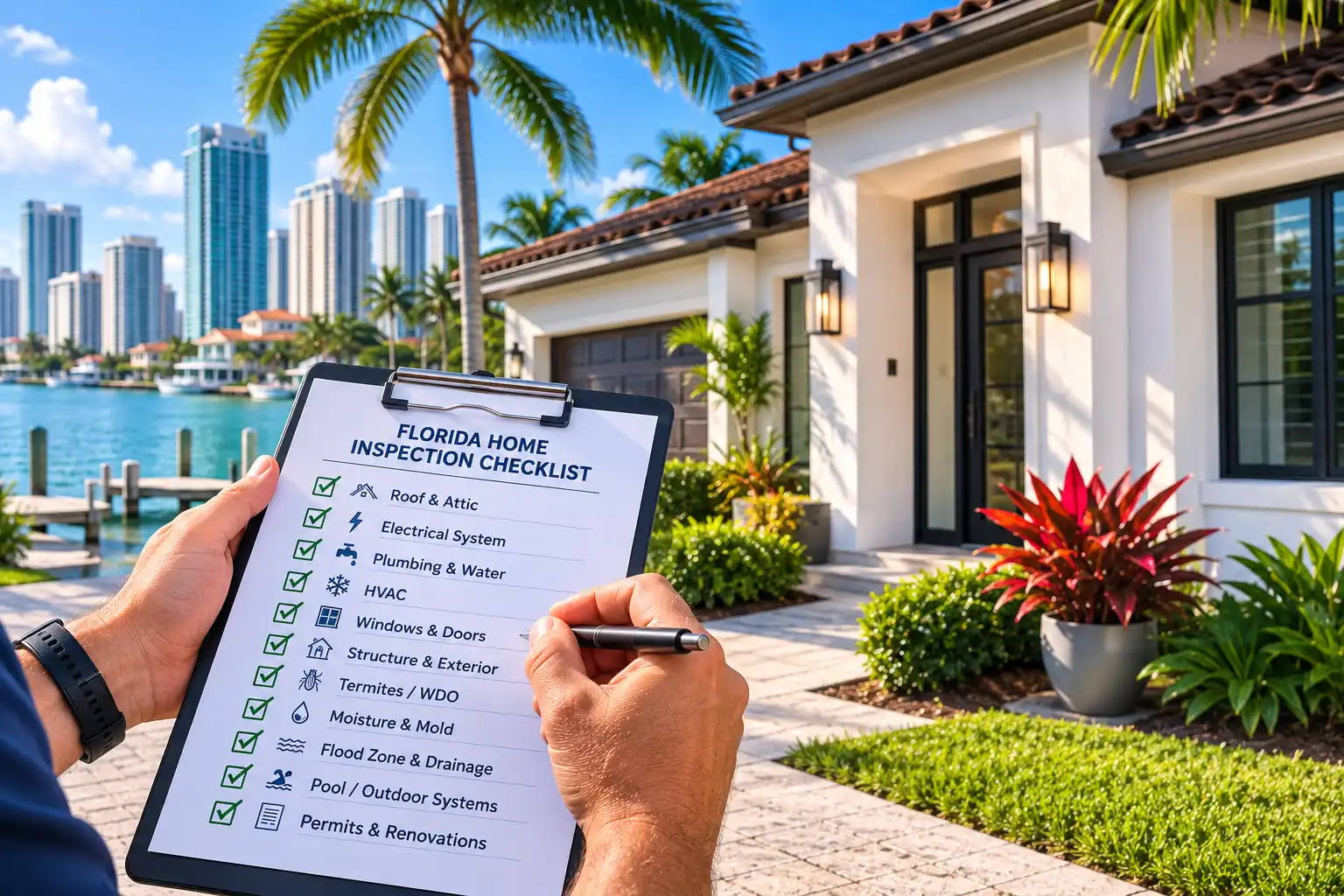
Florida Home Inspection Checklist: 11 Essential Checks Before You Buy
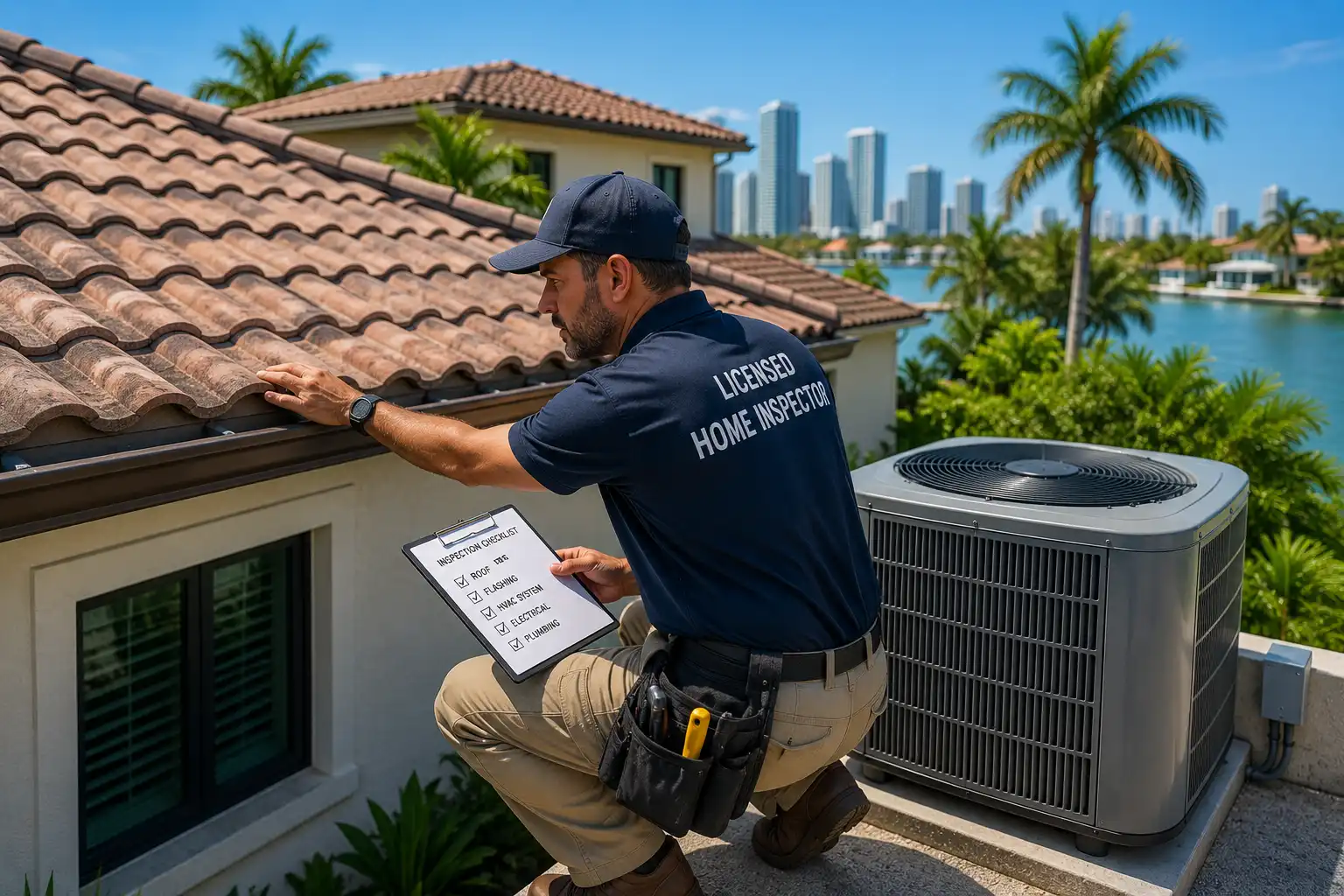
Use the following Florida home inspection checklist as a decision tool, not as a substitute for a licensed professional. The goal is to know what deserves attention before your inspection period or other contractual deadlines expire.
1. Start with the roof and attic
In South Florida, the roof affects far more than appearance. Ask the inspector to document the roof covering, visible deterioration, flashing, penetrations, signs of active or past leaks, and accessible attic conditions.
Confirm the approximate roof age separately through seller records, permits, invoices, or other available documentation. A roof that is still functioning may nevertheless create insurance or budgeting questions if it is near the end of its expected service life.
Your Florida home inspection checklist should also ask whether there are signs of prior repairs that deserve a roofer’s opinion. If insurance costs are a concern, compare the inspection findings with Miami P&B Investments’ guide to Miami property insurance costs.
2. Review the electrical system for safety and insurability
The general inspection should identify the visible electrical panel, breakers, accessible wiring, outlets, switches, and obvious safety concerns. Pay attention to signs of amateur modifications, overheating, corrosion, missing covers, damaged receptacles, or systems that appear inconsistent with the age of the property.
Do not assume a working light switch means the entire electrical system is fine. Older homes, converted spaces, additions, and heavily renovated properties may deserve review by a licensed electrician.
A strong Florida home inspection checklist separates cosmetic issues from conditions that could affect safety, repair cost, or an insurer’s willingness to write coverage.
3. Check plumbing for leaks, age, and water damage
Look beyond whether the faucets run. The inspector should check visible supply and drain components, fixtures, water heaters, accessible shutoffs, water pressure concerns, and evidence of leakage.
Water stains under sinks, around showers, beneath windows, near the water heater, or on ceilings deserve follow-up. Small leaks can create larger moisture problems when they continue unnoticed in a warm, humid climate.
For remote owners, your Florida home inspection checklist should also identify the main water shutoff and any areas that may need monitoring when the property is vacant for part of the year.
4. Inspect HVAC performance and moisture control
Air conditioning is a core operating system in South Florida. Ask about the apparent age and condition of the air handler and condenser, visible corrosion, condensate drainage, accessible ductwork, thermostat operation, and signs of deferred maintenance.
The Florida home inspection checklist should treat HVAC as both a comfort system and a moisture-control system. Poor drainage, blocked condensate lines, weak cooling performance, or excessive indoor humidity can contribute to recurring maintenance issues.
If the system is old, noisy, poorly maintained, or showing signs of malfunction, get a licensed HVAC contractor to estimate repair or replacement before you finalize your budget.
5. Examine windows, doors, and storm protection
Check that windows and exterior doors open, close, lock, and seal properly. Look for water staining, damaged frames, failed seals, corrosion, cracked glass, and signs of previous leaks.
Ask what storm protection is actually present. Impact-rated windows, shutters, or other systems should be supported by documentation when possible rather than assumptions based on appearance.
This part of the Florida home inspection checklist can connect directly to wind-mitigation and insurance conversations. Florida’s Department of Financial Services provides consumer guidance on home inspections and four-point inspections, which can help buyers understand how insurance-focused inspections differ from a full property inspection.
6. Look closely at structure, exterior walls, and drainage
Inspect visible foundations, slabs, exterior walls, stucco, balconies or decks where applicable, grading, drainage, and areas where water can collect against the structure.
Not every crack is a structural failure. However, widening cracks, repeated patching, displaced finishes, doors that do not operate properly, or moisture entering through exterior walls may justify specialist review.
A Florida home inspection checklist is most useful when it flags uncertainty early. If the general inspector sees something outside the scope of a normal visual inspection, bring in the right engineer, contractor, roofer, or other specialist before closing.
7. Look for termites and other wood-destroying organisms
Florida’s climate is favorable to termites, and a standard home inspection should not be treated as a substitute for a pest inspection. The Florida Department of Agriculture and Consumer Services recommends licensed pest professionals for termite inspection and treatment and notes that homeowners insurance generally does not cover termite damage. Its termite consumer guidance is a useful reference.
Watch for damaged wood, unexplained pellets, mud tubes, moisture-damaged trim, hollow-sounding wood, or prior treatment evidence.
If the property contains significant wood framing, decks, older trim, or previous moisture problems, add a licensed WDO inspection to your Florida home inspection checklist rather than relying on visual impressions alone.
8. Investigate moisture and visible mold conditions
South Florida properties deserve a deliberate moisture review. Look for musty odors, staining, swollen baseboards, damaged drywall, condensation, leaking air-conditioning components, roof leaks, plumbing leaks, and water intrusion around windows or doors.
Visible mold-like growth should be taken seriously, but sampling is not automatically the first step in every case. The more important question is what moisture source allowed the condition to develop and whether the source has been corrected.
Your Florida home inspection checklist should focus on cause, extent, repair history, and whether a licensed mold assessor or other specialist is appropriate for the specific condition.
9. Check flood exposure and waterfront features separately
A general inspector does not replace flood-risk due diligence. Use the FEMA Flood Map Service Center to review official flood hazard information for the property, then confirm insurance requirements and practical site conditions with the appropriate professionals.
For a house near canals, bays, or the Intracoastal, ask whether the seawall, dock, drainage system, or waterfront improvements need specialist evaluation. For condos, remember that a high-floor unit can still be affected by building-level flood exposure through garages, electrical rooms, elevators, mechanical systems, and common areas.
Miami P&B Investments’ guide to Miami flood zones can help you connect flood information to the wider ownership-cost picture.
10. Inspect pools, outdoor systems, and property-specific extras
Pools, spas, irrigation systems, generators, outdoor kitchens, docks, lifts, gates, and other specialty features can add meaningful repair costs. Do not assume the general inspection includes a detailed specialist evaluation of every accessory.
Ask which systems were inspected, which were excluded, and what deserves a separate opinion. A pool that appears clean can still have aging pumps, leaks, damaged finishes, heater problems, or electrical concerns.
The Florida home inspection checklist should match the actual property. A waterfront house with a pool and dock needs a different specialist plan than a newer inland townhome.
11. Match renovations and additions to available records
Fresh renovations can improve value, but they can also hide unanswered questions. Ask when major work was completed, who performed it, and whether permits or final inspections are available where required.
Pay particular attention to enclosed patios, converted garages, added bathrooms, electrical upgrades, new roofs, structural changes, HVAC replacements, and major plumbing work.
A Florida home inspection checklist cannot prove that every renovation was properly permitted. Use the inspection report to identify what needs documentary verification, then check the appropriate county or municipal records before treating the work as fully resolved.
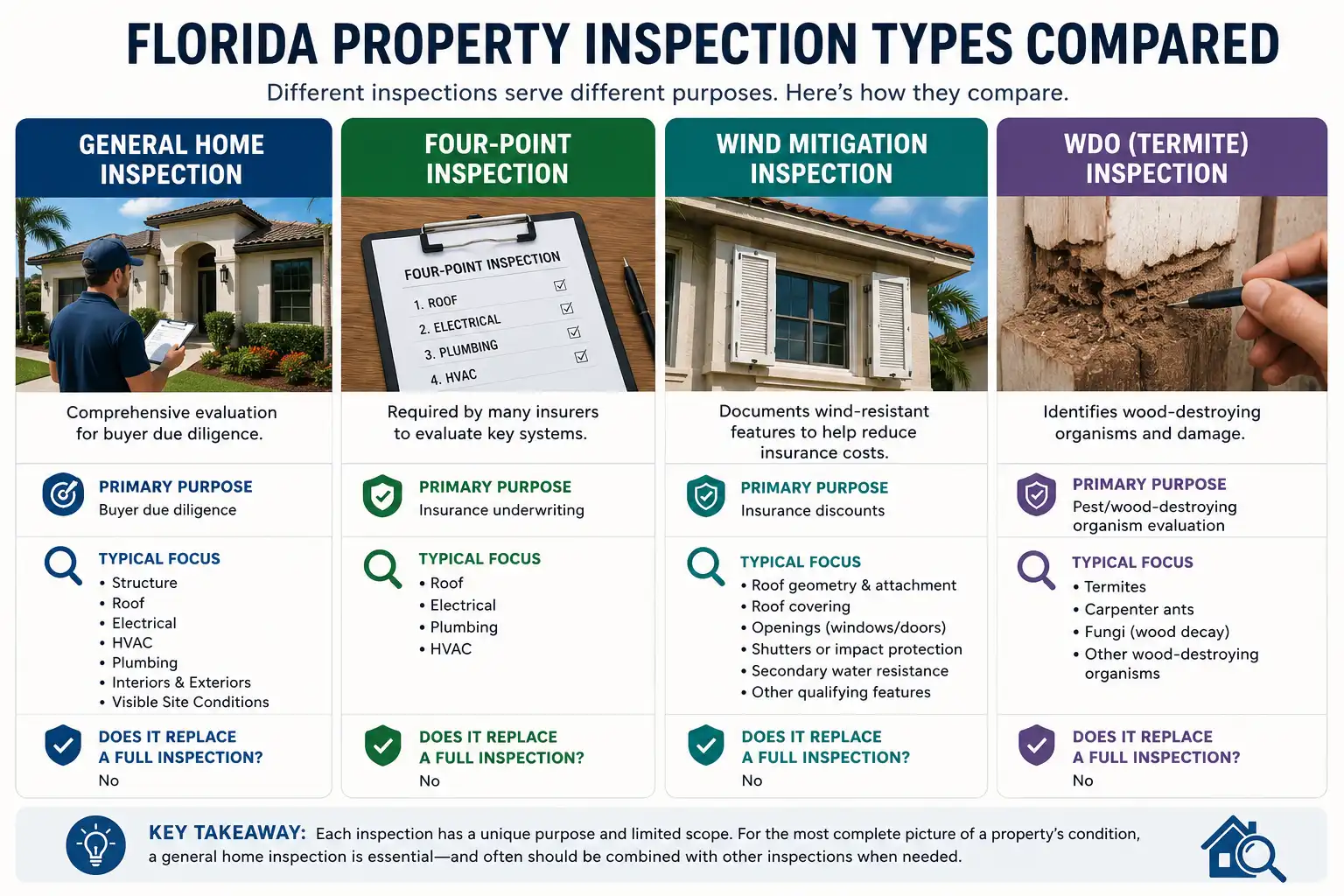
General Inspection vs. Four-Point, Wind Mitigation, and WDO
Buyers often hear several inspection terms at once. They are not interchangeable.
| Inspection type | Primary purpose | Typical focus | Does it replace a full inspection? |
|---|---|---|---|
| General home inspection | Buyer due diligence | Structure, roof, electrical, HVAC, plumbing, interiors, exteriors, visible site conditions | No |
| Four-point inspection | Insurance underwriting in many cases | Roof, electrical, plumbing, HVAC | No |
| Wind mitigation inspection | Documents wind-resistant features | Roof geometry and attachment, openings, shutters or impact protection, other qualifying features | No |
| WDO inspection | Pest/wood-destroying organism review | Termites and other wood-destroying organisms | No |
A complete Florida home inspection checklist may include more than one of these depending on the property, insurer, lender, age, and location. The cheapest approach is not always the lowest-risk approach.
Is a four-point inspection the same as a full home inspection?
No. A four-point inspection is narrower and is commonly used by insurers to evaluate four major systems. A full inspection is broader and is designed to give the buyer a more complete visual assessment of the property.
If an insurance agent requests a four-point report, do not treat that request as evidence that the full Florida home inspection checklist is unnecessary.
Does a condo inspection cover the entire building?
No. Florida’s statutory definition of a home can include a condominium unit, but it specifically excludes condominium common areas from the home-inspection definition.
That means a condo buyer needs two layers of due diligence: the unit inspection and the building review. Use the unit inspection alongside Miami P&B Investments’ Florida condo documents checklist to review reserves, insurance, rules, assessments, inspections, minutes, and other association-level issues.
What should you do when the inspection finds problems?
Do not react to the number of items on the report alone. Most reports contain a mix of minor maintenance, safety concerns, aging components, and issues that deserve specialist estimates.
Sort findings into four buckets: immediate safety, insurance or financing risk, near-term capital expense, and routine maintenance. Then price each meaningful issue before making a decision.
A Florida home inspection checklist works best when it turns observations into numbers, responsibilities, and next steps.
How Canadian Buyers Should Use the Inspection Results
For Canadian buyers, inspection findings should flow into a full ownership budget. Convert expected repairs into U.S. dollars first, then stress-test the cost in Canadian dollars so currency movement does not hide the true impact.
Get insurance quotes early when roof age, electrical condition, flood exposure, or wind protection may affect coverage. If the inspection identifies repairs, obtain estimates before assuming a seller credit or price reduction will cover the work.
Use specialists selectively. A general inspector is the first filter, not the final expert for every system. If the report identifies a structural concern, roofing issue, seawall defect, mold condition, electrical problem, or HVAC failure, the right specialist can turn uncertainty into a usable number.
Your Florida home inspection checklist should end with a simple decision: after repairs, insurance, taxes, HOA costs, financing, and expected maintenance, does this property still fit your goals?
Turn Inspection Findings Into a Smarter South Florida Purchase
A Florida home inspection checklist is most valuable when it is connected to the rest of the buying process. The inspection tells you what may be wrong; the next step is deciding what the findings mean for price, renovation, insurance, and long-term ownership.
Miami P&B Investments can help Canadian and international buyers coordinate the broader real estate process through its South Florida real estate services. If a property needs renovation or repair planning, the company also offers construction services for South Florida properties.
The goal of this Florida home inspection checklist is not to find a property with zero imperfections. It is to understand the property well enough to buy with clear expectations. If you are comparing homes or condos and want local support before making an offer, contact Miami P&B Investments to discuss your South Florida buying strategy.