
US estate tax for Canadians is easy to overlook when you are focused on Miami prices, rental income, financing, and the CAD-to-USD exchange rate. But for a Canadian investor buying a condo, home, or rental property in South Florida, estate-tax planning can affect how you take title, how your family inherits the property, and how smoothly the asset can be transferred later.
That does not mean a Miami purchase automatically creates an estate-tax bill. It means the issue should be reviewed before closing rather than after. Miami P&B Investments’ Canadian investor resource hub is a useful starting point for the broader cross-border buying process, while tax and legal advice should be tailored to your own circumstances.
What US Estate Tax for Canadians Actually Means for a Miami Buyer
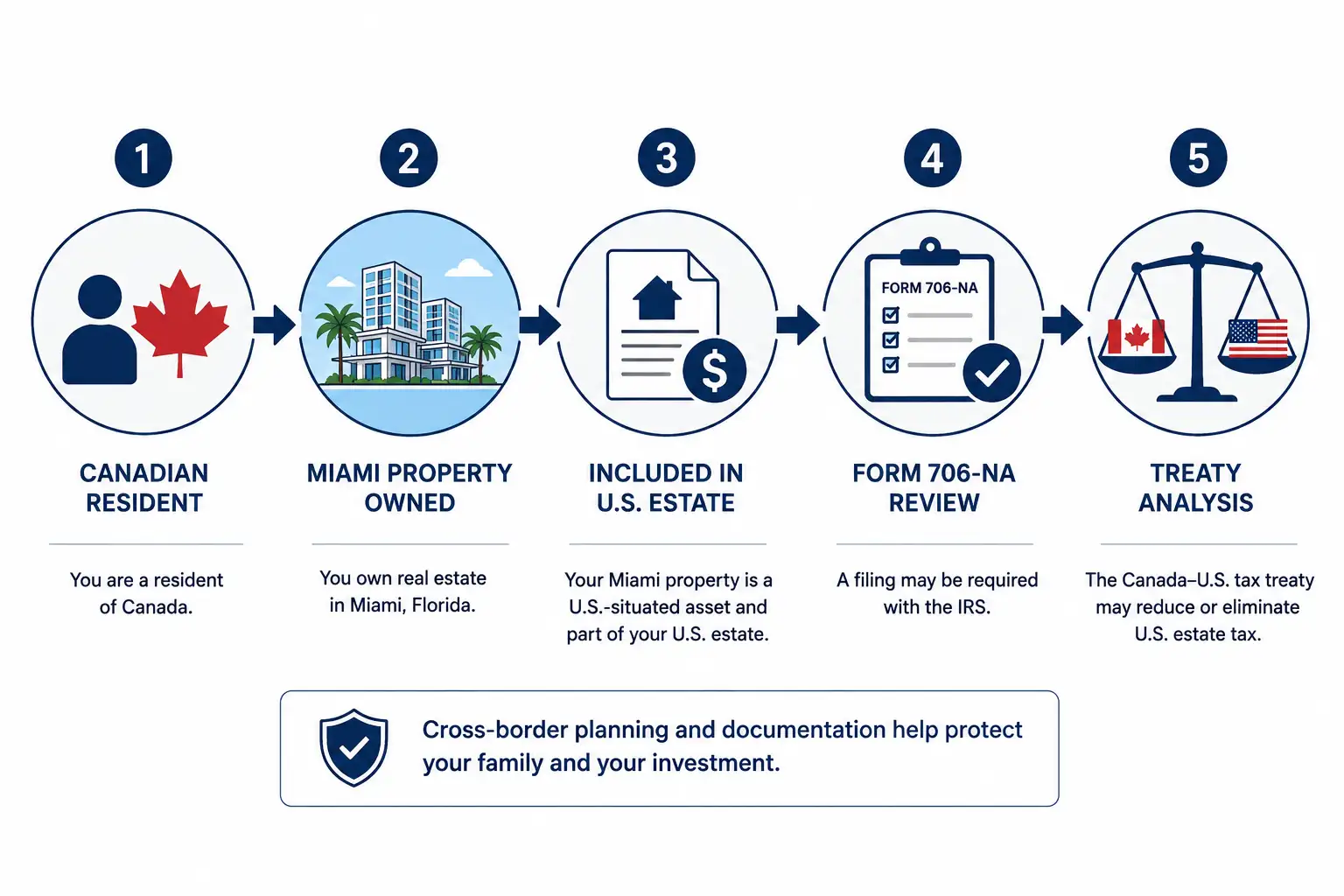
US estate tax for Canadians is a federal issue, not a Florida state estate tax. Florida currently does not impose a state-level estate tax on people who died after December 31, 2004. However, the United States can still impose federal estate tax on certain U.S.-situated assets owned by a person who was neither a U.S. citizen nor domiciled in the United States at death.
A Miami condo, single-family home, or investment property is U.S. real estate, so it is generally a U.S.-situated asset for federal estate-tax purposes. That is why a Canadian buying property in Miami should think beyond purchase price and rental projections.
If you are also a U.S. citizen, hold a green card, or have facts that could make you U.S.-domiciled for estate-tax purposes, the analysis can change. Residency for income-tax purposes and domicile for estate-tax purposes are not always the same.
The IRS guidance for nonresident noncitizens explains that U.S. real estate can be included in the U.S.-situated gross estate. The estate is generally valued at fair market value at the date of death, not at the original purchase price.
Does the $60,000 threshold mean a Canadian will owe estate tax?
No. This is one of the most important distinctions in US estate tax for Canadians.
The IRS uses a $60,000 filing threshold for Form 706-NA when a nonresident noncitizen dies owning U.S.-situated assets, subject to the form’s detailed rules. That $60,000 figure is not the same thing as saying tax is automatically due once a Miami property is worth more than $60,000.
The Form 706-NA instructions separate the filing requirement from the actual tax calculation. For many Canadian residents, the Canada-U.S. tax treaty can provide significant relief. The practical lesson is simple: filing exposure and tax exposure are related, but they are not identical.
7 Costly Mistakes to Avoid Before You Buy

A strong plan for US estate tax for Canadians starts before the deed is recorded. These seven mistakes are especially important for Canadian investors comparing Miami condos, rental properties, and second homes.
1. Assuming “Florida has no estate tax” means there is no estate-tax issue
Florida’s lack of a state estate tax is a real advantage, but it does not erase U.S. federal rules. The Florida Department of Revenue confirms that Florida’s state estate tax was eliminated for deaths after December 31, 2004.
For US estate tax for Canadians, the federal layer is the one that matters. If you are buying in Brickell, Edgewater, Aventura, Miami Beach, or elsewhere in South Florida, the location inside Florida does not remove the property from the federal U.S.-situs analysis.
2. Treating $60,000 as the amount you can own “tax free”
The $60,000 number is commonly misunderstood. For US estate tax for Canadians, it is primarily a Form 706-NA filing threshold under the federal nonresident rules, not a simple tax-free property allowance.
That matters because a Canadian could own a Miami property worth far more than $60,000 and still have little or no federal estate tax after treaty relief, depending on the person’s worldwide estate, ownership structure, deductions, and other facts. The opposite can also be true for a high-net-worth investor whose U.S. assets represent a meaningful portion of a large global estate.
3. Looking only at the Miami property value
The Canada-U.S. treaty makes worldwide wealth relevant. In 2026, the U.S. basic exclusion amount is $15 million. Under Article XXIX B of the Canada-U.S. tax treaty, a qualifying Canadian resident’s estate may receive a prorated unified credit based in part on the ratio of U.S.-situated assets to the worldwide gross estate.
That is why US estate tax for Canadians cannot be estimated accurately from the Miami condo price alone. A $1 million property may create a very different result for someone with a $4 million worldwide estate than for someone with a $25 million worldwide estate.
4. Assuming treaty relief happens automatically
Treaty protection can be powerful, but it is not something heirs should discover for the first time after a death. The estate may need to file Form 706-NA, disclose worldwide asset values, document the treaty position, and provide supporting records.
For US estate tax for Canadians, good documentation is part of the plan. Keep clear records of the purchase price, improvements, debt, ownership percentages, appraisals, entity documents if applicable, and major changes to the property.
5. Choosing an ownership structure only because someone said “use an LLC”
An LLC can be useful for liability, management, or business reasons, but it is not automatically the best structure for every Canadian. U.S. and Canadian tax treatment can differ, and the structure that works well for a U.S. investor may create unwanted complexity for a Canadian resident.
Before changing title or forming an entity, review Miami P&B Investments’ guide to buying property in Florida through an LLC and coordinate the decision with qualified cross-border tax and legal professionals. For US estate tax for Canadians, ownership structure should be analyzed alongside income tax, liability, financing, succession, and eventual sale planning.
6. Ignoring what happens if the property passes to a spouse
Married Canadian buyers often focus on who should be on title but not on what happens at the first death. The Canada-U.S. treaty contains a marital-credit mechanism that can be important when qualifying property passes to a surviving spouse.
This is one reason US estate tax for Canadians should be considered together with wills, title, beneficiary planning, and the couple’s broader estate plan. The right answer can change based on citizenship, residence, domicile, property use, ownership percentage, and the value of each spouse’s assets.
7. Waiting until heirs need to sell the property
Estate administration can create timing issues even when the final tax liability is low or zero. Depending on the facts, an estate may need IRS filings or a federal transfer certificate before certain U.S. assets can be released or transferred.
That makes liquidity and recordkeeping part of US estate tax for Canadians, not just the tax calculation itself. A property that is easy to buy today should also have a practical succession plan for tomorrow.
How the Canada-U.S. Treaty Changes US Estate Tax for Canadians
The treaty is the reason many Canadian residents should not panic when they first see the $60,000 filing threshold.
For US estate tax for Canadians, Article XXIX B can allow a Canadian resident’s estate to claim a proportionate share of the U.S. unified credit. In simplified terms, the U.S. credit is linked to the share of the worldwide estate represented by U.S.-situated assets.
For example, imagine a Canadian resident who is not a U.S. citizen owns a Miami investment property representing 10% of the person’s worldwide gross estate. The treaty calculation may allow access to a corresponding proportion of the U.S. citizen unified credit.
That does not mean every 10% scenario produces the same tax result. Debts, deductions, marital provisions, prior gifts, ownership, and other assets can change the calculation.
The key point is that US estate tax for Canadians is usually a cross-border calculation, not a simple percentage of the Miami property’s value.
Could the estate owe no U.S. estate tax and still have a filing obligation?
Yes. That is possible.
If the U.S.-situated assets exceed the Form 706-NA filing threshold, the estate may still need to file even when treaty relief ultimately reduces the U.S. estate tax to zero. Filing can be necessary to claim treaty benefits and document the estate’s position.
This is why Canadian investors should not use “no tax expected” as a substitute for planning.
Does Florida charge a separate estate tax?
For current purchases, Florida does not impose a separate state estate tax for deaths after December 31, 2004. US estate tax for Canadians remains a federal and treaty-planning issue.
That distinction is useful when comparing Miami with jurisdictions that impose their own estate or inheritance taxes, but it should not be interpreted as meaning that succession planning is unnecessary.
Pre-Purchase US Estate Tax for Canadians Checklist

Before making an offer, use this checklist to identify the questions that should be answered. It is not a substitute for individualized legal or tax advice, but it helps you know what information your advisers will need.
| Planning item | What to review before closing | Why it matters |
|---|---|---|
| Worldwide estate estimate | Approximate value of Canadian, U.S., and other assets | Treaty relief may depend on worldwide values |
| Miami property budget | Purchase price, expected appreciation, debt, and ownership share | Future value can change U.S.-situs exposure |
| Title and ownership | Personal name, joint ownership, entity, or trust options | Structure can affect tax, liability, succession, and reporting |
| Spouse and heirs | Who should inherit and how title should pass | Treaty marital provisions and estate administration may matter |
| Financing | Mortgage amount, lender rules, and debt structure | Debt can affect cash flow and may affect estate calculations |
| Canadian tax impact | Income, capital gains, foreign reporting, and estate consequences | U.S. planning should not be done in isolation from Canada |
| Records | Deed, closing statement, improvements, appraisals, entity documents | Strong records help future filings and valuation |
| Professional review | Cross-border accountant and Florida legal counsel | Major structure changes are easier before closing than after |
US estate tax for Canadians should be one line on a broader acquisition checklist that also includes financing, title, insurance, condo documents, rental restrictions, taxes, and property management. Miami P&B Investments’ real estate services can help coordinate the property side while specialized advisers handle the tax and legal analysis.
When Should Estate-Tax Planning Change Your Miami Buying Strategy?
Not every Canadian buyer needs an elaborate structure, but US estate tax for Canadians should still be screened before title is finalized. The level of planning should match the size and complexity of the investment.
A Canadian with a moderate worldwide estate buying one Miami condo may find that treaty relief substantially limits federal estate-tax exposure. The main priorities may be correct title, good records, a coordinated will, and a clear filing plan.
A higher-net-worth Canadian investor building a portfolio of multiple U.S. properties may need a deeper analysis. As the U.S.-situs portion of the worldwide estate grows, US estate tax for Canadians can become more material, especially when properties appreciate over time.
A Canadian couple buying for mixed personal and rental use may have different priorities again. They may care about succession, marital planning, financing, liability, rental-income reporting, and ease of management from Canada.
The common rule is to structure first and close second. Miami P&B Investments offers access to legal support and accounting support for investors who need to coordinate the real estate transaction with cross-border professionals.
Plan Your Miami Purchase Before You Sign
US estate tax for Canadians should not stop a well-planned Miami investment. It should help you ask better questions before you commit capital.
Start by defining the property’s purpose, your expected holding period, who will own it, who should inherit it, and how the purchase fits into your worldwide estate. Then compare those answers with financing, tax, legal, and management requirements before the deed is recorded.
Miami P&B Investments helps Canadian buyers evaluate properties, coordinate local due diligence, and connect the purchase process with the professionals needed for cross-border ownership. If you are considering a condo, rental property, second home, or larger investment in South Florida, contact Miami P&B Investments to build the property strategy before you close.