
Florida condo SIRS compliance is now a core due-diligence issue for Canadians buying in Miami and South Florida. The view, price and amenities still matter, but a buyer also needs to know whether the association has completed required reserve work, what the building’s structural reports say, and how those findings could affect fees, assessments and financing.
For a Canadian buyer working from Toronto, Montreal, Vancouver, Calgary or elsewhere, the risk is magnified by distance and currency. That makes Florida condo SIRS compliance a practical purchase-screening issue, not just an association-law detail. A surprise US$40,000 assessment is not just a building problem; it is a cross-border cash-flow problem.
Start by pairing the association’s SIRS and milestone reports with Miami P&B Investments’ Florida condo documents checklist rather than reviewing any one document in isolation.
What Florida Condo SIRS Compliance Means in 2026
A Structural Integrity Reserve Study, or SIRS, is a reserve-planning study for covered condominium buildings. It is based on a visual inspection of specified building components and estimates remaining useful life, replacement or deferred-maintenance costs, and a funding schedule.
Florida condo SIRS compliance generally matters to residential condominium associations with buildings that are three habitable stories or higher. Florida law excludes certain smaller residential structures and components that are not maintained by the association. Covered residential condominiums must complete a SIRS at least every 10 years after creation.
For associations that existed on or before July 1, 2022 and were controlled by unit owners rather than the developer, the standard deadline to complete the initial SIRS was December 31, 2025. An association required to complete a milestone inspection on or before December 31, 2026 may complete the SIRS at the same time, but the study cannot be pushed beyond December 31, 2026 under that coordination rule.
The current Florida DBPR SIRS reporting database should be a buyer’s starting point, not the finish line. Florida requires associations to report completed studies, but buyers should still request the actual study, budget, board minutes and repair plan.
Is the 47.6% Miami-Dade compliance figure still current?
No. Treat it as a historical warning sign, not a 2026 compliance rate.
A February 24, 2025 snapshot showed 787 of 1,653 tracked Miami-Dade condominium buildings had reported completion of a SIRS, or 47.6%. That was before the main December 31, 2025 deadline.
The useful lesson is that Florida condo SIRS compliance was uneven during the transition, so a buyer should verify the specific building today instead of relying on an old countywide percentage. For buyers in 2026, Florida condo SIRS compliance is a building-specific fact to confirm, not a market-wide assumption.
SIRS vs. Florida Condo Milestone Inspection
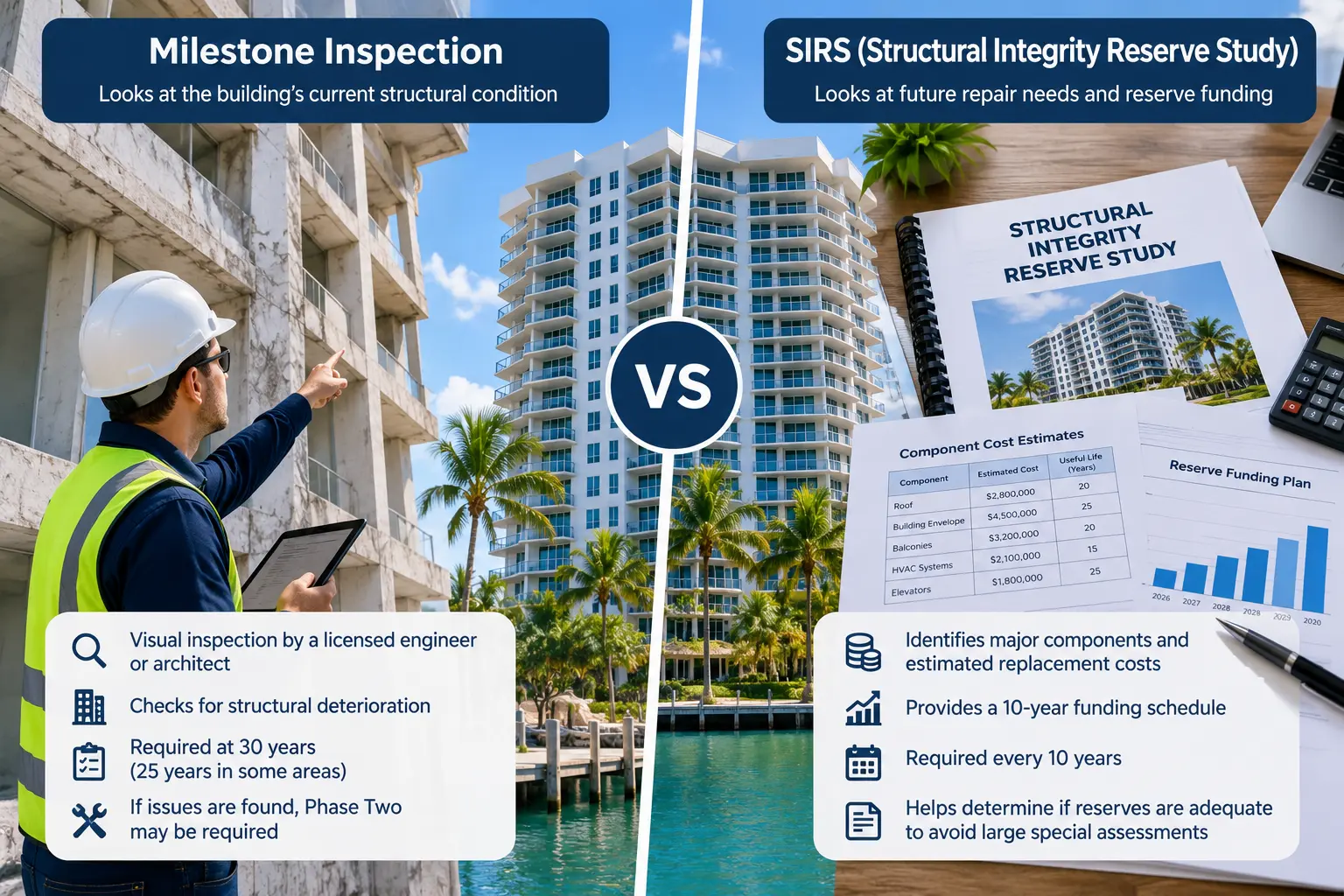
Florida condo SIRS compliance and a milestone inspection answer different questions. The SIRS asks, in practical terms, what major components will cost over time and how the association should fund them. A milestone inspection asks whether an aging building shows substantial structural deterioration and whether deeper investigation or repairs are required.
Florida’s milestone inspection law under Section 553.899 generally applies to condominium and cooperative buildings that are three habitable stories or higher when they reach 30 years of age, with inspections every 10 years after that.
A local enforcement agency may require the first milestone inspection at 25 years when local conditions justify an earlier review. That is more precise than the common shorthand that every coastal building automatically shifts to 25 years; buyers should verify the local enforcement agency’s actual requirement.
Phase One is a visual examination by a Florida-licensed architect or engineer. If no substantial structural deterioration is identified, Phase Two is not required.
If substantial structural deterioration is found, Phase Two may use destructive or nondestructive testing to define the problem and recommend the needed repair program.
| Document | Main question it answers | What a Canadian buyer should verify |
|---|---|---|
| SIRS | What major building components need future funding? | Completion date, component costs, remaining useful life, annual funding schedule |
| Milestone inspection | Is there substantial structural deterioration? | Phase One result, whether Phase Two was triggered, repair recommendations, timelines |
| Association budget | Is the funding plan actually being implemented? | Reserve contributions, loans, assessment income, rising monthly dues |
| Board minutes | What is the association discussing now? | Repair bids, owner votes, financing plans, delays, disputes and new assessments |
Read Miami P&B Investments’ Florida condo milestone inspection guide for a deeper explanation of the inspection process, then compare it with the Florida condo reserve requirements guide so the engineering and money sides of the building tell the same story.
Why Florida Condo SIRS Compliance Can Change Your Real Cost
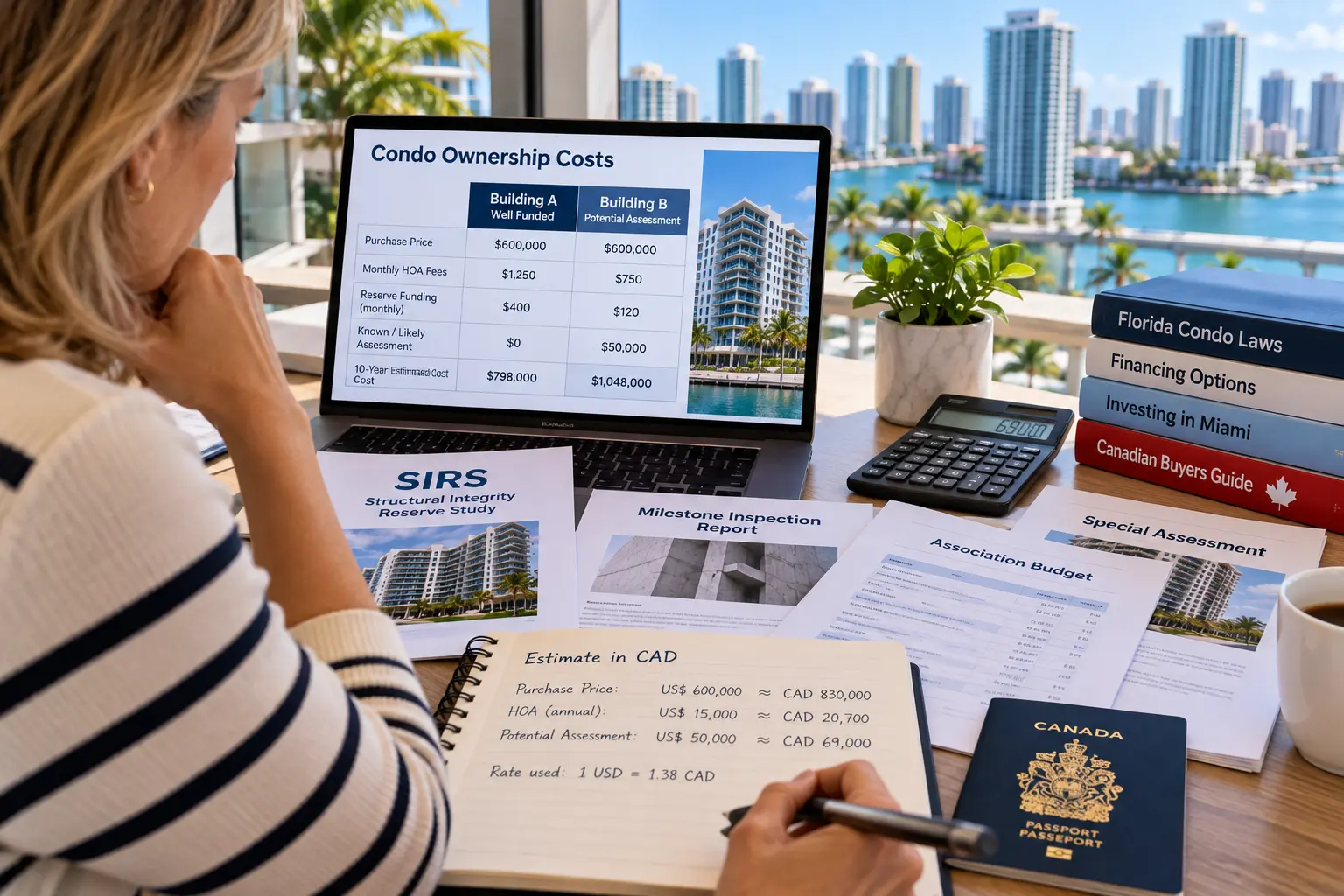
The SIRS itself does not create a special assessment. It reveals future repair and replacement needs and recommends a funding path. If the association has not saved enough, however, owners still have to close the gap.
That can happen through higher regular dues, a special assessment, permitted borrowing, or a combination of funding methods. This is why Florida condo SIRS compliance should be reviewed next to the association’s current cash balance and approved budget, not treated as a simple yes-or-no certificate.
Consider a Canadian buyer comparing two US$600,000 condos.
Building A charges higher monthly dues but has completed its study, is funding reserves, and has already addressed near-term concrete work. Building B has lower dues, a thin reserve balance and a large roof and waterproofing requirement inside the next few years.
Building B may look cheaper on the listing portal. It may be more expensive after closing.
For a Canadian paying expenses in U.S. dollars, the CAD/USD exchange rate can magnify every increase. A US$30,000 owner obligation becomes more painful if the Canadian dollar weakens between the offer date and the payment deadline.
Miami P&B Investments’ guide to Florida condo special assessments is useful for stress-testing that risk.
Does a completed SIRS mean the building is financially safe?
No. Florida condo SIRS compliance is a starting point, not a guarantee.
A completed study can still reveal expensive work. The association can still face insurance increases, owner delinquencies, litigation or a large funding shortfall.
A buyer should ask whether the board adopted the recommended funding approach, whether any repair bids exceed the study estimates, and whether a loan or special assessment has already been discussed.
The better question is not “Does the building have a SIRS?” It is “What does the SIRS require, and how is the association paying for it?”
7 Checks Canadian Buyers Should Make Before Closing
1. Verify Florida Condo SIRS Compliance Directly
Ask for the full SIRS and confirm the association’s reporting status with Florida DBPR. Check the date, professional credentials, buildings covered and whether an updated or amended study exists.
If the association says the study is being coordinated with a milestone inspection due in 2026, ask for the contract, expected completion timeline and any notices from the local enforcement agency.
Florida condo SIRS compliance should be documented, not explained only in a phone call.
2. Read the Milestone Report for Repair Language
Look for substantial structural deterioration, unsafe conditions, recommended repairs and items requiring further inspection.
If Phase Two was triggered, ask what has been completed, what remains open and when repairs must begin.
A clean lobby does not answer any of those questions.
3. Match the Reports to the Budget
Florida condo SIRS compliance matters financially only when you connect the study to the budget. Compare recommended reserve contributions with the adopted budget and current reserve balances.
Then review recent board minutes. If the SIRS calls for major waterproofing and the minutes discuss bids, loans or an owner vote, you are seeing the future cost structure take shape.
Use Miami P&B Investments’ Florida condo questionnaire guide to make sure the same issues are disclosed consistently across lender and association documents.
4. Ask About Special Assessments Before They Are Approved
Do not limit the question to “Is there a current special assessment?”
Ask whether the board has discussed, proposed, budgeted or received bids for projects that could require one.
A US$50,000 assessment announced after closing has a different effect on a Canadian buyer than a US$50,000 assessment identified before contract, when price and assessment responsibility may still be negotiated.
5. Screen Financing Early, Even If You Could Pay Cash
Florida condo SIRS compliance can affect the financing conversation indirectly through structural condition, inspection status, reserves and special assessments.
A missing SIRS does not automatically make every condo non-warrantable under every loan program. But Fannie Mae’s current condo-project rules treat projects needing critical repairs, including certain failures of mandatory structural inspections, as ineligible, and lenders may need inspection reports, reserve studies and assessment information to complete project review.
That matters even to cash buyers because future purchasers may need financing. Review Miami P&B Investments’ guide to non-warrantable condos in Florida before assuming cash removes the issue.
6. Convert the Risk Into Canadian Dollars
Build a simple worst-case line into your purchase budget. Model the current monthly HOA, the SIRS reserve contribution, any known assessment, and one realistic additional capital call.
Then convert those costs at both today’s CAD/USD rate and a weaker-Canadian-dollar scenario.
Florida condo SIRS compliance is ultimately about whether the building’s long-term obligations fit your own long-term cash flow.
7. Put Unresolved Items Into Your Due-Diligence Decision
If documents are missing, inconsistent or still being updated, do not treat the uncertainty as zero cost. Give it a value.
That may mean requesting more records, involving a Florida real estate attorney, asking your lender to review the project earlier, obtaining an engineer’s explanation, negotiating price or assessment responsibility, or choosing a different building.
Florida condo SIRS compliance is most useful when it changes what you do before the contingency period expires.
What Red Flags Deserve More Investigation?
One red flag does not automatically make a building a bad purchase. Several connected red flags are more concerning.
Slow down when you see:
- no completed SIRS when one should be available;
- a Phase Two milestone inspection with major repairs still unresolved;
- reserve contributions well below the study’s funding schedule;
- repeated discussion of loans or assessments with no adopted plan;
- unusually low HOA dues in an older, maintenance-heavy building;
- difficulty obtaining engineering reports, budgets or board minutes;
- inconsistent answers between the association, questionnaire and lender review.
Florida condo SIRS compliance should reduce uncertainty. If the paperwork creates more uncertainty, keep digging.
Strong Florida condo SIRS compliance documentation should make the building’s condition, funding needs and next steps easier to understand.
Can a well-managed older condo still be a good buy?
Yes. Age alone is not the issue.
An older Miami or South Florida building can have completed milestone inspections, transparent engineering records, realistic reserves and a board that acts early. A newer building can still have weak governance or financial problems.
For Canadian buyers, a well-documented older building may be easier to underwrite than a superficially cheaper building with missing reports and deferred decisions.
How SIRS Fits the Rest of Your Condo Due Diligence
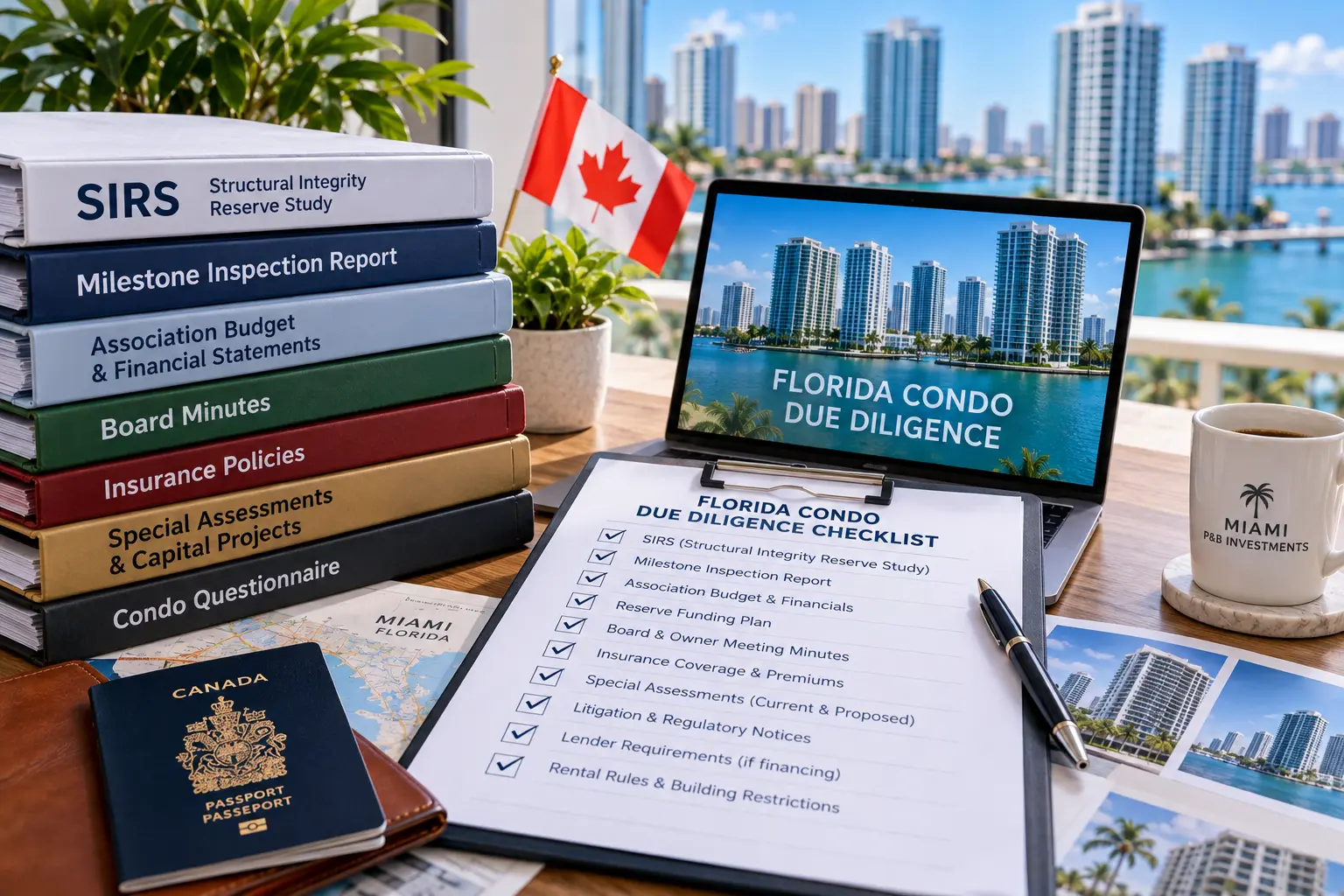
Florida condo SIRS compliance is one layer of a broader building review.
Before closing, connect it with:
- the current budget and prior-year financial statements;
- reserve balances and funding schedule;
- milestone and other structural inspection reports;
- master insurance coverage and deductibles;
- special assessments and capital projects;
- recent board and owner meeting minutes;
- litigation and regulatory notices;
- rental rules and your intended use;
- lender project review, if financing is involved.
That full picture is why the condo questionnaire, special-assessment history, reserve documents and non-warrantable analysis all belong in the same due-diligence cluster. None of them replaces the others.
Florida condo SIRS compliance is strongest as a decision tool when those documents agree with one another.
Review Florida Condo SIRS Compliance Before You Commit
For a Canadian buyer, the goal is not to find a building with zero future expenses. Every condominium needs maintenance.
The goal is to know what the building needs, whether the association has a credible funding plan, and how those obligations affect your cash flow, financing and eventual resale.
Miami P&B Investments works with Canadian buyers who need local help coordinating property search, association documents, financing questions and South Florida due diligence. Start with the team’s Canadian investor resources and, when you have a specific building in mind, contact Miami P&B Investments before making or removing conditions from an offer.