
Miami property management fees look simple on a quote: a monthly percentage of rent. The real cost is usually higher once leasing, renewal, maintenance and setup charges are added. If you own a condo or house in South Florida and live in Canada or overseas, knowing the full fee picture helps you compare managers fairly and protect your cash flow.
This guide breaks down what each fee covers, typical ranges, a worked example and the Florida rules that apply. To see what full-service management looks like for remote owners, read our overview of property management for Miami owners.
What Do Miami Property Management Fees Typically Cover?
A full-service manager acts as your local landlord, and in a condo building that includes working with the association. Many Miami condo associations screen and approve new tenants and charge their own application fee, which is separate from Miami property management fees.
The monthly fee usually pays for rent collection, tenant communication, routine maintenance coordination, monthly statements and responding to emergencies. Remote owners pay for one thing above all: not having to fly in when a water heater fails.
What the monthly fee does not cover varies a lot between companies. Finding a new tenant, renewing a lease, overseeing larger repairs and handling an eviction are often billed separately. That is why two quotes with the same percentage can produce very different Miami property management fees over a year.
Miami Property Management Fees at a Glance
The ranges below are typical for long-term residential rentals in Miami-Dade, Broward and Palm Beach counties. They are not fixed prices. Each company sets its own schedule, so treat them as a benchmark for comparing written quotes.
| Fee | Typical range | When it is charged |
|---|---|---|
| Monthly management fee | About 8% to 12% of collected rent | Every month the unit is rented |
| Leasing or tenant placement fee | Often 50% to 100% of one month’s rent | Each time a new tenant signs |
| Lease renewal fee | Flat fee of roughly $100 to $500, or a small percentage of one month’s rent | When an existing tenant renews |
| Setup or onboarding fee | Flat one-time charge, sometimes waived | When you sign the management agreement |
| Maintenance markup | Commonly 0% to 10% on vendor invoices | On repairs the manager arranges |
| Vacancy or minimum fee | Flat monthly charge at some firms | While the unit sits empty |
| Eviction coordination | Flat fee plus attorney and court costs | Only if a tenant must be removed |
What percentage do property managers charge in Miami?
Most long-term rental managers in Miami charge about 8% to 12% of the monthly rent collected. Lower rates usually come with more add-on fees, and higher rates sometimes include leasing or renewals. Ask whether the percentage applies to rent collected or rent due. You should not pay a management fee on rent the tenant never paid.
Seven Fees Beyond the Monthly Percentage
The headline percentage is only part of Miami property management fees. These seven line items decide what you really pay.
- Leasing fee. Covers marketing, showings, screening and lease signing. It is the largest one-time charge, so check whether a discount applies if you also buy full management.
- Renewal fee. Some managers charge nothing; others charge a flat amount or a slice of one month’s rent. A good renewal saves you a vacancy, so a modest fee is reasonable.
- Setup fee. Pays for onboarding, inspection photos and account setup. It is often negotiable.
- Maintenance markup. A percentage added to contractor invoices. Ask for the rate in writing and the dollar limit above which the manager must get your approval first.
- Vacancy or minimum fee. A flat charge while the property is empty. Many owners prefer managers who only earn when rent comes in.
- Eviction fee. Covers the manager’s time to coordinate the Florida eviction process. Court filing fees and attorney fees are extra.
- Early termination fee. Charged if you cancel the agreement before its term ends. Look for a reasonable notice period and no fee if the manager breaches the contract.
Short-Term Rental Management Costs More
Vacation and short-term rental management is a different service, and Miami property management fees for it are priced differently. The manager handles guest messaging, dynamic pricing, cleaning turnovers, linens, check-ins and platform listings. Fees are commonly 20% to 30% or more of booking revenue, and cleaning is usually charged per stay.
Before you budget for short-term income, confirm the building and the city allow it. Many Miami condo associations set minimum lease terms or cap rentals per year, as explained in our guide to Miami condo rental restrictions. Local licensing and tax registration also apply, covered in our article on Florida short-term rental laws in Miami.
Is it worth paying 20% or more for vacation rental management?
It can be, if the property is legally rentable short term and nightly rates are strong. For a remote owner, self-managing guest turnovers from Canada is rarely practical. Compare the net result after management, cleaning, platform fees, utilities and furnishing against a long-term lease at 8% to 12%, not just the gross booking revenue.
A Worked Example: Managing a $3,000-a-Month Condo
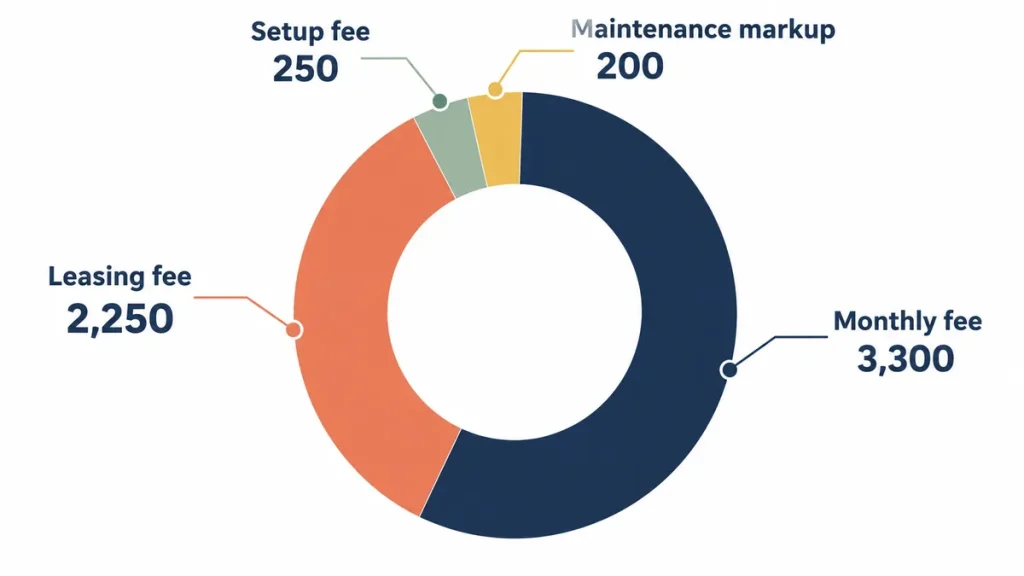
Here is how Miami property management fees could add up in year one for a condo leased at $3,000 a month. The figures are illustrative, using mid-range rates from the table above.
- Monthly fee at 10% for 11 rented months (one month vacant while a tenant is found): $3,300
- Leasing fee at 75% of one month’s rent: $2,250
- Setup fee: $250
- Maintenance markup of 10% on $2,000 of repairs: $200
That puts year-one Miami property management fees at about $6,000, or roughly 18% of the $33,000 in rent collected. In year two, with the same tenant renewing, the cost could fall to the monthly fee plus a renewal fee. This is why tenant retention matters as much as the headline rate. Run these numbers alongside the other cash flow checks for Miami rentals before you buy.
Extra Considerations for Canadian and Foreign Owners
When you compare Miami property management fees as a nonresident owner, look for a manager who understands cross-border paperwork, not just tenants. Ask how rent reaches you, in which currency, and how often. A US-dollar account for rent and expenses avoids converting money back and forth every month.
Year-end reporting is part of what Miami property management fees should buy. Your accountant will need a clean annual statement of rent, fees, repairs and condo dues for your US and Canadian returns. Our guide to Florida rental income tax for Canadians explains how those figures are used.
Does my property manager have to withhold tax on my rent?
Often, yes, unless you give them the right form. Under IRS rules, rental income of a nonresident alien from US real property is taxed at a flat 30% of gross rent (or a lower treaty rate) unless the owner elects to treat it as effectively connected income. A manager who collects rent on your behalf is generally the withholding agent.
With the election, you can deduct expenses and pay tax on net income instead. The IRS explains on its page about nonresident aliens with US real property that you give Form W-8ECI to the withholding agent and file Form 1040-NR each year. Confirm the details with a cross-border tax professional before the first rent payment.
Florida Rules That Protect Owners

Two Florida laws are worth knowing before you weigh Miami property management fees or sign any management agreement:
- Licensing. Under Chapter 475 of the Florida Statutes, a person who rents property for others for compensation generally needs a real estate license. You can confirm a company or agent through the state’s DBPR license search.
- Security deposits. Section 83.49 of the Florida Statutes requires deposits to be held in a separate Florida account or covered by a surety bond. Tenants must get written notice within 30 days of payment. After move-out, the landlord has 15 days to return the deposit or 30 days to send a written notice of claim.
Missing a deposit deadline can cost you the right to deduct for damage. A manager who tracks these dates is worth more than slightly lower Miami property management fees.
How to Compare Miami Property Management Fees Between Companies
Ask every company for a complete written fee schedule and a sample owner statement. Then compare them line by line:
- Is the monthly fee charged on rent collected or rent due?
- What does the leasing fee include, and is there a tenant placement guarantee?
- What is the repair approval limit and the maintenance markup?
- Are there vacancy, minimum, inspection or technology fees?
- How long is the agreement, and what does it cost to cancel?
- Who holds security deposits, and in what kind of account?
- Can they handle W-8ECI paperwork and send year-end statements for nonresident owners?
The lowest percentage rarely means the lowest Miami property management fees once these answers are in.
Can you negotiate Miami property management fees?
Often, yes. Setup fees, leasing discounts and renewal fees are the easiest items to negotiate, especially if you have more than one unit or sign a longer agreement. The monthly percentage is harder to move, but some companies lower it for higher-rent properties.
Negotiate on terms as well as price. A shorter cancellation notice, a higher repair approval limit, and a written promise not to charge for vacant months can be worth more over time than shaving a point off Miami property management fees. Get every concession written into the management agreement itself, not only in an email.
Get a Clear Management Quote for Your Miami Property
Miami P&B Investments works with Canadian and international owners across Miami, Fort Lauderdale, Boca Raton and West Palm Beach. Our team handles leasing, tenant screening, rent collection and monthly reporting, and our property maintenance services cover repairs and upkeep while you are away.
Fee structures and tax rules depend on your property and situation, so get advice that fits yours. If you want a written breakdown of Miami property management fees for your condo or home, contact our team for a no-pressure review.