
Canadian snowbird rules decide how long you can spend in Florida each winter, and they are stricter than most first-time snowbirds expect. There is no single number to remember. US immigration, the IRS, Washington’s newer registration requirement and your own provincial health plan each keep a separate count, and you can be fine under one while breaking another.
This guide walks through each of the Canadian snowbird rules as they stand for the 2026–2027 season, with real day counts and the forms involved. If you are still deciding where to spend your winters, our real estate services for Canadian snowbirds cover buying in Miami, Fort Lauderdale, Boca Raton and West Palm Beach.
Canadian Snowbird Rules: Two Clocks, Two Agencies
Most confusion about the Canadian snowbird rules comes from mixing up two different tests. The first is immigration: how long US Customs and Border Protection (CBP) lets you stay as a visitor. The second is tax: whether the IRS treats you as a US resident who owes tax on worldwide income.
The two clocks count differently. Immigration looks at how long you stay on each visit and how much of the year you spend in the US. The IRS uses a weighted formula that reaches back over three calendar years. Following the Canadian snowbird rules means passing both tests, plus a third check from your province if you want to keep public health coverage.
How Long Can Canadians Stay in Florida?
The first of the Canadian snowbird rules is the visitor limit. Canadian citizens can usually stay in the United States for up to six months without a visa, according to the Government of Canada’s travel advice for the United States. You must declare how long you plan to stay when you enter, and the CBP officer decides how long you are admitted.
If an officer thinks you spend more time in the US than in Canada, you have to show you are a temporary visitor. Bring proof of your Canadian ties: a home, provincial health card, bank accounts and a return date. If you need more time once you are in Florida, the Canadian government says you must apply to US Citizenship and Immigration Services (USCIS) before your authorized stay runs out.
Is the 182-day rule a law?
Not exactly. The “182-day rule” is the best-known of the Canadian snowbird rules, but it is a planning guideline rather than a statute. It keeps you inside the usual six-month visitor stay and under the 183-day tax threshold described below. Most snowbird advisers treat 182 days in any rolling 12-month period as the outer limit for immigration purposes.
Bills to let older Canadians stay up to 240 days have been introduced in Congress several times. As of this writing none has become law, so the current Canadian snowbird rules still apply.
The Substantial Presence Test, Explained With Real Numbers
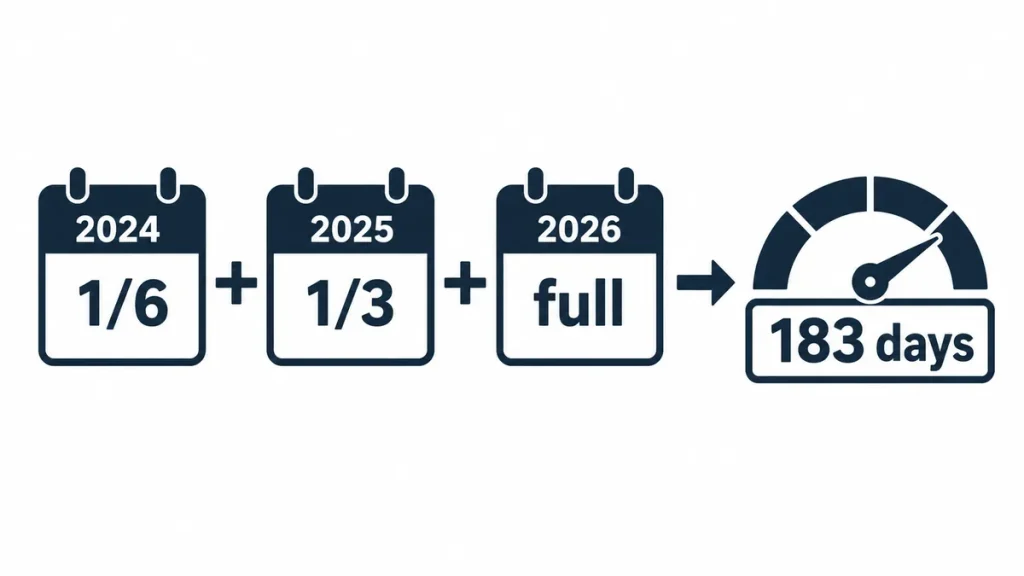
The IRS uses the substantial presence test to decide who is a US tax resident. You meet it if you were in the US at least 31 days this year and at least 183 days over a three-year window, counted this way:
- Every day in the current year counts in full.
- One-third of the days from last year count.
- One-sixth of the days from the year before that count.
This is the part of the Canadian snowbird rules that catches people. You can stay well under six months every winter and still meet the test, because the earlier years keep adding to the total. The table assumes the same stay each year for three years.
| Days in the US each year | Weighted three-year total | Meets the test? | What it means under the Canadian snowbird rules |
|---|---|---|---|
| 90 days (about 3 months) | 135 | No | No US tax residency issue |
| 120 days (about 4 months) | 180 | No | Very close to the line; track every day |
| 122 days | 183 | Yes | File Form 8840 to claim the closer connection exception |
| 150 days (about 5 months) | 225 | Yes | File Form 8840 every year |
| 182 days (about 6 months) | 273 | Yes | Form 8840 still works, but you have no margin left |
The tipping point is about 122 days a year, or roughly four months. A snowbird who stays from late November to early April every year will cross it.
Do partial days count toward the 183 days?
Yes. The IRS generally counts any day you are physically in the US, even for a few hours, as a full day, which makes the Canadian snowbird rules stricter than a simple month count suggests. Your arrival day and departure day both count. There are narrow exceptions, such as a stopover of less than 24 hours between two foreign points, or days you cannot leave because of a medical condition that started while you were in the US.
Form 8840 and the Closer Connection Exception
Meeting the substantial presence test does not automatically make you a US tax resident, and this is where the Canadian snowbird rules give you a way out. Under the closer connection exception, you can still be treated as a nonresident if you:
- were in the US fewer than 183 days during the year,
- kept your tax home in Canada for the entire year,
- had a closer connection to Canada than to the US, and
- had not applied for, or taken steps toward, a green card.
You claim it by filing Form 8840 for each person, so a couple files two forms. If you file a US return (Form 1040-NR, for example because you rent out your condo), attach Form 8840 to it. If you have no US return to file, mail it on its own by the 1040-NR due date. For people with no US wages, that is generally June 15 of the following year, so your 2026 form would be due by June 15, 2027.
Do not treat the deadline as optional; it is the easiest of the Canadian snowbird rules to miss. The IRS says that if you file late, you cannot claim the exception unless you can show by clear and convincing evidence that you took reasonable steps to learn and meet the requirement.
Do I need to file Form 8840 if I own a Florida condo?
Owning property does not decide it. Your day count does. If your weighted total reaches 183, file Form 8840 whether you own, rent or stay with family.
If you spend 183 days or more in the US in a single calendar year, the closer connection exception is no longer available. At that point the Canada–US tax treaty may still help, usually through a treaty position disclosed on Form 8833, but that needs a cross-border tax professional.
Alien Registration: The Newest of the Canadian Snowbird Rules
Since April 2025, the US has enforced an alien registration requirement for visitors aged 14 and over who stay 30 days or longer. USCIS specifically lists Canadian visitors who entered at a land port without being issued evidence of registration, which usually means no I-94 record.
- Registration is done online on Form G-325R through a USCIS online account, one account per person.
- USCIS states that registrants do not pay a biometric services fee.
- Anyone 18 or older who is required to register must carry proof of registration at all times.
- An I-94 record generally counts as registration, so check yours on the CBP I-94 website before assuming you are covered.
This area has changed several times. DHS finalized the rule in June 2026 and USCIS issued a further update and a new form edition in September 2026, parts of which are on hold for some people because of a court injunction. Check the official USCIS alien registration page before each trip rather than relying on what your neighbors did last season.
Provincial Health Coverage Has Its Own Limit
Your province keeps its own clock, and it is the one of the Canadian snowbird rules people forget most often. Ontario, for example, lets eligible residents be away for up to seven months in any 12-month period and keep OHIP. Other provinces use different limits, so check yours before booking a long season.
Keeping provincial coverage does not mean you are covered in a Miami hospital. Ontario’s out-of-country emergency program pays only a fixed daily amount, up to $400 CAD a day for intensive inpatient care and $50 CAD a day for emergency outpatient care, and US hospital bills are usually far higher. Ontario strongly recommends private travel medical insurance. Read the policy’s limits on trip length and pre-existing conditions.
Owning a Florida Home Doesn’t Change the Canadian Snowbird Rules
Buying a condo in Aventura or a house in Boca Raton gives you a place to stay. It does not give you a longer visitor stay, any immigration status or an exemption from the Canadian snowbird rules. It does add a few obligations that are worth planning for before you buy:
- Renting while you are away: rent from a Florida property creates US filing duties. Our guide to Florida rental income tax for Canadians covers the 30% withholding and the net-income election.
- Estate exposure: US real estate can be subject to US estate tax even for nonresidents. See what Canadian owners should know about US estate tax.
- An empty home for six-plus months: Florida humidity, storms and plumbing leaks don’t wait for your return. Regular checks by a local property maintenance team catch problems before they become insurance claims.
A Simple Day-Count System That Keeps You Compliant
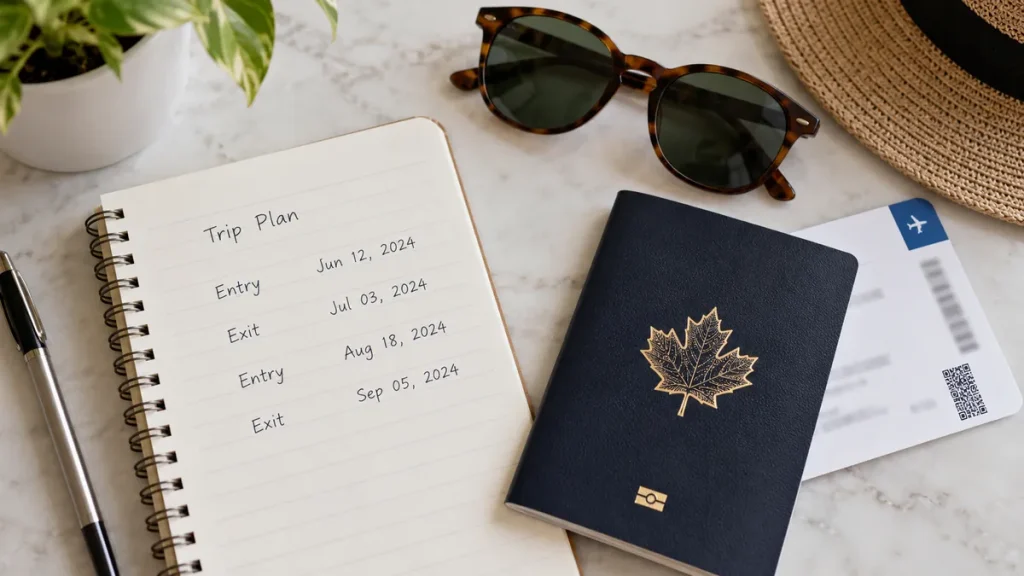
The easiest way to follow the Canadian snowbird rules is a written log. You can’t rely on memory, and you can’t assume nobody is counting. At land crossings, Canada and the US exchange entry records, so your entry into one country becomes the record of your exit from the other. Keep your own log that matches:
- Record every entry and exit date, including short trips home for holidays.
- Count each partial day as a full day.
- Run the three-year weighted total every January and again before you book your next season.
- Keep at least a one-week cushion under any limit for flight delays or illness.
- Diary your Form 8840 due date and your registration status alongside your flights.
- Keep proof of Canadian ties together in one folder for the border.
Couples should keep separate logs. One spouse often stays longer, and the Canadian snowbird rules test each person individually.
Plan Your Florida Season With Local Support
The Canadian snowbird rules are manageable once you know which clock you are watching. Most problems come from a longer-than-planned season, a missed Form 8840, or a Florida home left unchecked for months. Immigration and tax rules change, and your situation may differ from the examples here, so confirm the details with a cross-border tax adviser or immigration lawyer before each season.
Miami P&B Investments helps Canadian buyers choose and buy the right Florida property. Through our partner network for cross-border accounting and tax filing, we can also connect you with someone to handle your filings. If you are planning a winter base in South Florida, contact our team to talk through neighborhoods, budget and the paperwork that comes with owning here.