
Miami condo closing costs can change your cash requirement by thousands of dollars, even when the purchase price and down payment are already settled. For buyers in Brickell, Edgewater, Aventura, Miami Beach, Coconut Grove, or other South Florida condo markets, the smartest move is to estimate the full cash-to-close number before making an offer, not during the final week before closing.
Miami P&B Investments’ real estate services are designed around that broader acquisition process rather than simply finding a listing.
That matters even more for Canadian and international buyers. Miami condo closing costs may include Florida mortgage taxes, lender charges, title and settlement services, condo association fees, insurance-related prepaids, escrow deposits, inspections, wire costs, and currency conversion.
Canadian buyers can also review Miami P&B Investments’ dedicated Canadian investor resources when planning the wider cross-border purchase.
A clean budget helps you compare properties on the true acquisition cost rather than the listing price alone.
How Much Are Miami Condo Closing Costs?
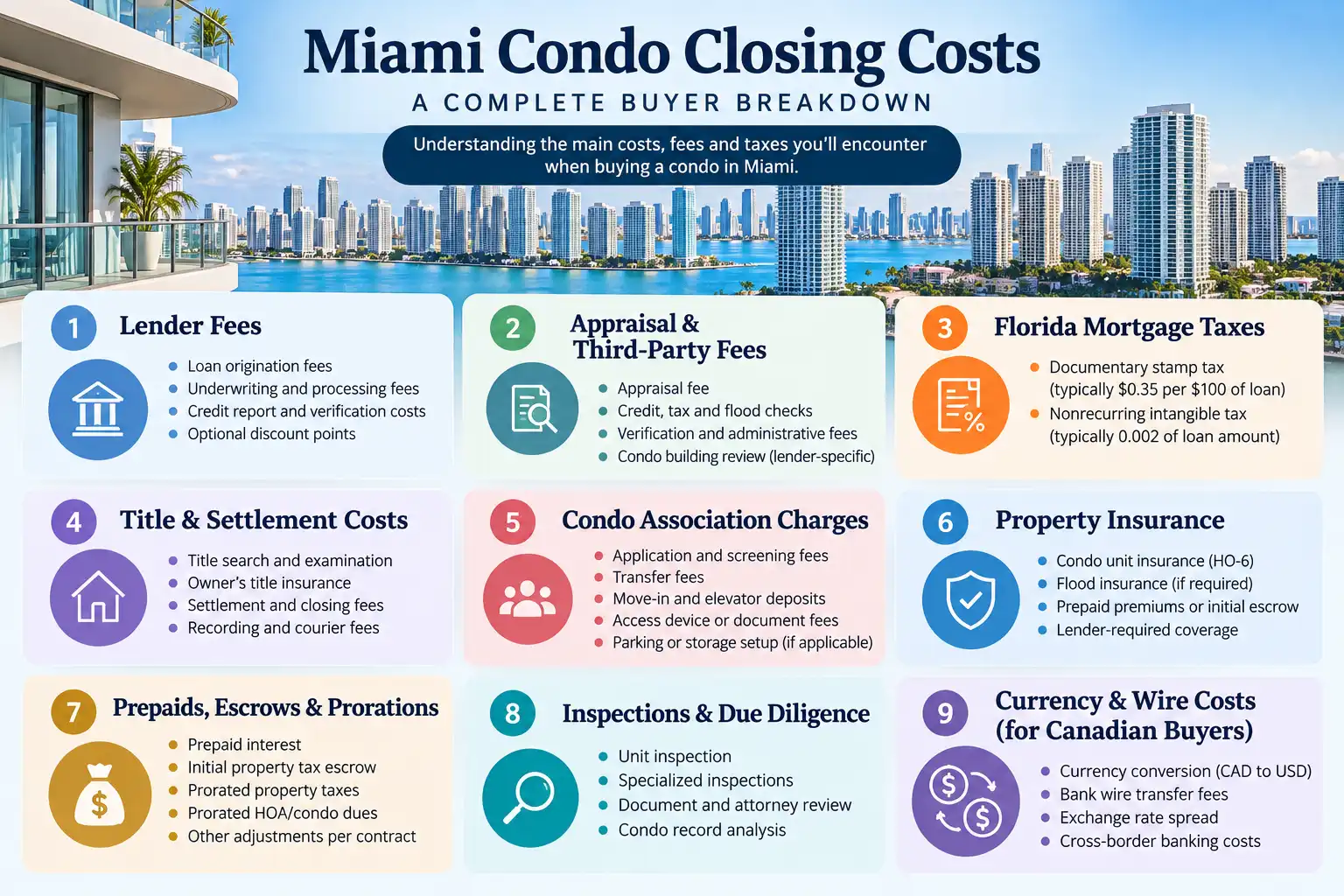
For a financed purchase, a practical starting point is the Consumer Financial Protection Bureau’s closing-cost guidance, which says closing costs often range from about 2% to 5% of the purchase price, excluding the down payment.
That is a national planning range, not a Miami quote.
Your actual Miami condo closing costs depend on the loan amount, lender, title arrangement, insurance, property taxes, association charges, negotiated credits, and whether the condo is resale or new construction. That broader range is useful when researching Florida buyer closing costs, but a property-specific estimate is much more valuable.
Cash buyers usually face fewer loan-driven expenses, so their total can be materially lower. Financed buyers should expect additional charges tied directly to the mortgage, including Florida documentary stamp tax on the obligation and the state’s nonrecurring intangible tax.
The key distinction is this: closing costs are not the same as cash to close.
Cash to close can include the down payment, Miami condo closing costs, prepaid items, escrow deposits, prorations, and adjustments, less deposits and credits already applied.
What Is Included in Miami Condo Closing Costs?
There is no single fixed fee called “closing costs.” The final number is a stack of separate charges.
These are the nine categories buyers should model early.
1. Lender Origination, Underwriting, and Discount Points
If you finance the purchase, lender charges can include origination, underwriting, processing, credit-related charges, and optional discount points used to lower the interest rate.
Some lenders use flat fees. Others price certain charges as a percentage of the loan.
Do not compare lenders on rate alone. Compare the annual percentage rate, lender credits, points, and the complete Loan Estimate.
A slightly lower rate can be less attractive if it requires a large upfront payment that pushes Miami condo closing costs higher.
2. Appraisal and Mortgage-Related Third-Party Fees
Financed purchases commonly require an appraisal. Depending on the lender and property, there may also be credit, tax-service, flood-determination, verification, or other third-party charges.
For condo buyers, the lender may review both the borrower and the building.
If the association has insurance, reserve, litigation, ownership-concentration, or financial issues, extra documentation can be required. That is one reason a low-priced condo can still create a complicated closing.
3. Florida Documentary Stamp Tax and Intangible Tax on the Mortgage
Florida imposes documentary stamp tax on certain written obligations and recorded mortgages. The Florida Department of Revenue’s documentary stamp tax guidance currently lists a rate of $0.35 per $100, or portion thereof, for applicable written obligations and mortgage indebtedness, subject to the detailed state rules.
Florida also imposes a nonrecurring intangible tax on certain obligations secured by Florida real property, generally calculated at 0.002 of the taxable obligation.
For example, consider a $600,000 mortgage.
- Documentary stamp tax illustration: $2,100
- Nonrecurring intangible tax illustration: $1,200
- Combined mortgage-tax illustration: $3,300
That $3,300 comes before lender charges, title work, insurance, escrow funding, association fees, or other expenses.
Cash buyers do not have a mortgage, so these loan-driven items generally do not apply to a cash purchase.
For financed buyers, they are an important reason Miami condo closing costs increase with the loan amount. A larger mortgage can therefore raise Miami condo closing costs even when the purchase price stays the same.
4. Title Insurance, Title Search, Settlement, and Recording
Title work confirms ownership, reviews recorded matters, identifies liens or other issues, and supports the transfer of insurable title.
The closing file can also include settlement, search, examination, recording, wire, courier, or legal charges depending on the transaction and provider.
Who pays particular title-related charges can depend on the contract and local practice, so do not assume a generic Florida rule applies to every Miami-Dade deal.
Review the contract early and ask for a written title and settlement estimate.
Miami P&B Investments has a more detailed guide explaining title insurance in Florida for Miami buyers if you want to understand title commitments, exceptions, liens, and coverage separately from this closing-cost discussion.
5. Condo Association Application, Transfer, and Building Charges
A condo purchase can add building-specific costs that a single-family buyer may never see.
Possible charges include:
- application fees
- screening fees
- move-in deposits
- elevator deposits
- transfer fees
- access-device charges
- parking or storage setup
- document charges
- other association-approved amounts
Not every building charges every fee. Some deposits are refundable; others are not.
Ask for the current fee schedule before the inspection or due-diligence deadline so your Miami condo closing costs reflect the actual building rather than a generic estimate.
Buyers should also understand what the association says is already owed on the unit. Miami P&B Investments’ explanation of the Florida condo estoppel certificate covers that part of condo due diligence in more detail.
A manageable closing fee does not compensate for a large pending special assessment, weak reserves, or a building-level insurance problem.
6. Property Insurance, Flood Coverage, and Required Prepaids
Insurance can affect both approval and cash to close.
A financed buyer may need proof of suitable coverage before funding, and the closing statement can include prepaid premiums or initial escrow deposits.
For a condo, separate the association’s master policy from the owner’s unit-level coverage. A master policy does not automatically cover every interior improvement, personal item, liability exposure, or loss-assessment risk.
Request insurance quotes early.
Waiting until closing week can turn a manageable budget into a scramble, especially if the lender requires additional coverage or the building has a high-deductible master policy.
The site’s guide to Miami property insurance costs provides a deeper checklist for evaluating that risk before closing.
7. Property Tax Escrows, Prepaid Interest, and Prorations
Some amounts on the closing statement are not fees in the ordinary sense. They are prepayments or adjustments.
Financed buyers may fund an initial property-tax escrow and prepaid interest from the closing date through the end of the month.
Taxes, association dues, rents, or other property expenses may also be prorated between buyer and seller according to the contract and closing date.
This is why Miami condo closing costs can move even after the offer is accepted. Closing ten days earlier or later can change prepaid interest, prorations, and escrow requirements.
Nonresident and Canadian buyers should also understand the longer-term tax bill beyond closing. The guide to Florida property taxes for nonresidents explains that ownership expense separately.
8. Inspections and Due-Diligence Costs Paid Before Closing
Many buyer expenses happen before the closing date and may not all appear as a final settlement charge.
These can include the unit inspection, specialized inspections, attorney review, document review, or professional analysis of condo records.
Do not cut essential due diligence just to reduce Miami condo closing costs.
Saving a few hundred dollars on review can be expensive if you miss a major assessment, unresolved building issue, insurance gap, rental restriction, or title problem.
For condos, the unit is only part of the purchase.
The association, reserves, insurance, structural compliance, rules, and current financial obligations all matter.
9. Canadian Buyer Currency, Wire, and Cross-Border Banking Costs
Canadian buyers should add one more line to the budget: the cost of moving Canadian dollars into U.S. dollars.
The exchange rate and provider spread can change the real Canadian-dollar cost of the down payment and Miami condo closing costs.
Bank wire charges may be small compared with the purchase price, but currency movement on a large transfer can be meaningful.
Do not treat foreign exchange as an afterthought.
Build a USD closing budget, then convert that amount under more than one CAD/USD scenario so you know how much buffer you need.
Miami Condo Closing Costs: Cash vs. Financed Purchase
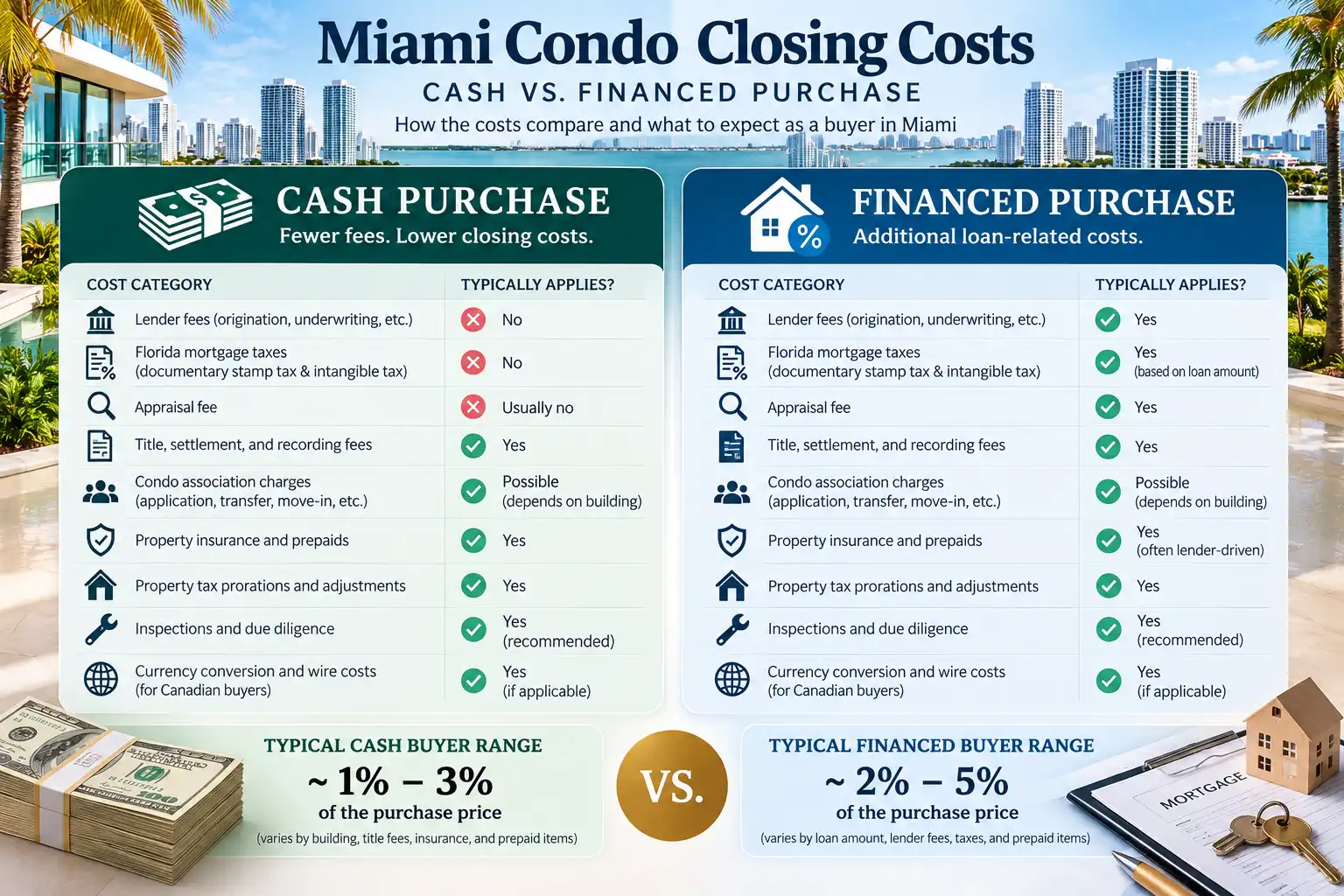
The biggest structural difference is the mortgage.
| Cost category | Cash buyer | Financed buyer | What changes the amount |
|---|---|---|---|
| Lender fees | No | Yes | Lender, loan type, points |
| Appraisal | Often optional | Commonly required | Lender and property |
| Mortgage documentary stamp tax | No | Yes | Loan amount |
| Nonrecurring intangible tax | No | Yes | Secured loan amount |
| Title/settlement/recording | Yes | Yes | Contract and provider |
| Condo association charges | Possible | Possible | Building rules |
| Insurance/prepaids | Property-specific | Often lender-driven | Coverage and escrow |
| Inspections/due diligence | Recommended | Recommended | Property and building |
A cash purchase is not a no-cost closing.
Title work, recording, association fees, inspections, prorations, and other transaction items can still apply.
But removing lender fees and mortgage taxes can materially reduce Miami condo closing costs.
Do cash buyers still need title insurance?
Cash buyers are not being required by a mortgage lender to purchase a lender’s title policy, but that does not eliminate title risk.
The buyer should still understand the title search, exceptions, liens, ownership history, and the protection an owner’s policy may provide before deciding how to proceed.
Are New-Construction Condo Closing Costs Different?
They can be.
Developer contracts may allocate costs differently from a typical resale contract.
A new-construction buyer may be asked to pay charges that a resale seller might otherwise cover by local custom, plus developer, legal, association, working-capital, transfer, utility, or setup charges defined in the purchase agreement.
That means you should never apply a resale percentage blindly to a pre-construction purchase.
Miami condo closing costs on new construction should be modeled from the developer contract, not from resale assumptions.
Request a project-specific closing-cost worksheet and read the contract before signing.
For Canadian buyers making staged deposits over many months, the currency impact also matters.
Miami condo closing costs are only the final step; the effective CAD cost can change at every deposit milestone.
What Would Closing Costs Look Like on an $800,000 Miami Condo?
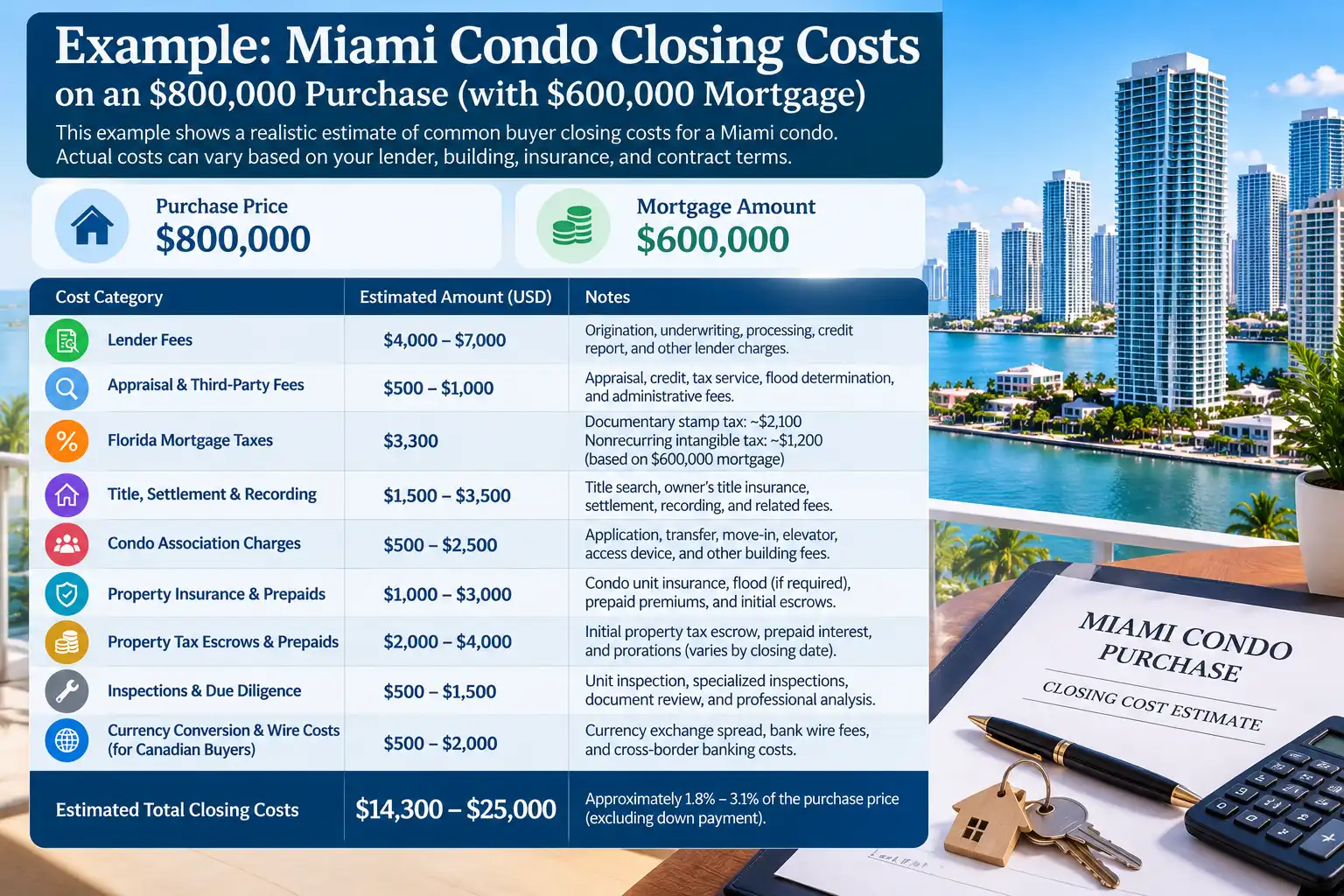
Assume an $800,000 resale condo with a $600,000 mortgage.
Before lender, title, insurance, escrow, association, and inspection charges, the two Florida mortgage taxes alone would be approximately:
- Documentary stamp tax on the $600,000 mortgage: $2,100
- Nonrecurring intangible tax at 0.002: $1,200
- Combined mortgage-tax illustration: $3,300
From there, add the lender’s actual charges, appraisal, title and settlement items, recording, insurance and prepaids, initial escrow funding, association charges, and due-diligence expenses.
This example is intentionally not presented as a universal total.
Miami condo closing costs vary too much by financing, contract, building, insurance, and timing for one flat dollar estimate to be reliable.
When will a financed buyer see the final number?
Use the lender’s Loan Estimate early in the process to compare expected loan and closing charges.
Before closing, review the Closing Disclosure carefully and compare changes with the earlier estimate.
Miami P&B Investments’ Florida real estate closing timeline can help buyers understand where those documents and other due-diligence steps fit into the transaction.
If a line item is unfamiliar, ask:
- What is this charge?
- Who receives the money?
- Why did the amount change?
- Is it fixed or negotiable?
- Can I shop for this service?
- Is it a fee, prepaid expense, escrow deposit, or prorated charge?
The goal is to understand the statement before you are under pressure to wire funds.
How Can Buyers Reduce Miami Condo Closing Costs?
The best strategy is not to cut every fee.
It is to avoid unnecessary cost while keeping the due diligence that protects the purchase.
A useful Miami condo closing costs estimate should separate negotiable charges, fixed taxes, prepaids, and property-specific expenses.
Start with these steps:
- Compare complete Loan Estimates, not just mortgage rates.
- Ask which settlement or title services you are allowed to shop.
- Negotiate seller credits when the contract and loan program allow them.
- Confirm who pays title-related and transfer-related items before signing.
- Request the condo’s current application and move-in fee schedule early.
- Get insurance quotes before financing and inspection deadlines.
- Separate true fees from prepaids and escrow deposits when comparing estimates.
- For Canadian buyers, price currency conversion and wire timing separately.
- Keep a contingency buffer instead of wiring the exact first estimate.
The CFPB specifically recommends using the Loan Estimate to identify title and closing services buyers may be able to shop for.
That matters because two buyers can finance the same purchase price and still receive very different lender and third-party fee structures.
Plan Miami Condo Closing Costs Before You Make the Offer
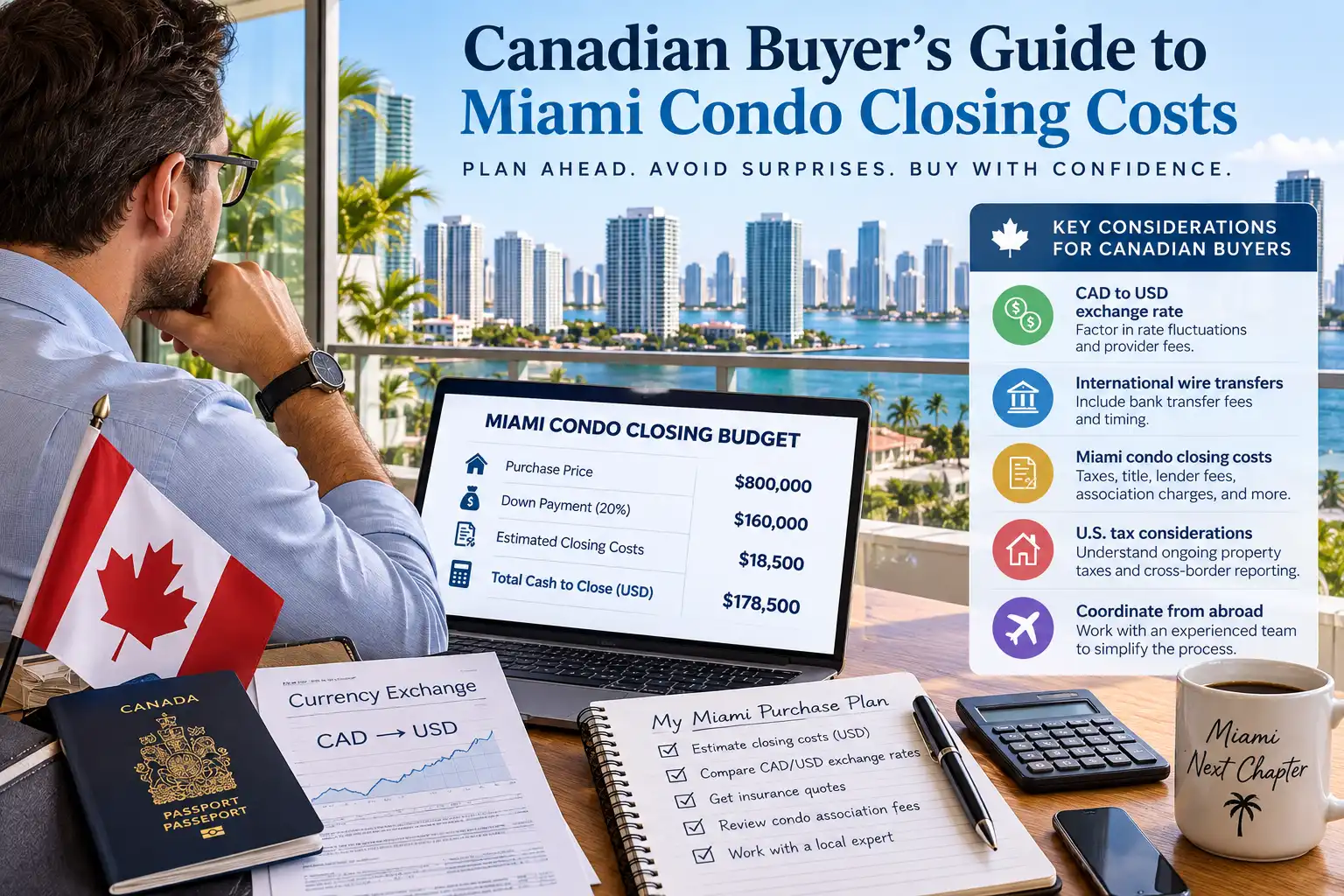
Miami condo closing costs should be part of the property comparison, not an expense you discover after the deal is already under contract.
A condo with a slightly lower purchase price can still require more cash if the building has high transfer fees, expensive insurance, weak reserves, or loan-related complications.
Miami P&B Investments helps buyers evaluate South Florida properties with the full ownership picture in mind: acquisition cost, financing, taxes, insurance, association risk, rental strategy, property management, and long-distance ownership.
For Canadian buyers, that also includes the practical realities of currency conversion and coordinating a purchase from outside the United States.
If you are comparing Miami condos, build the closing budget before you write the offer. Then update it as soon as you receive the lender, title, insurance, and association numbers.
A property-specific estimate is far more useful than a generic percentage.
When you want help comparing a specific condo or building, contact Miami P&B Investments for a practical review of the real estate side of the purchase and coordination with the appropriate local closing, legal, lending, insurance, and tax professionals.