
A 1031 exchange Florida strategy can help a real estate investor move from one U.S. investment property into another while deferring eligible federal gain, but the rules are unforgiving. The biggest mistakes usually happen before or immediately after the sale: the owner receives the proceeds, misses the 45-day identification window, chooses property that does not qualify, or waits too long to coordinate the tax and closing teams.
For Miami and South Florida investors, a 1031 exchange Florida plan is most useful when the goal is to keep equity working rather than cash out completely. It can support a move from a smaller rental into a larger property, from one market to another, or from a management-heavy asset into a property that better fits the investor’s long-term plan.
The key is to treat the exchange as part of the sale from day one. Miami P&B Investments’ real estate services can help investors compare replacement opportunities while tax and legal professionals handle the exchange structure.
What a 1031 Exchange Florida Transaction Actually Does
Section 1031 of the Internal Revenue Code allows qualifying business or investment real property to be exchanged for other like-kind business or investment real property. In practical terms, a 1031 exchange Florida transaction can defer eligible federal gain that would otherwise be recognized when an investment property is sold.
Deferral is not the same as elimination. The tax basis generally carries into the replacement property, which means the deferred gain can matter later if the replacement property is sold in a taxable transaction. The IRS also requires the exchange to be reported, even when no gain is currently recognized.
Florida does not create a separate 1031 system. The exchange is governed primarily by federal tax rules. Florida transaction costs, title issues, documentary stamp taxes, condo requirements, financing, and due diligence still need to be handled like any other real estate closing.
1031 Exchange Florida: 7 Essential Rules to Get Right
1. Use Property Held for Investment or Business
A 1031 exchange Florida transaction generally applies to real property held for productive use in a trade or business or for investment. A long-term rental, qualifying investment condo, commercial building, or vacant land held for investment may fit the rule.
A primary residence does not become exchange property simply because it appreciated. Property held mainly for resale, such as a typical fix-and-flip bought with the intent to renovate and sell quickly, also presents a different tax profile.
Can a Miami Rental Condo Qualify for a 1031 Exchange?
Yes, a Miami rental condo may qualify when it is genuinely held for investment and the other requirements are met. The building itself still needs normal due diligence, including rental rules, insurance, reserves, assessments, and financing eligibility.
That is why replacement-property selection should not focus only on the tax deadline. A 1031 exchange Florida investor still needs to buy a property that works economically after the exchange is complete.
2. Hire a Qualified Intermediary Before the Sale Closes
In a typical deferred exchange, the investor should not receive or control the sale proceeds. A qualified intermediary, often called a QI, is engaged before closing and holds the exchange funds under the exchange agreement.
This timing matters. If the seller closes, takes possession of the money, and then decides to turn it into a 1031 exchange Florida transaction, the opportunity may already be lost.
The IRS explains the federal framework for like-kind and deferred exchanges in its guidance on like-kind real estate exchanges.
3. Respect the 45-Day Identification Rule
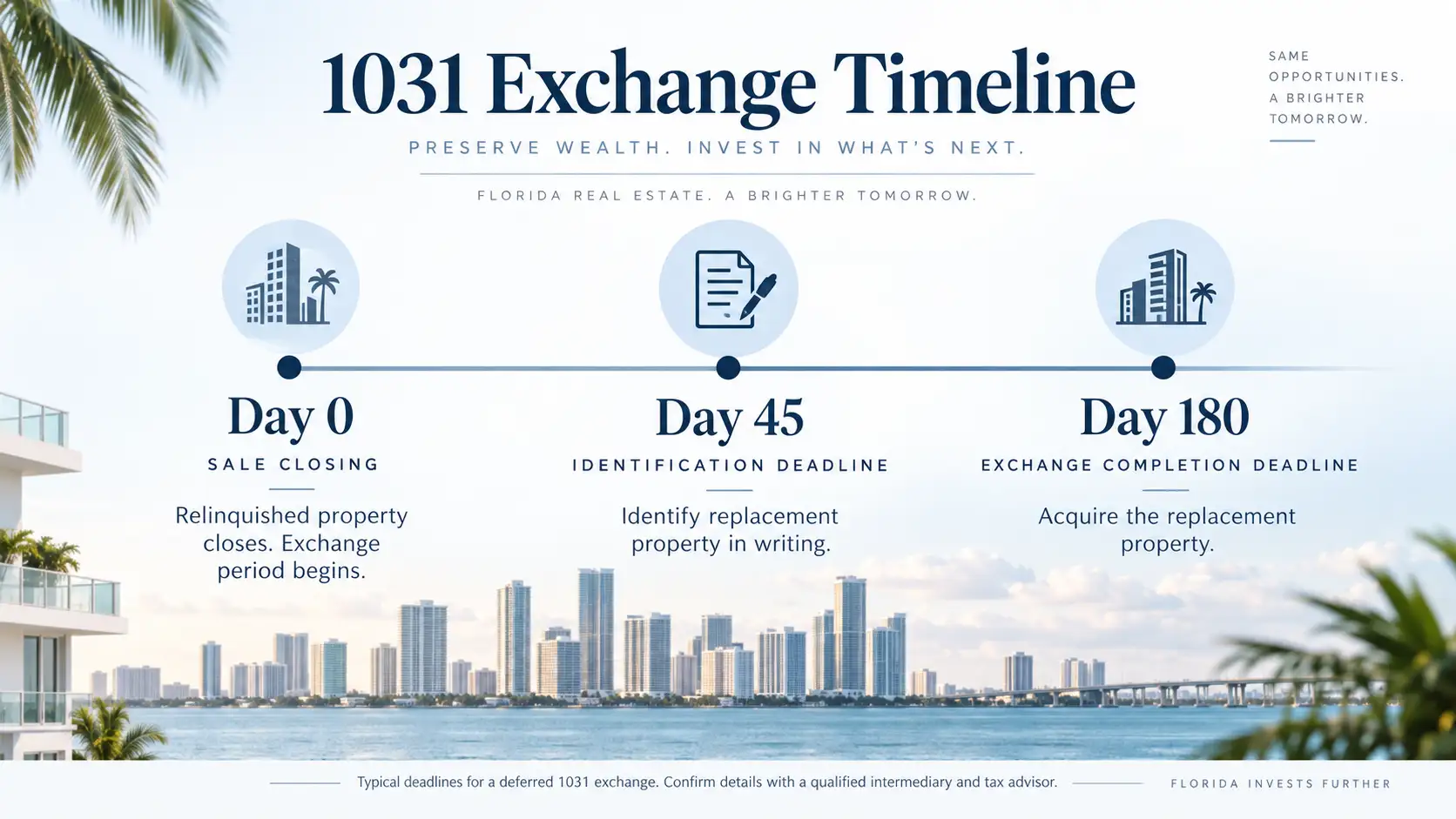
The 45-day identification rule is one of the hardest deadlines in the process. The replacement property must generally be identified in writing within 45 days after the relinquished property is transferred.
The clock runs on calendar days, not business days. Weekends and holidays do not automatically give you extra time.
For a 1031 exchange Florida investor looking in Miami, Fort Lauderdale, Boca Raton, or West Palm Beach, this makes pre-sale planning valuable. If possible, create a realistic replacement-property shortlist before the relinquished property closes.
What Happens If I Miss the 45-Day Deadline?
The exchange can fail. The 45-day period is not a casual target; it is a federal timing requirement.
Waiting until day 35 to begin property research leaves very little room for inspections, financing review, condo document analysis, insurance quotes, negotiation, and backup options.
4. Close Before the 180-Day Exchange Deadline
The replacement property must generally be received by the earlier of 180 days after the transfer of the relinquished property or the due date of the relevant federal tax return, including extensions.
A 1031 exchange Florida transaction therefore has two clocks running at once: the 45-day identification period and the broader 180-day completion period.
The IRS Form 8824 instructions spell out both timing rules. Investors should build the closing calendar backward from those hard deadlines instead of relying on a normal purchase timeline.
5. Follow the Replacement Property Identification Rules
Many investors use the three-property rule, which allows identification of up to three replacement properties regardless of their fair market value. Other identification methods may apply, including the 200% and 95% rules.
The practical lesson is simple: do not casually submit a long list of possible properties. A 1031 exchange Florida identification should be deliberate, correctly documented, and reviewed by the professionals managing the exchange.
Do I Have to Buy the Same Type of Property?
Usually, no. “Like-kind” for U.S. real estate is broader than many investors expect.
Investment real property can often be exchanged for a different type of investment real property, such as a rental condo for a duplex, or vacant investment land for a commercial property, provided the federal requirements are satisfied.
U.S. real property and real property outside the United States are not treated as like-kind to each other under Section 1031.
6. Understand Cash, Debt, and “Boot”
Receiving cash or other non-like-kind property can create currently taxable gain. Debt changes can also affect the calculation.
Investors seeking full deferral often aim to reinvest the available exchange proceeds and acquire replacement property with sufficient value and financing structure, but the exact calculation depends on basis, liabilities, closing adjustments, and other facts.
A 1031 exchange Florida decision should therefore be modeled before the sale closes. Miami P&B Investments’ accounting services can coordinate with your tax adviser so the real estate search reflects the actual reinvestment target instead of a rough guess.
7. Report the Exchange and Coordinate the Whole Team
A completed like-kind exchange is reported on Form 8824. The filing captures the relinquished property, replacement property, dates, values, basis information, and other exchange details.
The IRS requires the exchange to be reported even if no gain or loss is recognized at the time. A 1031 exchange Florida plan should therefore include the CPA or tax preparer early, not only after the replacement property closes.
Legal structure matters too. If an LLC, partnership, corporation, trust, or individual owns the relinquished property, do not change ownership casually in the middle of the process. Review entity and title questions with qualified advisers before signing.
Miami P&B Investments’ guide to buying Florida property through an LLC is a useful starting point for broader ownership-structure questions.
Which Florida Properties May Fit a 1031 Exchange?

The table below is a practical screening tool, not a tax ruling. Actual qualification depends on how the property is held and used.
| Property scenario | General 1031 fit | Main issue to review |
|---|---|---|
| Long-term rental condo | Often possible | Investment intent, rental history, building rules |
| Multifamily rental | Often possible | Ownership, income history, replacement timing |
| Commercial property | Often possible | Business/investment use and transaction structure |
| Vacant land held for investment | Often possible | Investment intent and documentation |
| Vacation property with substantial personal use | Depends | Personal-use limits and investment facts |
| Primary residence | Generally not under Section 1031 | Separate home-sale tax rules may apply |
| Fix-and-flip held mainly for resale | Often problematic | Property held primarily for sale |
A 1031 exchange Florida investor should also evaluate the replacement property on its own merits. Tax deferral cannot rescue a weak deal.
Condo reserves, master insurance, special assessments, rental restrictions, financing, and long-term carrying costs still matter.
A Simple Miami 1031 Exchange Example
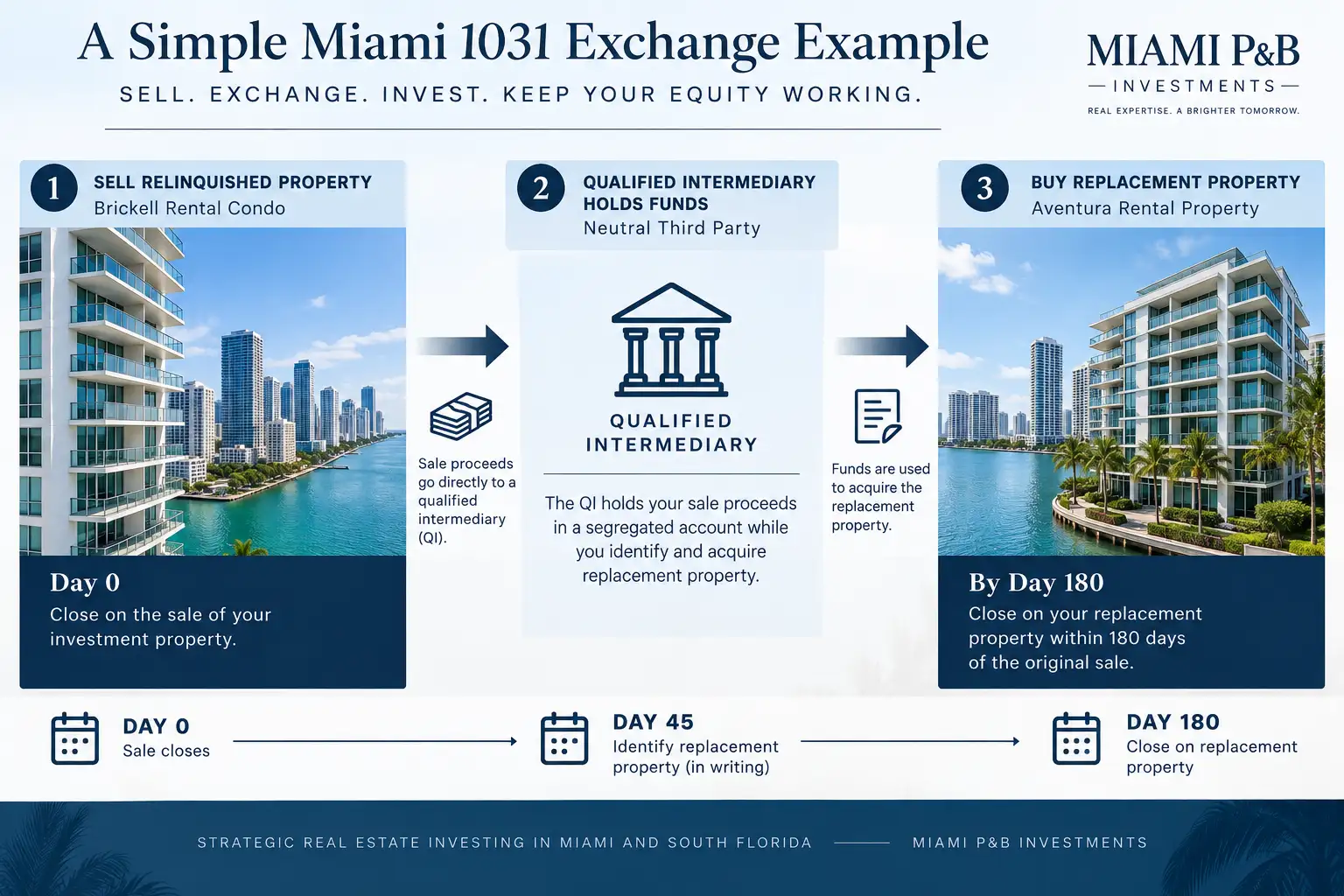
Assume an investor owns a Brickell rental condo that has appreciated and now wants a larger income property. The investor plans to sell the condo and acquire a rental property in Aventura.
Before the Brickell sale closes, the investor engages a qualified intermediary and tells the closing team that the sale is part of a 1031 exchange Florida transaction. The sale proceeds go to the QI rather than to the investor.
Day 0 is the closing on the Brickell condo. The investor then has 45 days to identify qualifying replacement property and works through inspections, condo documents, insurance, financing, and projected cash flow.
By day 45, the investor has delivered a valid written identification. The Aventura purchase then closes within the applicable 180-day period.
This example shows why the exchange is operational, not just tax-related. The tax rules create the deadline, but real estate due diligence determines whether the replacement property is worth owning.
Common 1031 Exchange Florida Mistakes to Avoid
The most expensive mistakes are often procedural rather than sophisticated tax issues.
- Closing the sale before a qualified intermediary is in place.
- Letting the sale proceeds reach the taxpayer directly.
- Treating the 45-day identification period as flexible.
- Identifying replacement property without following the applicable identification rules.
- Choosing a replacement property only because it fits the deadline.
- Ignoring condo financing, insurance, reserves, or assessment risk.
- Changing the ownership entity or title structure without tax and legal review.
- Assuming every dollar of gain is automatically deferred.
- Forgetting to file Form 8824.
- Assuming U.S. tax deferral automatically creates the same result in another country.
For investors who are selling Florida property, the existing guide to Florida seller closing costs is also worth reviewing because normal transaction expenses, loan payoffs, title charges, and other closing items still affect the economics of the sale.
What Florida-Specific Costs Still Apply?
A 1031 exchange Florida transaction does not make ordinary Florida closing costs disappear. Florida documentary stamp tax can apply to deeds and other documents that transfer an interest in Florida real property, and mortgage-related taxes can apply when financing is involved.
The Florida Department of Revenue documentary stamp tax guide explains the current treatment of deeds, mortgages, and other taxable documents. Those costs should be included in the exchange budget before you set a replacement-property price range.
South Florida buyers also face property-specific costs that can be much larger than a transfer tax: HOA dues, insurance, reserves, repairs, special assessments, property management, and financing terms.
A tax-efficient exchange into an expensive or poorly managed building can still be a bad investment.
What Should Canadian Investors Check Before Using a 1031 Exchange Florida Strategy?
Canadian owners of U.S. investment property should treat a 1031 exchange Florida transaction as a cross-border planning issue, not just a U.S. closing technique.
U.S. Section 1031 rules determine the federal like-kind exchange treatment, but Canadian tax treatment and reporting may not mirror the U.S. result. A Canadian resident should get advice from a professional who understands both systems before assuming the same gain is deferred in Canada.
FIRPTA withholding rules can also interact with a property sale. That does not mean a Canadian investor cannot use Section 1031, but the closing agent, qualified intermediary, CPA, and legal adviser should coordinate the structure before closing.
Miami P&B Investments’ FIRPTA guide for Canadian property investors explains the broader withholding issue for Canadian sellers.
Currency also matters. The sale, exchange proceeds, replacement property, and many expenses are in U.S. dollars, while the investor may measure wealth and tax exposure in Canadian dollars. That makes pre-closing modeling especially important.
Build Your 1031 Exchange Florida Plan Before You Sell
The strongest 1031 exchange Florida transactions begin before the relinquished property closes. Investors know the likely replacement budget, hire the qualified intermediary early, understand the 45-day and 180-day deadlines, and start screening real estate before the clock becomes a problem.
Miami P&B Investments can support the real estate side of that process across Miami and South Florida, while its legal services network and accounting support can help coordinate the tax, ownership, and closing questions that surround a cross-border exchange.
The goal is not simply to complete an exchange. It is to replace one property with another asset that fits your income goals, risk tolerance, and long-term strategy.
If you are considering a sale and want to compare replacement opportunities, contact Miami P&B Investments before closing. For a 1031 exchange Florida strategy, early coordination is part of the investment decision, not an afterthought.