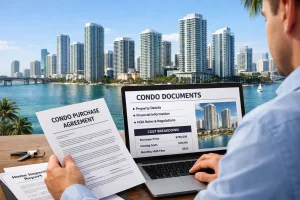
Florida condo milestone inspection rules are now one of the most important parts of buying a condo in Miami, Fort Lauderdale, Aventura, Brickell, Edgewater, Coconut Grove, Bay Harbor Islands, and other South Florida markets.
For years, many buyers focused mostly on the unit itself. They looked at the view, balcony, finishes, amenities, parking, rental potential, and monthly HOA fee. Those details still matter. But in today’s market, the building behind the unit can affect your financing, insurance, future assessments, resale value, and long-term comfort just as much as the property you fall in love with.
This is especially true for Canadian buyers, snowbirds, and investors who are purchasing from outside Florida. When you are not local, you need more than a nice listing photo. You need to understand whether the building has been inspected, what repairs may be coming, how reserves are being handled, and whether the association is prepared for the next stage of ownership.
A Florida condo milestone inspection is not just another document to collect. It is a building-level safety and risk signal. If you understand how to read it, you can make a smarter purchase. If you ignore it, you may walk into a building with hidden repair pressure, rising fees, financing challenges, or major special assessments.
Why Florida Condo Milestone Inspection Rules Matter More in 2026
The Florida condo milestone inspection process matters because South Florida has many aging condo buildings, especially near the coast. Some are well maintained, financially stable, and professionally managed. Others may be facing repairs, deferred maintenance, reserve shortages, insurance pressure, or new compliance costs.
That does not mean buyers should avoid condos. Miami and South Florida condos remain attractive for lifestyle, rental income, seasonal use, and long-term investment. A condo can be a strong option for Canadians who want a lock-and-leave property, professional building management, waterfront access, or a winter residence that can also serve as part of a broader investment strategy.
The key is knowing which building you are buying into.
A Florida condo milestone inspection can help reveal whether the building has substantial structural deterioration, whether additional inspections are needed, and whether repairs may affect the association budget. This is why it should be reviewed alongside the budget, board minutes, insurance information, reserve study, condo questionnaire, and other association records.
If you are still early in your research, it may help to review Miami P&B Investments’ guide to Florida condo documents and the article on the Florida condo questionnaire. Those documents often work together with the milestone inspection to show the full building picture.
What Is a Florida Condo Milestone Inspection?
A Florida condo milestone inspection is a structural inspection required for certain aging condominium and cooperative buildings. In simple terms, it is designed to evaluate the safety and structural condition of the building, especially load-bearing elements and primary structural systems.
For buyers, the practical question is simple: does the building look financially and physically prepared for the years ahead?
The inspection is not the same as a personal home inspection inside your unit. A home inspection may look at the air conditioning, appliances, plumbing fixtures, electrical panel, windows, and interior condition of the condo you want to buy. A Florida condo milestone inspection looks at the larger building structure. That distinction matters.
You can have a beautiful unit in a building that has serious association-level issues. You can also find an older building that looks less flashy but has strong records, proactive maintenance, realistic reserves, and a clear plan for repairs. The inspection helps you separate appearance from risk.
For official background, buyers can review Florida’s public condo inspection resources through the Florida Department of Business and Professional Regulation and the statutory language in Florida Statutes Section 553.899. These are useful references, but they should not replace professional review from a qualified real estate, legal, engineering, or accounting advisor.
Florida Condo Milestone Inspection vs. SIRS vs. Local Recertification
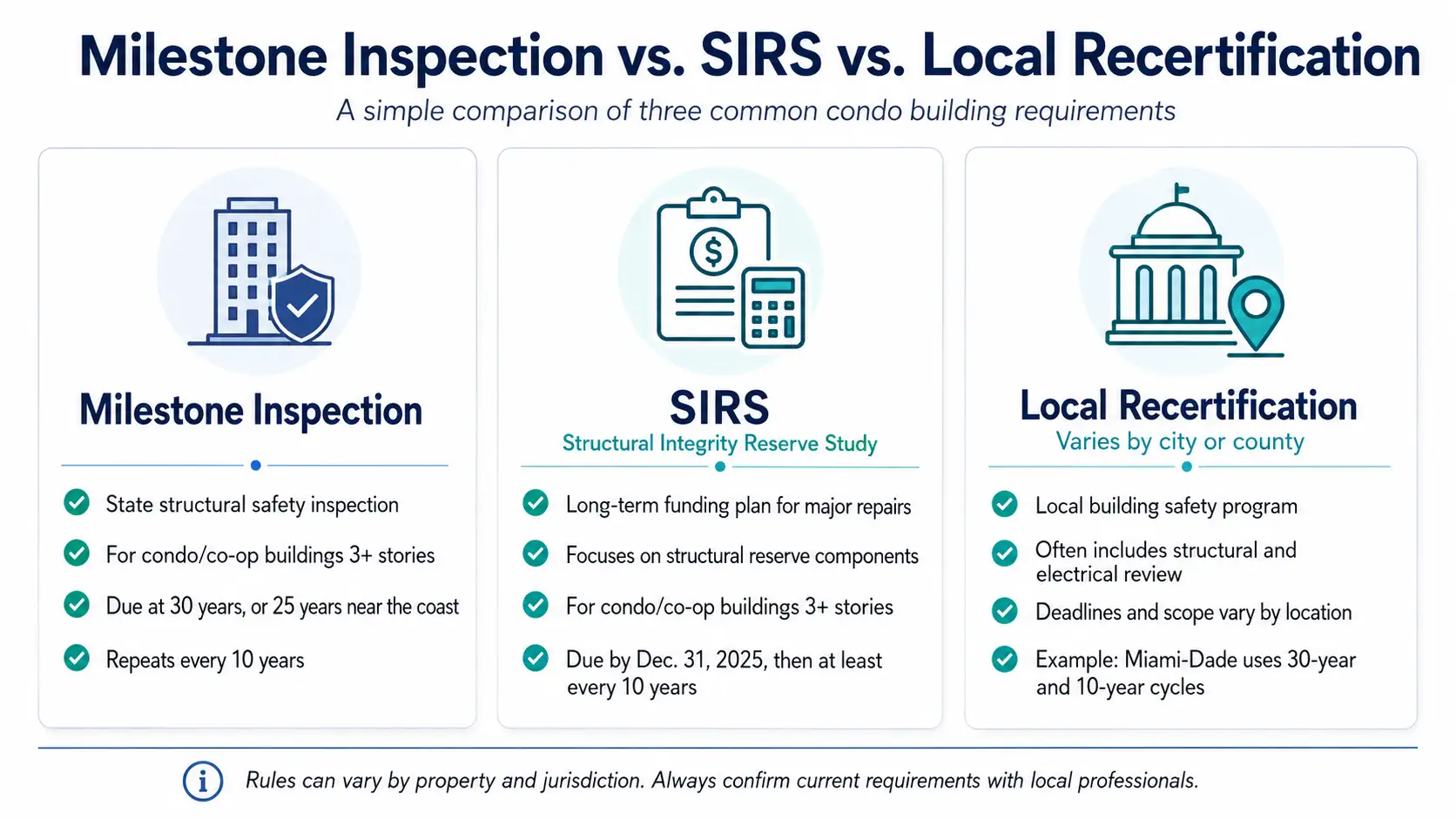
One reason buyers get confused is that several building-safety terms are often discussed at the same time. A Florida condo milestone inspection, a Structural Integrity Reserve Study, and local building recertification are related, but they are not identical.
Here is a simple breakdown:
| Item | Main purpose | What buyers should ask |
|---|---|---|
| Florida condo milestone inspection | Reviews the structural condition of certain aging condo or cooperative buildings | Was it completed, what did it find, and are repairs required? |
| Structural Integrity Reserve Study | Helps estimate and plan funding for major building components over time | Are reserves realistic, funded, and connected to actual repair needs? |
| Local building recertification | Local government process confirming continued safe occupancy, often including structural and electrical review | Is the building current, overdue, or under correction? |
In Miami-Dade County, local recertification is also a major issue because older buildings may be subject to county or municipal requirements. Buyers can review general county information through the Miami-Dade County recertification page. For properties within the City of Miami, the City of Miami building recertification page is another helpful starting point.
The key takeaway is this: a Florida condo milestone inspection tells you about structural condition, while the reserve study helps show how the association plans to fund future repairs. A smart buyer reviews both.
9 Smart Checks Before Buying in a Building With a Florida Condo Milestone Inspection
Before you move forward with a Miami or South Florida condo purchase, use these nine checks to understand what the building records may be telling you.
1. Confirm whether the building is subject to milestone inspection rules
Do not assume every condo building has the same requirements. The rules generally focus on condominium and cooperative buildings of a certain height and age. Coastal location, building age, certificate of occupancy date, and local enforcement requirements can all matter.
When reviewing a property, ask whether the building is required to complete a Florida condo milestone inspection, whether it has already been completed, and whether any future phase is pending.
This question is especially important in older waterfront and high-rise areas such as Brickell, Edgewater Miami, Aventura, Sunny Isles, Miami Beach, Fort Lauderdale, and parts of Coconut Grove.
2. Ask for the actual report, not just a verbal summary
A seller, listing agent, or building representative may say, “The building passed,” or “There are no major issues.” That is not enough. Buyers should ask for the actual Florida condo milestone inspection report, related engineer letters, board communications, repair plans, and any follow-up notices.
The details matter. A report may show no immediate safety concern but still recommend repairs. It may identify areas that need further review. It may also connect to future reserve contributions, special assessments, or construction timelines.
If the seller cannot provide the report, ask why. Sometimes the association controls access. Sometimes the report is pending. Sometimes the building is still working through follow-up. None of those answers automatically means the purchase is bad, but each answer changes the risk discussion.
3. Review whether the inspection triggered repairs
A Florida condo milestone inspection becomes especially important when it identifies repairs that need to be completed. The report itself is only the beginning. Buyers need to understand what happens next.
Ask whether repairs have already been completed, are currently underway, have been budgeted, or are still being discussed. A repair plan that is fully funded and actively managed is very different from a vague plan with no budget and no timeline.
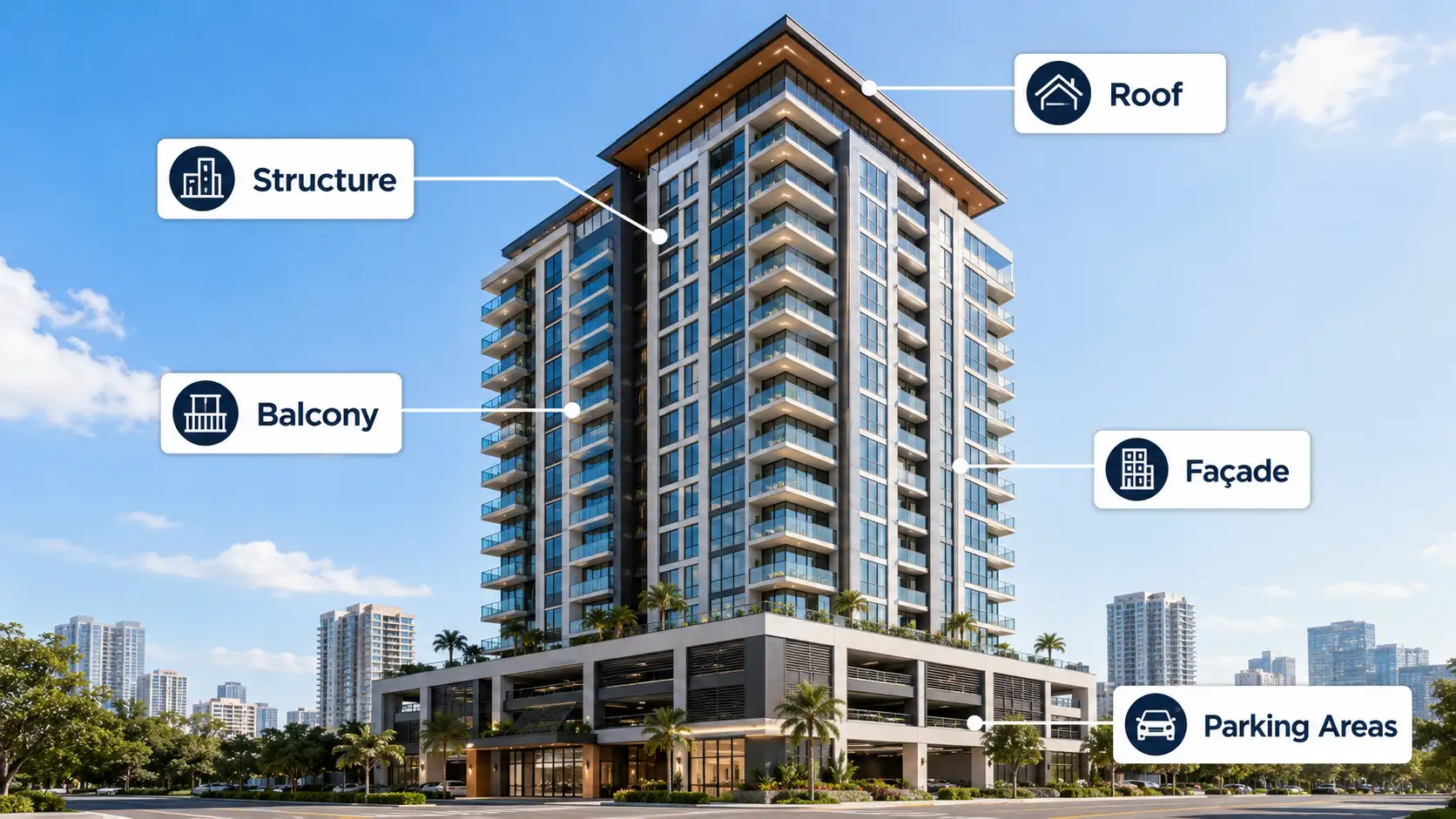
This is where the inspection connects directly to your ownership costs. If the association needs major concrete restoration, balcony work, façade repairs, roof work, waterproofing, electrical upgrades, or structural repairs, the money has to come from somewhere.
That money may come from reserves, loans, increased monthly fees, special assessments, or a combination of funding sources. Miami P&B Investments has also covered this topic in detail in the guide to Florida condo special assessments.
4. Compare the inspection with the reserve study
The Florida condo milestone inspection and the reserve study should not be reviewed in isolation. They should speak to each other.
If the inspection identifies structural or major repair concerns, the reserve study should help show how the association plans to fund those items over time. If the reserve study looks optimistic but the inspection shows expensive repairs, that gap deserves attention.
For Canadian buyers, this matters because unexpected costs can be amplified by currency exchange. A $25,000 assessment in U.S. dollars can feel very different once converted to Canadian dollars. If the Canadian dollar weakens, the real cost rises further.
That is why Canadian investors should also review Miami P&B Investments’ resources for Canadian investors buying in Miami and South Florida, especially when comparing purchase price, carrying costs, rental income, and long-term ownership exposure.
5. Look for signs of deferred maintenance
Deferred maintenance is one of the biggest red flags in condo ownership. It usually means repairs were postponed for too long, often because monthly fees were kept artificially low or owners resisted reserve funding.
A Florida condo milestone inspection may bring deferred maintenance into the open. That can be uncomfortable, but it is better to know before buying than after closing.

Red flags may include repeated concrete repairs, unresolved balcony issues, water intrusion, roof problems, elevator modernization needs, façade deterioration, garage issues, plumbing failures, or repeated emergency repairs.
These issues do not automatically make a building unbuyable. Many strong buildings go through repair cycles. The better question is whether the association is transparent, realistic, and financially prepared.
6. Check board minutes for owner discussions
Board minutes can be more revealing than marketing materials. They may show whether owners are debating repairs, assessments, reserve funding, insurance increases, engineering reports, or contractor bids.
If the Florida condo milestone inspection has created concern inside the building, you may see that reflected in meeting minutes. Look for repeated delays, owner pushback, unresolved votes, or disagreements about funding.
Also look for positive signs. A proactive board may have clear timelines, multiple bids, engineer updates, transparent owner communication, and a reasonable funding plan. That can make an older building much more attractive than a newer building with poor governance.
This is why a complete document review is so important. The inspection report gives you one piece of the story. The board minutes help show how the association is responding.
7. Understand financing impact
Lenders care about building risk. If a Florida condo milestone inspection points to major unresolved issues, it may affect condo financing, especially if the building also has weak reserves, high investor concentration, inadequate insurance, litigation, or major deferred maintenance.
Some buildings may become harder to finance or may be considered non-warrantable. This can reduce the buyer pool, increase down payment requirements, or limit loan options. Miami P&B Investments explains this broader issue in the guide to non-warrantable condos in Florida.
Cash buyers should still pay attention. Paying cash does not remove building risk. It only removes the lender from the review process. If you skip the same level of due diligence that a careful lender would require, you may take on problems that could affect resale later.
8. Connect inspection findings to insurance and HOA fees
Insurance and HOA fees are already major issues in South Florida condo ownership. A Florida condo milestone inspection can add another layer to that cost picture.
If a building has major repair needs, insurers may ask more questions. If the association needs to fund repairs, monthly dues may rise. If reserves are underfunded, owners may face special assessments. If multiple pressures happen at once, the affordability of the unit can change quickly.
Before buying, compare the inspection findings with current HOA fees, reserve contributions, insurance premiums, and pending association projects. A low monthly fee is not always a bargain. Sometimes it means the building has not yet adjusted to real costs.
For more context, review Miami P&B Investments’ guide to Miami property insurance costs and the article on Miami condo rental restrictions if rental income is part of your strategy.
9. Decide whether the price reflects the risk
A Florida condo milestone inspection does not automatically tell you whether to buy or walk away. It helps you understand whether the price makes sense.
A building with completed repairs, strong reserves, clean records, and transparent governance may justify a stronger price. A building with unresolved repairs, unclear funding, or pending assessments should be priced differently.
This is where buyers need a practical investment lens. What is the true cost after HOA fees, insurance, assessments, taxes, repairs, financing, currency exchange, and property management? What will the unit be worth if the building completes improvements? What happens if repair costs rise?
A strong deal is not always the cheapest unit. A strong deal is the property where risk, price, location, building quality, and ownership goals line up.
How Canadian Buyers Should Think About Florida Condo Milestone Inspection Risk
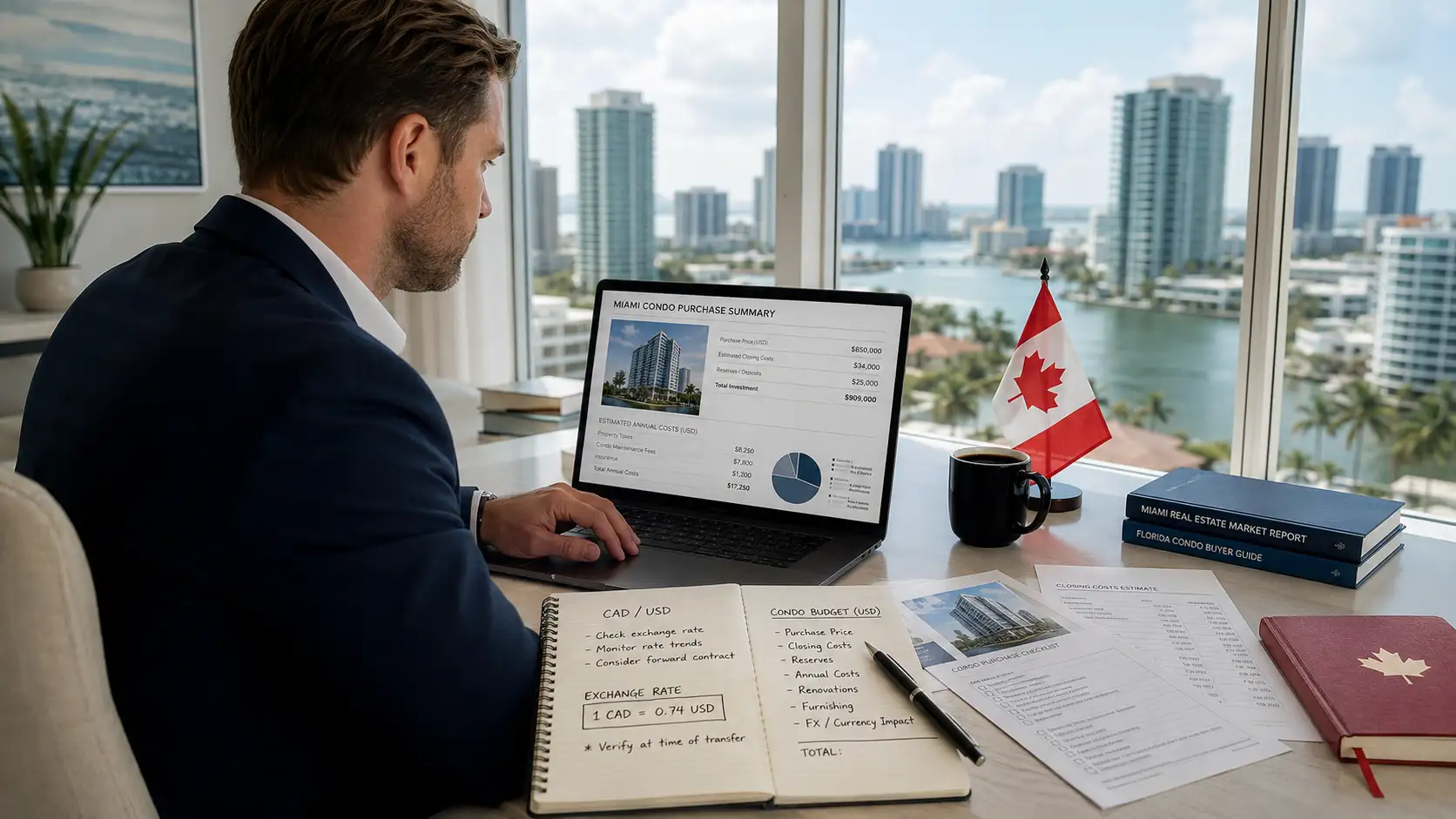
Canadian buyers often approach South Florida real estate with a different set of priorities. Some want a winter home. Some want rental income. Some want long-term U.S. dollar exposure. Some want a future retirement base. Others want a property their family can use while still protecting capital.
A Florida condo milestone inspection affects all of those goals because it can influence carrying costs, timing, financing, and resale.
For example, a Canadian snowbird may be comfortable paying a higher HOA fee if the building is well managed and the unit provides reliable seasonal use. An investor focused on rental income may be more sensitive to assessments, restrictions, and repair disruptions. A buyer planning to sell in five years may care deeply about how the inspection affects future resale confidence.
There is also the exchange-rate issue. A special assessment, repair contribution, or higher monthly fee is paid in U.S. dollars. For Canadians earning or saving in Canadian dollars, this adds another layer of planning. The cost is not just the U.S. amount. It is the U.S. amount translated into your real Canadian budget.
This is why many Canadians benefit from working with a local team that understands both South Florida real estate and cross-border ownership. Miami P&B Investments’ Canadian snowbirds realty services are built around this type of buyer support.
Which South Florida Condo Markets Need Extra Attention?
Any older condo building can deserve careful review, but some markets naturally require closer attention because of age, coastal exposure, height, salt air, concrete structures, balcony systems, and insurance pressure.
In Miami, buyers often compare urban high-rises, waterfront condos, boutique buildings, and older communities with very different maintenance histories. In Brickell and Edgewater, many buyers focus on skyline views and amenities, but the building’s inspection and reserve position can be just as important.
In Aventura and Sunny Isles Beach, buyers may compare larger condo communities, luxury towers, and waterfront buildings where association governance and long-term maintenance planning matter. In Bay Harbor Islands and Coconut Grove, buyers may see a mix of boutique condos, older buildings, and newer luxury projects.
In Fort Lauderdale, Boca Raton, and West Palm Beach, buyers should also look beyond the unit and study the association’s long-term repair planning. South Florida’s appeal is regional, but every building is different.
The right question is not, “Is this neighborhood good?” The better question is, “Is this specific building financially and physically ready for the next decade?”
What Documents Should Buyers Request Alongside the Inspection?
A Florida condo milestone inspection is most useful when reviewed with the rest of the due diligence package. Buyers should ask for documents that explain the building’s finances, rules, insurance, governance, and repair history.
Useful records may include the current budget, reserve study, year-end financials, insurance summary, board minutes, special assessment notices, litigation disclosures, condo questionnaire, rules and regulations, rental restrictions, engineering letters, repair contracts, permits, and local recertification updates.
If the building has recently completed major work, ask for documentation. If the building is planning major work, ask for budgets and timelines. If the association says no assessment is planned, ask whether that is reflected in meeting minutes or financial records.
Buyers should also pay attention to timing. A pending Florida condo milestone inspection may create uncertainty. A completed inspection with clear repair funding may be easier to evaluate. A building that is overdue or unclear may require deeper review before making a firm decision.
Common Buyer Mistakes to Avoid
The first mistake is focusing only on the unit. A renovated kitchen does not fix a weak association. A beautiful balcony view does not remove the risk of unfunded structural repairs.
The second mistake is assuming the HOA fee tells the whole story. A low fee can be attractive, but if reserves are weak or repairs are delayed, the real cost may arrive later through assessments or sharp increases.
The third mistake is treating the Florida condo milestone inspection as a pass-or-fail document. The better approach is to ask what the report means for safety, funding, timing, financing, insurance, and resale.
The fourth mistake is waiting too long to review documents. In a competitive purchase, buyers may feel pressure to move fast. But document review should happen early enough to inform your offer, inspection period, financing strategy, and negotiation position.
The fifth mistake is not using local expertise. South Florida condo ownership is highly building-specific. Two condos on the same street can have very different risk profiles.
How a Strong Building Can Turn Inspection Rules Into a Buyer Advantage
Not every Florida condo milestone inspection creates bad news. In fact, the new inspection environment can help careful buyers identify stronger buildings.
A building that has completed inspections, funded reserves, managed repairs, improved transparency, and communicated clearly with owners may stand out in a market where buyers are more cautious. These buildings may be better positioned for financing, insurance, resale confidence, and long-term ownership stability.
This is why 2026 can still be a smart buying window for informed condo buyers. Some sellers are adjusting prices because of higher fees, assessment concerns, or broader condo-market uncertainty. Buyers who know how to evaluate building quality may find opportunities that less-prepared buyers miss.
The goal is not to avoid every building with repairs. The goal is to avoid surprises. A known issue with a clear plan can be manageable. An unknown issue with no funding plan is much riskier.
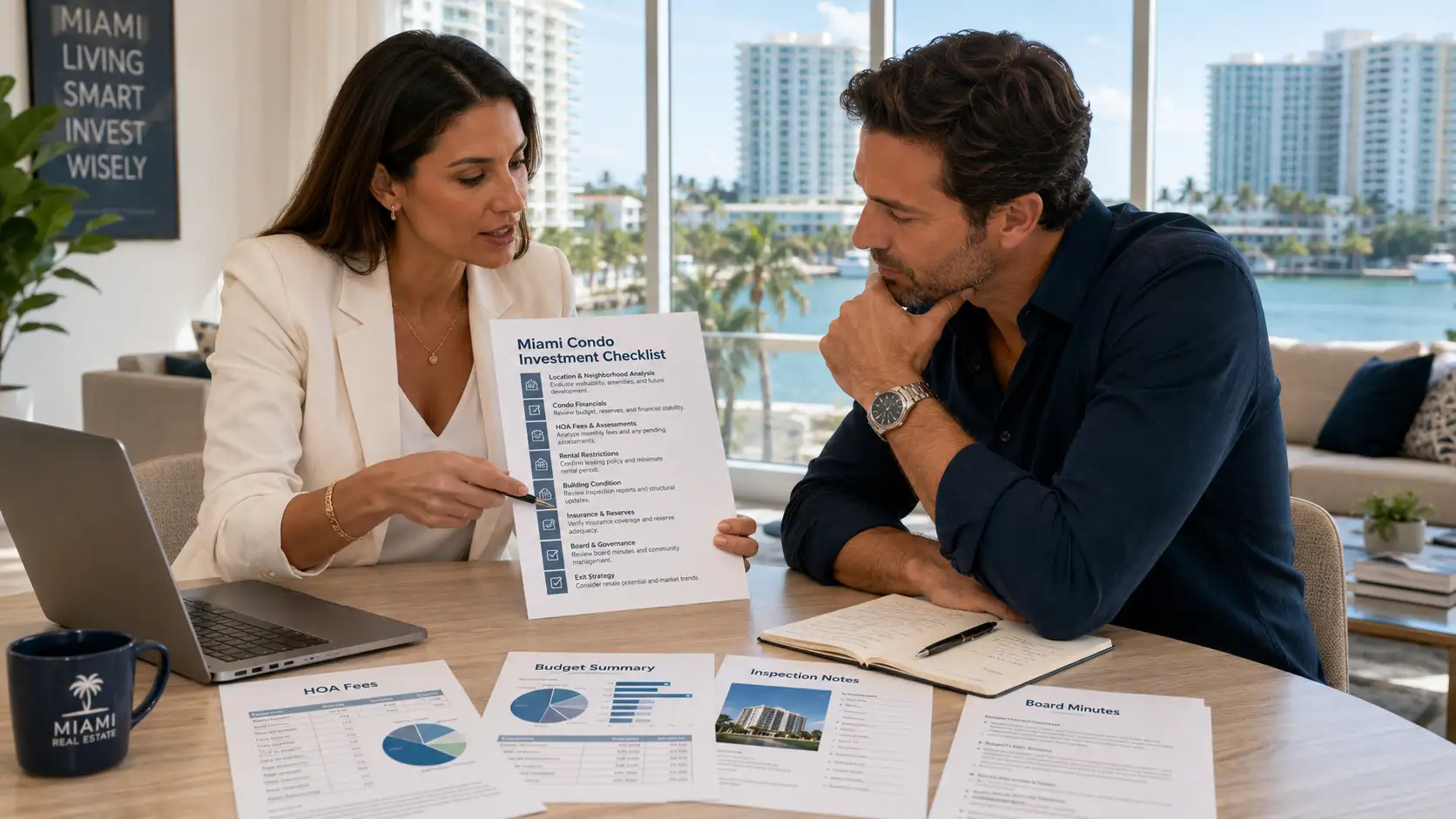
How Miami P&B Investments Helps Buyers Review Condo Building Risk
A Florida condo milestone inspection can be technical, but your buying decision should be practical. You need to know what the report means for your budget, your timeline, your rental strategy, your financing, and your long-term ownership plan.
That is where Miami P&B Investments can help.
Our team supports buyers with real estate guidance, property selection, document review coordination, local market insight, and connections to relevant professionals. For Canadian buyers and international investors, we also understand the added challenges of distance, currency exposure, cross-border planning, and ongoing property oversight.
If you are comparing condos in Miami, Brickell, Edgewater, Aventura, Coconut Grove, Bay Harbor Islands, Fort Lauderdale, Boca Raton, or West Palm Beach, we can help you look beyond the listing and understand the building behind the unit.
Through our real estate services, we help buyers identify suitable properties and evaluate investment potential. Through property management, we support owners who need local oversight after closing. Through property maintenance and construction services, we help owners manage the practical realities of property care, repairs, and improvements. We can also coordinate with trusted partners for legal and accounting guidance when cross-border ownership requires deeper planning.
Before you buy, make sure the Florida condo milestone inspection is part of your bigger due diligence picture. The right review can help you avoid costly surprises, negotiate with more confidence, and choose a South Florida condo that truly fits your goals.
If you are considering a Miami or South Florida condo purchase and want help understanding the building, the documents, and the ownership costs, contact Miami P&B Investments to start a focused buyer conversation.