If you’re a Canadian looking at condos in Brickell, Edgewater, Coconut Grove, or anywhere near the water, you’ve probably typed Miami HOA fees into Google and then spiraled. You’re not imagining it: South Florida high-rise ownership can carry some of the highest monthly association costs in the U.S., driven by insurance, staffing, and stronger reserve funding after post‑Surfside safety reforms.
This guide is built around the real questions people ask online (Reddit threads about “Is $X/month a lot?” and “What happens if I can’t pay a special assessment?” are everywhere). We’ll explain what Miami HOA fees include, why they’ve been rising, how to spot red flags in condo documents, and how to budget in CAD without guessing your true monthly cost.
Quick take: why Miami HOA fees matter more than the listing price
- They can be “a second mortgage.” High-rise condo fees in Miami-Dade can be extremely high depending on building type and services.
- They can jump fast. A Miami Herald analysis reported Miami‑Dade’s median condo association fee around $900 (Apr–Jun 2024), up over 59% from 2019 (PDF source).
- They impact financing and resale. Buyers and lenders increasingly scrutinize reserves, insurance, and inspections—especially in older towers.
- They affect your CAD budget every month. Canadians have FX exposure on the carrying costs, not just the purchase price.
New to Miami buying from Canada? Start with our step‑by‑step guide, then come back here to master Miami HOA fees as part of your carry-cost plan: Canadians Buying Property in Miami (Step‑by‑Step).
What are Miami HOA fees, exactly?
Miami HOA fees are the recurring payments owners make to a homeowners association (HOA) or condo association to operate and maintain the community and its shared areas.
In Miami, you’ll see a few common structures:
- Condominium association dues (common in towers): cover building operations and common elements (lobbies, elevators, pools, roofs, structure, etc.).
- HOA dues (common in single-family or townhouse communities): cover community maintenance, landscaping, gates, amenities, and sometimes exterior maintenance (varies widely).
- Master association + sub-association: some communities have a “master” fee plus a building/condo fee.
In listing data, the phrase “HOA” often appears even for condo dues. That’s why Canadians searching Miami HOA fees are usually trying to answer one practical question:
“What will I actually pay every month after I buy?”
For an overview of Miami neighborhoods and property types (condos vs single-family), see: Top Miami Real Estate and our guide to Miami Condos for Sale (Canadian Guide).
What do Miami HOA fees usually include?
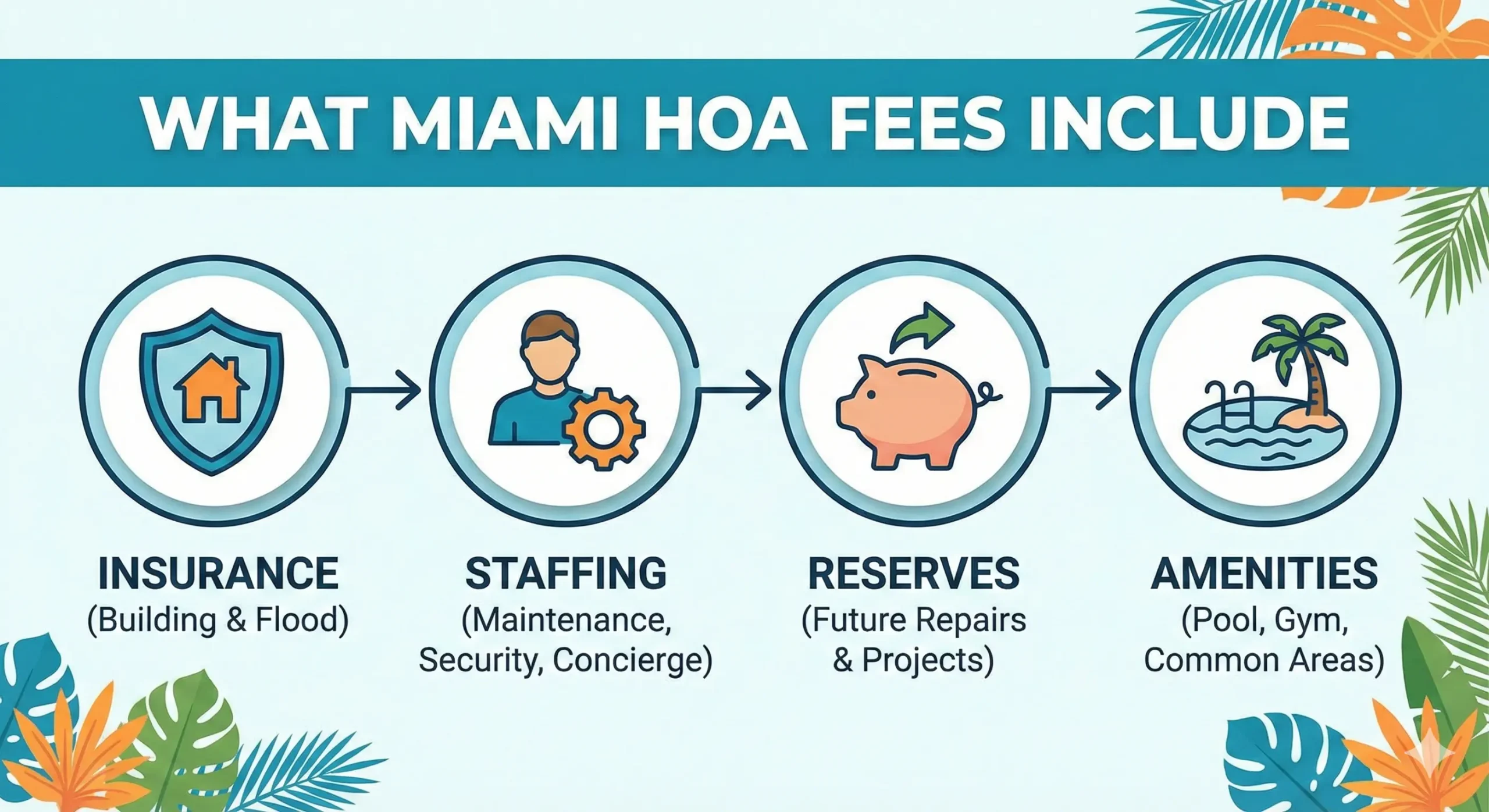
The most helpful way to think about Miami HOA fees is: operating costs + insurance + reserves.
1) Operating costs
Operating expenses pay for the day-to-day running of the building or community, such as:
- On-site staff (security, concierge, maintenance crew)
- Property management company fees
- Cleaning, landscaping, pest control
- Utilities for common areas (lobby A/C, hallway lighting)
- Amenities upkeep (pool, gym, spa areas)
- Waste, sometimes water/sewer (varies by building)
In high-service towers, staffing and management can be a major driver of Miami HOA fees. WLRN reported professional management fees rising sharply in recent benchmark data (source).
2) Insurance
Insurance is one of the biggest reasons Miami HOA fees have been painful in recent years. Waterfront risk, hurricane exposure, and rebuilding costs often mean higher premiums, which roll into the association’s budget and, therefore, into Miami HOA fees.
3) Reserves (the part buyers ignore… until they can’t)
Reserves are the savings account for major repairs and replacement items—think roofs, concrete restoration, elevators, plumbing systems, seawalls, and structural components.
After Surfside, Florida tightened building safety requirements, including milestone inspections and structural integrity reserve studies (SIRS) for certain condos (see Florida SB 4‑D, Florida Statute 718.112, and DBPR inspection resources). These changes push associations to fund reserves more consistently.
Why this matters: Underfunded reserves often lead to large special assessments—which can turn “affordable” Miami HOA fees into a sudden multi‑thousand‑dollar surprise.
If you want hands‑off ownership while you’re back in Canada, our Property Management and Property Maintenance teams help you plan and manage the real-world operating costs beyond Miami HOA fees.
Why Miami HOA fees are rising (2026 update)

Canadians ask “Why are Miami HOA fees so high?” almost daily. Here are the biggest drivers we see in Miami-Dade and across South Florida:
1) Insurance premiums
Insurance has been a major driver in many buildings, and it can move sharply at renewal—especially for older towers and coastal exposure.
2) Staffing and “service expectations”
Miami luxury towers are built on full-service living: security, concierge, valet, package rooms, and amenity decks. Those payroll costs don’t pause when you’re in Toronto.
3) Reserve funding, inspections, and catch‑up maintenance
Many older buildings are now facing “catch-up” repairs after years of deferred maintenance. Realtor.com highlighted that aging inventory and post‑Surfside regulatory changes (inspections, reserve studies, reserve funding) are pushing fees higher (source).
4) Special assessments becoming more common
Special assessments are one-time or installment charges for major projects (or to fill reserve gaps). If you’re researching Miami HOA fees, treat “assessment risk” as part of the same conversation.
Bottom line: Miami HOA fees are not just “amenity dues.” For many buildings, they’re the financial mechanism for keeping a complex, hurricane‑exposed structure safe, insured, and maintained.
Miami HOA fees vs. special assessments: the difference (and why Canadians confuse them)
Miami HOA fees are recurring (monthly/quarterly). A special assessment is additional—usually temporary, but sometimes massive.
Here’s the key investor logic:
- Higher HOA fees can be a “good sign” if they reflect full reserve funding and proactive maintenance.
- Low HOA fees can be a “bad sign” if the building is underinsured, underfunded, or deferring repairs—often leading to a future assessment.
Canadian buyer takeaway: Don’t shop for the lowest Miami HOA fees. Shop for the best financial health relative to the building’s age, size, and risk profile.
How to estimate your “true monthly cost” (with a CAD/USD method)

Most Canadians underestimate the monthly carrying cost because they look at the mortgage payment and forget the rest. A better approach is to build a “carry cost stack.”
Step 1: Build your monthly cost stack (USD)
- Mortgage payment (P&I, if financing)
- Property taxes (monthly estimate — see Miami-Dade County Real Estate Taxes guide)
- Insurance (HO-6 + umbrella; building insurance is usually inside Miami HOA fees)
- Miami HOA fees (monthly)
- Utilities not included (electric, internet, etc.)
- Property management (if renting or hands-off)
For financing specifics, see: U.S. Mortgage for Canadians in Florida.
Step 2: Convert to CAD using a “rate range” instead of a single guess
FX moves. Instead of guessing today’s rate and calling it “the answer,” use a range that helps you stress-test the monthly budget.
Formula: Monthly Carry Cost (CAD) = Monthly Carry Cost (USD) × CAD per USD
If you want a live CAD/USD reference, use the real-time conversion widget on our Canadian investor hub: For Canadian Investors: Investing in Miami.
Step 3: Quick table (example only)
Below is just a budgeting example to illustrate how FX changes the monthly impact of Miami HOA fees. Use your real-time rate when you build your personal plan.
| Miami HOA fees (USD/month) | At 1.30 CAD/USD | At 1.35 CAD/USD | At 1.40 CAD/USD |
|---|---|---|---|
| $500 | $650 CAD | $675 CAD | $700 CAD |
| $900 | $1,170 CAD | $1,215 CAD | $1,260 CAD |
| $1,500 | $1,950 CAD | $2,025 CAD | $2,100 CAD |
| $1,900 | $2,470 CAD | $2,565 CAD | $2,660 CAD |
If you want a full carry-cost plan (including insurance, taxes, and rental income), our Accounting partners can help build a cross-border-friendly structure, and our Legal team can help you understand condo document obligations and disclosures.
Also helpful: How Canadians Manage Currency Exchange Risk in Miami.
How Miami HOA fees impact your ROI (rental and resale)
Whether you’re buying a seasonal “snowbird” condo or a rental investment, Miami HOA fees have two direct impacts:
- Cash flow: every $100/month in fees is $1,200/year off net operating income.
- Buyer pool: higher monthly costs shrink affordability and can lengthen days on market.
If your strategy is short-term rentals, also verify building rules carefully—some towers allow monthly minimums, some do not. Our neighborhood guides highlight these differences, and our Property Management team can keep your investment compliant after closing.
Want an ROI comparison mindset? See: Toronto to Miami Real Estate ROI (it already flags Miami HOA fees as a key cost line item).
Neighborhood snapshots: typical HOA ranges (and what they often mean)
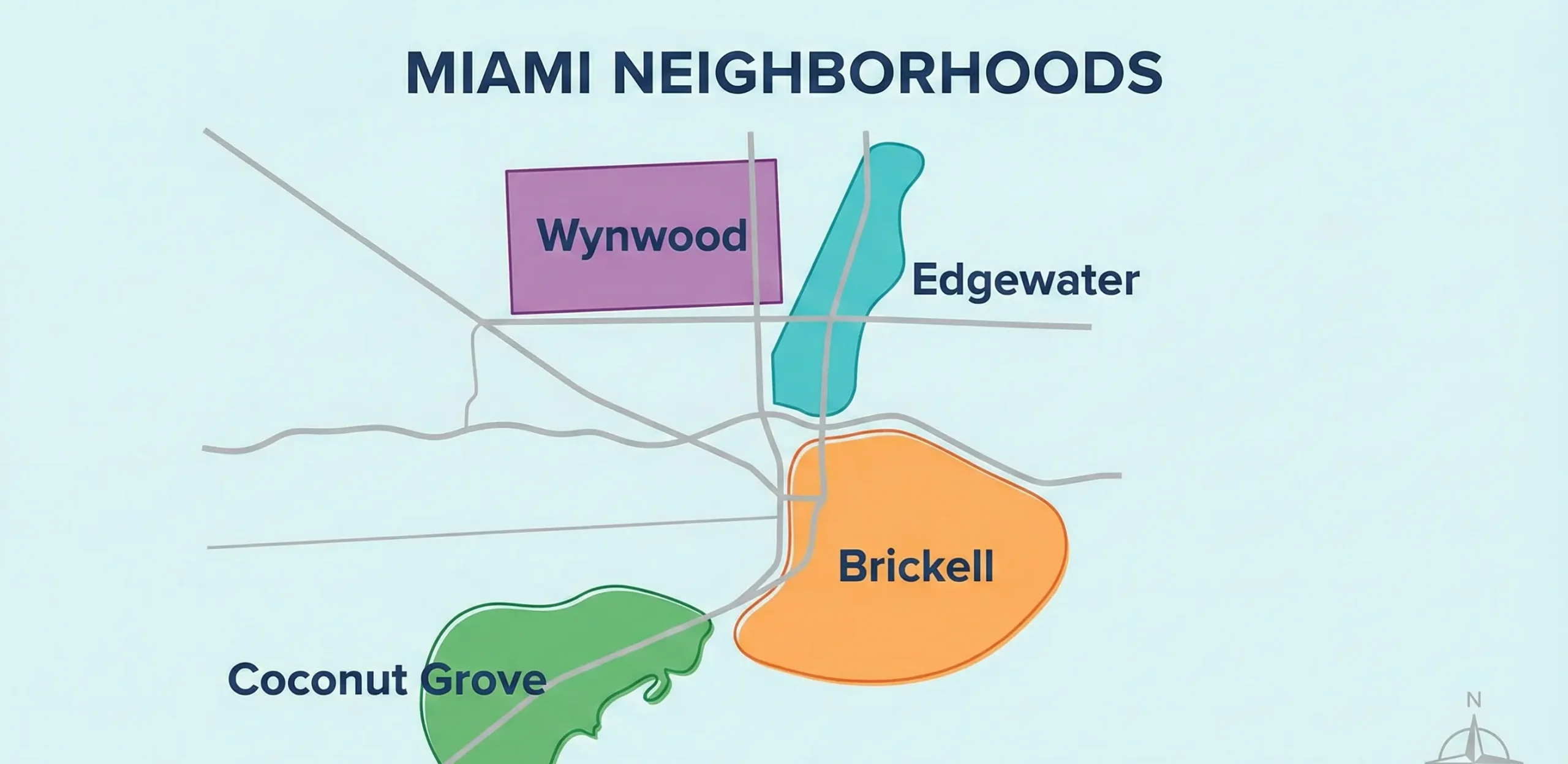
Canadians often ask “Where can I get reasonable Miami HOA fees without sacrificing lifestyle?” There’s no universal answer, but neighborhood + building type changes the equation.
Edgewater: bayfront towers and full-service living
Edgewater is packed with high-rises and bay views. Our Edgewater page cites a typical HOA around $1,110/month (varies by tower). Miami HOA fees at this level often reflect pools, gyms, staffing, and higher insurance/reserve needs for towers.
Explore: Edgewater Miami Real Estate.
Coconut Grove: boutique luxury + greenery
Coconut Grove skews upscale and often boutique. Our Coconut Grove page cites a typical HOA around $1,500/month (varies by building).
Explore: Coconut Grove Real Estate.
Brickell: walkability and luxury high-rises
Brickell is the “condo capital” feel: towers, walkability, and amenities. Start here: Brickell Real Estate.
Wynwood: lifestyle + investor angles
Wynwood’s appeal is culture and (in select buildings) stronger rental flexibility. But always verify building rules and total carry costs—Miami HOA fees can still be substantial depending on the building. Explore: Wynwood Real Estate.
Pro tip: If you’re still browsing, use our live MLS feed and filter by neighborhood, property type, and HOA: Listing Results.
The due diligence checklist (what to ask for before you fall in love)
The safest way to handle Miami HOA fees is to treat the condo association like a mini‑company. You’re buying into its finances, not just a unit.
Documents you (or your agent) should request (and where to verify public records: Miami-Dade Property Search guide)
- Current year budget + prior year actuals
- Reserve study / SIRS (structural integrity reserve study for certain buildings)
- Milestone inspection reports (where required — see DBPR guidance)
- Insurance summary (what’s covered, deductibles, upcoming renewal notes)
- Board meeting minutes (12–24 months)
- Special assessments history + any pending votes
- Litigation status (lawsuits can affect financing and risk)
- Rules & restrictions: rentals (minimum term), pets, renovations, guest policies
Simple “health” metrics to check
- Reserve funding trend: Is the building contributing enough annually?
- Deferred maintenance: Are big projects listed but not funded?
- Insurance renewals: Any warnings about premium spikes?
- Delinquencies: Too many non-paying owners strains the budget.
If you want a local team to coordinate condo documents, inspections, and closing logistics, start with our Real Estate Services and then plug into Legal + Accounting for cross‑border setup.
Red flags that predict future HOA surprises
When evaluating Miami HOA fees, these patterns often predict pain later:
- Very low fees for an older high-rise (may imply underfunded reserves)
- Repeated special assessments instead of consistent reserve funding
- Elevator, roof, concrete, or seawall issues with no clear funding plan
- Insurance uncertainty or unusually high deductibles
- Bank financing resistance (condo questionnaire issues, reserve shortfalls)
Green flags that make higher Miami HOA fees “worth it”
Not all high Miami HOA fees are bad. In fact, some of the “best” buildings have higher fees because they:
- Fund reserves consistently (less assessment risk)
- Maintain strong insurance and risk planning
- Have professional management and transparent reporting
- Offer genuine lifestyle value (staffing, security, amenities) that supports rental and resale demand
How to negotiate when HOA fees are high or an assessment exists
Here’s a practical approach Canadians can use when Miami HOA fees feel high:
1) Separate “high but healthy” from “high because it’s broken”
- High but healthy: funded reserves, clean inspection trajectory, stable insurance, clear capital plan.
- High because broken: emergency repairs, chaotic finances, repeated assessments, unclear safety/inspection status.
2) Treat a special assessment like price
If a unit has a large assessment, you can negotiate purchase price, closing credits, or seller payment. The key is to price the risk, not ignore it.
3) Ask “what’s next?”
One assessment often isn’t the end. Always ask for upcoming projects, inspection timelines, and reserve funding plans.
4) Build in a USD reserve buffer
For Canadians, the easiest operational win is to keep a small USD buffer for Miami HOA fees, insurance deductibles, and minor repairs—so FX timing doesn’t force you into bad conversions. This aligns with our FX risk framework here: Currency Exchange Risk in Miami.
FAQ: Miami HOA fees (the questions Canadians actually ask)
Are Miami HOA fees tax-deductible for Canadians?
For personal-use properties, Miami HOA fees are typically not “deductible” like an investment expense would be. For rental properties, HOA/condo dues are often treated as an operating expense for U.S. tax purposes, but cross-border outcomes depend on structure and use. Work with a qualified cross-border accountant (our Accounting team can coordinate with your advisors).
Can Miami HOA fees go up after I buy?
Yes. Budgets change yearly, insurance renews, staffing costs rise, and reserves may need to be increased.
What is a “condo questionnaire” and why does it matter?
Lenders often require association information (insurance, reserves, delinquencies, litigation) to approve condo financing. That’s why our Canadian mortgage guide tells buyers to screen buildings early for reserves and insurance health: U.S. Mortgage for Canadians.
Is it better to buy a single-family home to avoid Miami HOA fees?
Sometimes—but not always. Some single-family communities still have HOAs, and homes can have higher insurance and maintenance responsibilities. Condos trade personal maintenance for shared Miami HOA fees.
How do I avoid “surprise” assessments?
Read minutes, review reserves/SIRS, verify inspections where required, and confirm upcoming capital projects before closing.
Next step: get a building-specific HOA reality check
Because Miami HOA fees vary so widely by building, the smartest move is to shortlist 3–5 buildings and review their financial health before you commit.
- Browse listings and shortlist buildings: Listing Results
- Explore neighborhood dynamics: Miami Real Estate, Edgewater, Brickell, Coconut Grove, Wynwood
- If you’re a seasonal buyer, start here: Canadian Snowbirds Realty
Want help reviewing condo docs and forecasting your monthly cost? Contact us here: Contact Miami P&B Investments (or meet your local advisor on our Team page) or explore our full service stack: Services.
Tip: If you send us 2–3 MLS links, we can compare Miami HOA fees, reserves, insurance, and rental rules building-by-building before you commit.
Disclaimer: This article is for informational purposes only and is not legal, tax, or financial advice. Always consult licensed professionals for your specific situation.